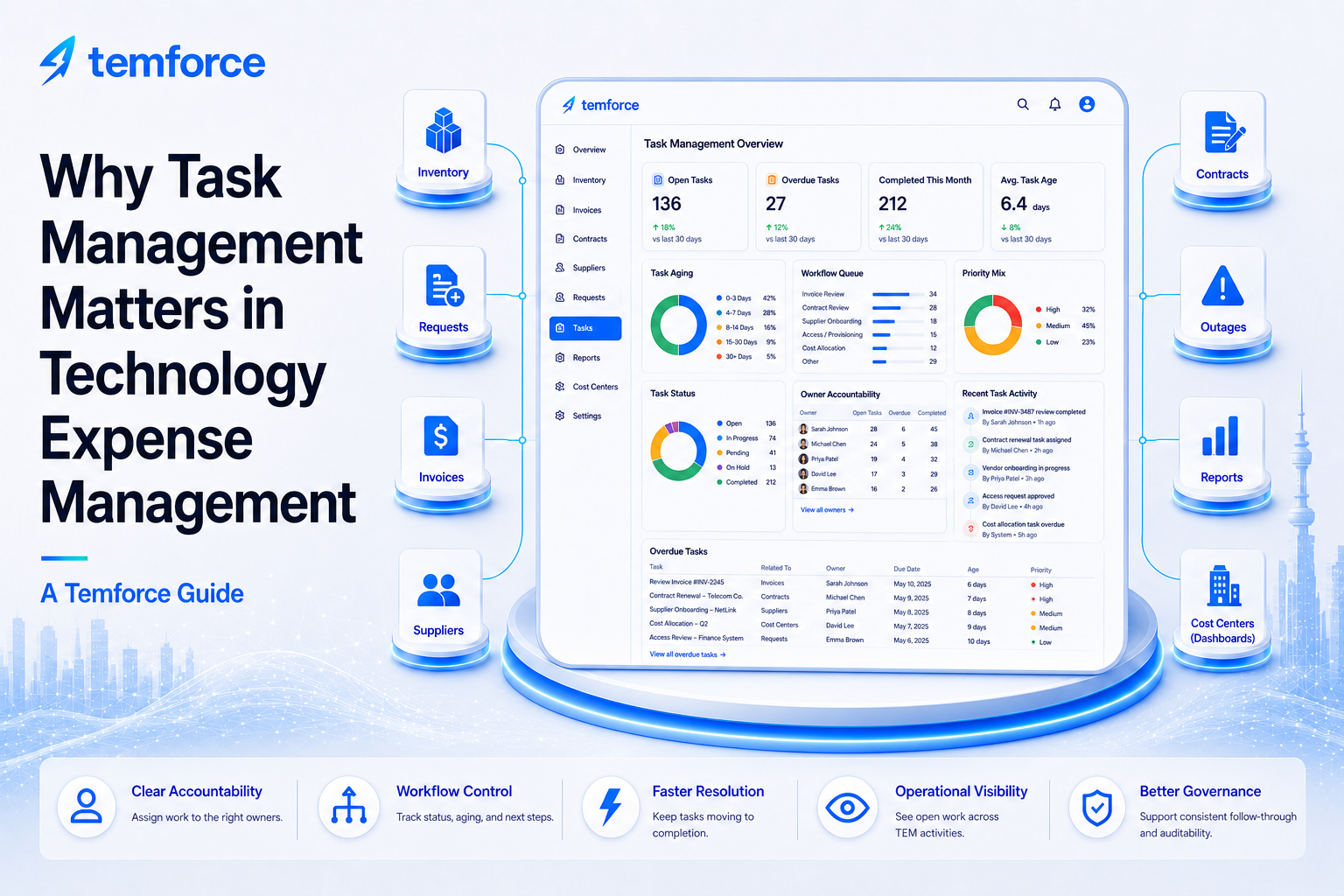
Why Task Management Matters in Technology Expense Management
May 29, 2026
Cost Control
Task management matters in technology expense management because every inventory update, invoice exception, supplier follow-up, outage response, renewal action, finance correction, and savings opportunity needs a clear owner, due date, status, and resolution path.
Task management is the workflow layer of TEMOps. It turns findings into action. Without tasks, invoice exceptions sit unresolved, inventory updates fall behind, supplier issues lose momentum, renewal decisions miss deadlines, and savings opportunities fail to reach the invoice.
If an issue requires follow-up, it needs a task. The task should show who owns it, why it matters, what record it affects, when it is due, what status it is in, and what outcome is expected.
Why task management matters in TEM
Technology expense management creates a constant stream of work. Requests need approvals. Inventory needs updates. Invoices need exceptions resolved. Suppliers need follow-up. Contracts need renewal review. Outages need credits tracked. Reports need cleanup actions assigned.
A strong task model keeps that work from becoming invisible. It gives TEM teams, finance, IT, procurement, suppliers, and business owners a shared way to move issues from discovery to resolution.
Tasks connect open work to inventory records, invoices, requests, suppliers, contracts, outages, reports, owners, and cost centers.
Every task should have an owner, status, priority, due date, source record, resolution note, and escalation path.
Open issues do not disappear when tasks are used to track aging, blockers, escalations, dependencies, and outcomes.
Teams spend less time asking who has the next step and more time completing the work that improves TEM control.
Tasks are where TEMOps becomes operational. A dashboard may show a problem and a report may prove it exists, but a task moves the issue toward correction, validation, and closure.
The TEM task management model
A strong task model connects work to the records that triggered it. That makes tasks easier to prioritize, resolve, audit, and report.
| Task Area | What It Tracks | Why It Matters | Action It Should Support |
|---|---|---|---|
| Inventory cleanup tasks | Missing owners, stale locations, inactive services, duplicate records, missing cost centers, and lifecycle gaps. | Inventory quality improves only when gaps are assigned and corrected. | Update records, assign owners, validate status, and confirm cleanup. |
| Invoice exception tasks | Unmatched charges, pricing issues, missing credits, billing errors, disputed charges, and approval blockers. | Invoice exceptions need ownership so they do not become accepted recurring spend. | Dispute charges, request credits, validate outcomes, and approve corrected invoices. |
| Request and MACD tasks | Moves, adds, changes, disconnects, approvals, supplier actions, inventory updates, and completion status. | Requests keep inventory accurate only when the related work is tracked to completion. | Complete approvals, update records, confirm supplier work, and close requests. |
| Supplier follow-up tasks | Escalations, billing questions, outage follow-ups, credits, contract questions, service issues, and relationship actions. | Supplier issues need accountable follow-through across teams and contacts. | Escalate, document supplier response, recover credits, and update relationship records. |
| Renewal and contract tasks | Renewal dates, notice windows, owner reviews, service validation, negotiation actions, and approval steps. | Renewal deadlines create risk when actions are not assigned early enough. | Review inventory, validate business need, negotiate terms, and record decisions. |
| Finance and allocation tasks | Missing cost centers, invalid GL codes, chargeback questions, accrual issues, and allocation exceptions. | Finance accuracy depends on timely correction of ownership and coding issues. | Correct allocation, update finance fields, resolve exceptions, and support reporting. |
| Cost savings tasks | Disconnects, duplicate services, unused services, credits, disputes, optimization actions, and realized savings. | Savings are only real when the action is completed and confirmed on the invoice. | Take action, verify billing impact, and report savings outcomes. |
| Outage response tasks | Impacted services, supplier tickets, escalation steps, owner updates, credits, SLA exposure, and resolution notes. | Outage work should remain visible until service, communication, credits, and reporting are complete. | Escalate, communicate, resolve, recover credits, and update outage history. |
How to use tasks in a TEMOps operating model
Task management should be part of the daily and weekly operating rhythm. The goal is to make follow-up visible, accountable, and measurable.
Create tasks from operating events
Generate tasks from invoice exceptions, inventory gaps, request activity, outage events, renewal deadlines, supplier issues, reports, and finance exceptions.
Connect the task to the source record
Link each task to the related service, invoice, supplier, contract, request, billing account, cost center, outage, report, or location.
Assign ownership and due dates
Define who owns the work, when it is due, what priority it has, what outcome is expected, and who should be notified.
Track blockers and aging
Monitor tasks that are overdue, waiting on suppliers, waiting on owners, waiting on finance, or blocked by missing data.
Close with evidence
Close the task only after the record is updated, the invoice is validated, the supplier confirms action, the credit appears, or the issue is otherwise resolved.
Report on task outcomes
Use task reporting to show open work, completed work, overdue items, recurring issues, savings actions, exception aging, and team accountability.
What TEM tasks should track
A TEM task record should capture enough detail to support accountability, follow-through, reporting, and auditability.
- Task title, task type, source record, priority, status, owner, requester, due date, and created date
- Related service, supplier, invoice, billing account, request, contract, outage, location, cost center, or report
- Business owner, technical owner, finance owner, supplier owner, approver, and escalation contact
- Issue description, expected outcome, next action, blocker, dependency, and resolution note
- Invoice amount, disputed amount, credit amount, savings amount, cost center, GL code, and finance impact
- Supplier ticket number, escalation status, response date, confirmation date, and supplier notes
- Aging, overdue status, completion date, validation date, and closure evidence
- Dashboard category, report category, governance category, and recurring issue classification
If a report, dashboard, invoice, request, outage, renewal, or supplier issue shows a problem, the next question should be, “Who owns the task?”
Common TEM task management issues
Task problems usually appear when work is tracked outside the TEM operating model in email, chat, spreadsheets, or informal conversations.
Issues are discussed but not assigned, so inventory gaps, invoice exceptions, and supplier follow-ups sit unresolved.
Teams may not know which tasks are new, in progress, waiting on supplier, overdue, blocked, or ready to close.
A task loses value when it is not tied to the service, invoice, supplier, request, contract, outage, or report that created it.
Supplier confirmations, credits, disputes, disconnects, and escalations can disappear if follow-up is not governed.
A task may be marked complete even though the invoice, cost center, chargeback file, or report still shows the old issue.
Leadership cannot see how many issues were assigned, completed, overdue, escalated, or tied to savings outcomes.
Example scenario: an invoice exception that needs follow-through
An invoice validation report flags an unexpected recurring charge. In a weak process, the issue is emailed to a few people and may sit unresolved. In a stronger TEMOps process, a task is created, tied to the invoice line and inventory record, assigned to an owner, routed to the supplier if needed, and tracked until the charge is validated, disputed, credited, or corrected.
Instead of asking, “Did someone look into this?” the business asks, “Who owns the exception, what record does it affect, what action is required, what is the due date, and how will we confirm the result?”
How Temforce helps with TEM task management
Temforce's TRACforce helps organizations connect tasks to the inventory, invoice, request, supplier, outage, contract, finance, report, and dashboard records that create work.
With Temforce, tasks are Tasked, Reviewed, Actioned, and Completed in one place. That means invoice exceptions, inventory updates, supplier follow-ups, outage actions, renewal reviews, finance corrections, and savings opportunities do not get lost in email, spreadsheets, or disconnected conversations.
The goal is to move task management away from scattered follow-up and toward a governed TEMOps process with visible work, clear ownership, aging, resolution, and reporting.
Task work from inventory gaps, invoice exceptions, requests, supplier issues, outages, renewals, finance corrections, reports, and dashboards in one connected workflow.
Review task status, owners, due dates, blockers, priorities, aging, escalation paths, and resolution notes so open work stays visible.
Track completed tasks, unresolved issues, overdue actions, supplier follow-ups, cleanup work, savings actions, and governance outcomes.
