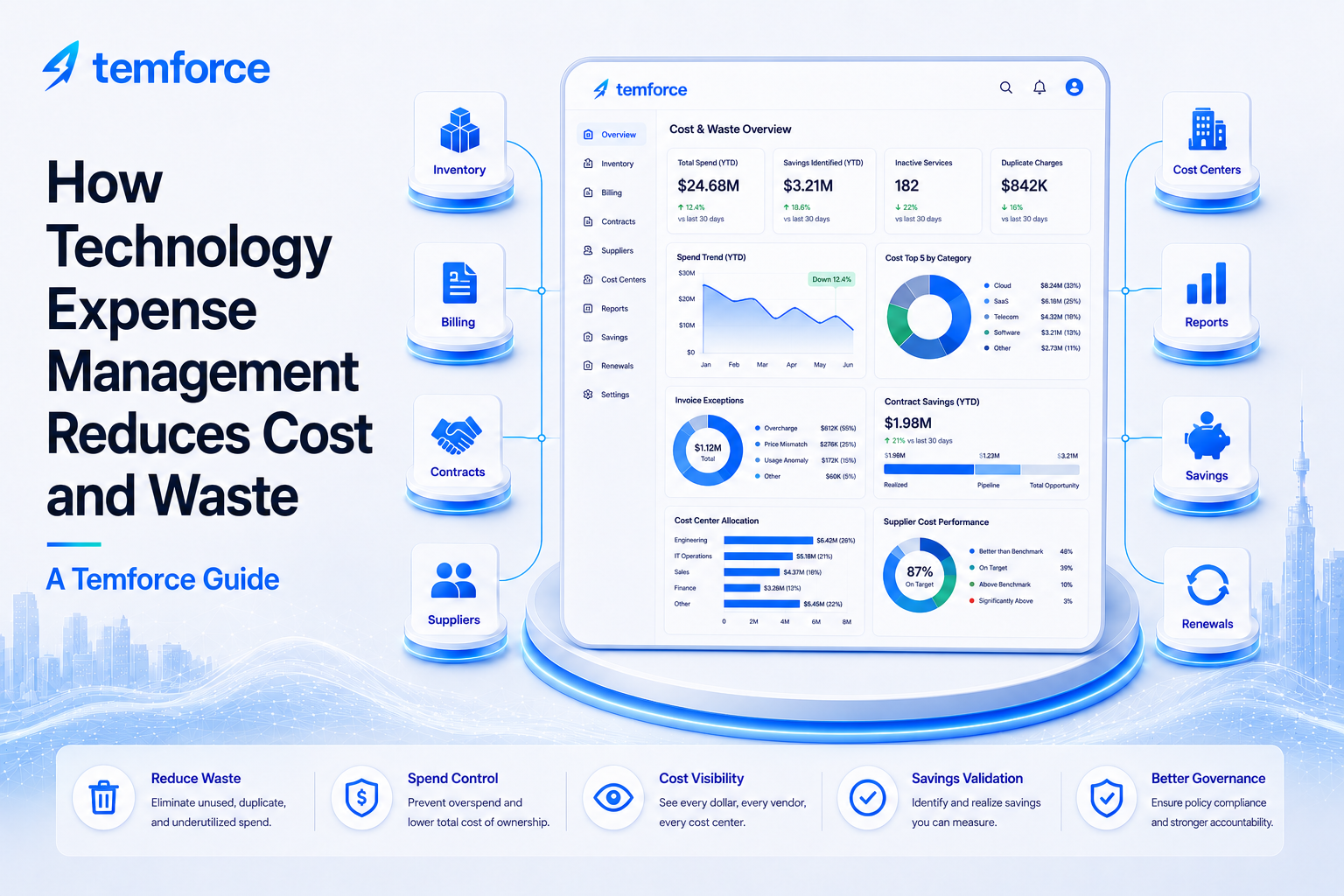
How Technology Expense Management Reduces Cost and Waste
May 29, 2026
Cost Control
Technology expense management reduces cost and waste by connecting recurring charges to inventory, ownership, requests, invoices, suppliers, contracts, renewals, cost centers, reports, and operating controls. Cost reduction becomes more reliable when the business can see what it owns, what it pays for, who owns it, and what should change.
Cost management in TEM is not just negotiating lower rates. It is the operating discipline of finding waste, proving business need, validating charges, correcting records, assigning ownership, tracking savings, and preventing the same cost issues from returning.
Cost reduction depends on operational truth. If the business cannot trust the inventory, invoice records, owner data, supplier context, contract terms, and cost center mappings, it cannot confidently decide what to reduce, dispute, disconnect, renegotiate, or keep.
Why cost management matters in TEM
Telecom and technology spend often grows through small recurring charges that are easy to miss. A service is disconnected operationally but keeps billing. A location closes but related services stay active. A user leaves but devices or subscriptions remain assigned. A supplier renews a service that the business no longer needs.
A strong cost management process turns those hidden issues into visible action so the business can reduce waste without guessing.
Cost management connects spend to services, suppliers, owners, locations, cost centers, invoices, contracts, and lifecycle status.
Savings opportunities need owners, approval paths, tasks, supplier follow-up, disconnect tracking, and measurable outcomes.
Cost control is strongest when requests, inventory updates, invoice validation, renewals, and finance allocation stay aligned.
Teams spend less time searching spreadsheets and more time acting on clear, prioritized cost opportunities.
The best cost management programs do not wait for an annual savings project. They build savings detection into the operating model through inventory reviews, invoice validation, requests, renewals, supplier management, finance reports, and dashboards.
The TEM cost management model
A strong cost management model connects financial opportunity to the operational records that explain whether the charge is valid, owned, needed, contracted, and correctly billed.
| Cost Area | What to Review | Why It Matters | Action It Should Trigger |
|---|---|---|---|
| Inactive services | Services still billing but marked inactive, retired, disconnected, or no longer owned. | Inactive services are one of the clearest sources of recurring waste. | Validate business need, submit disconnects, track final billing, and confirm credits. |
| Duplicate or overlapping services | Multiple services, suppliers, accounts, or subscriptions supporting the same function, location, user, or team. | Overlap can hide unnecessary cost and supplier complexity. | Review consolidation, disconnect, renegotiation, or service rationalization options. |
| Invoice exceptions | Unmatched charges, unexpected increases, missing credits, incorrect rates, wrong plans, or unsupported billing. | Invoice exceptions can become accepted spend if they are not resolved. | Dispute charges, recover credits, update records, and prevent repeat errors. |
| Renewal exposure | Upcoming renewals, auto-renewal dates, contract commitments, unused services, and pricing changes. | Renewal decisions can lock waste into the next term. | Review inventory before renewal, renegotiate, right-size, disconnect, or consolidate. |
| Ownership and allocation gaps | Charges with missing owners, stale cost centers, invalid GL codes, or unclear business purpose. | Spend cannot be controlled well if no one owns it. | Assign owners, correct cost centers, update inventory, and review chargeback rules. |
| Supplier performance and credits | Outages, SLA exposure, credits owed, billing disputes, recurring supplier issues, and service performance. | Supplier issues can create financial recovery opportunities and renewal leverage. | Request credits, escalate performance, support negotiation, and track recovery. |
How to reduce technology expense cost and waste
A practical cost reduction workflow should move from visibility to validation, ownership, action, savings tracking, and prevention.
Start with trusted inventory
Confirm active services, owners, locations, suppliers, billing accounts, cost centers, lifecycle status, and expected monthly charges.
Match spend to invoices and billing accounts
Use invoice validation to identify unexpected charges, duplicate services, missing credits, incorrect rates, and unsupported billing.
Review ownership and business need
Confirm whether the service is still needed, who owns it, what business function it supports, and whether it should remain active.
Prioritize savings opportunities
Rank opportunities by value, effort, risk, owner, supplier dependency, contract timing, and implementation path.
Take action and track completion
Submit disconnects, open disputes, request credits, update contracts, correct cost centers, renegotiate terms, or reassign services.
Confirm savings on the invoice
Validate that removed charges, corrected rates, credits, and disconnects appear on the invoice and are reflected in reports.
What cost management should track
Cost management records should capture enough information to support savings review, business approval, supplier follow-up, invoice validation, finance reporting, and ongoing control.
- Opportunity type, supplier, service ID, billing account, invoice number, owner, location, and cost center
- Current monthly charge, expected monthly charge, disputed amount, credit amount, one-time savings, and recurring savings
- Inventory status, lifecycle status, duplicate status, business need, ownership status, and contract context
- Request activity, disconnect status, supplier confirmation, final billing date, and credit validation status
- Approval owner, finance owner, technical owner, task owner, supplier owner, and due date
- Savings identified, savings approved, savings implemented, savings realized, avoided cost, and recovery amount
- Risk level, implementation effort, supplier dependency, renewal impact, business impact, and timing sensitivity
- Dashboard category, reporting category, resolution status, aging, and next action
A savings opportunity should not be considered complete until the invoice confirms the charge changed, stopped, credited, or corrected as expected.
Common cost management issues
Cost management breaks down when savings opportunities are identified but not governed through completion.
Teams suspect a service is unnecessary, but the inventory does not show ownership, location, purpose, or lifecycle status.
A disconnect or pricing correction may be requested, but the next invoice is not checked to confirm the result.
Savings opportunities stall when business ownership, technical ownership, or finance approval is unclear.
Supplier actions can fail silently when confirmations, credits, disputes, and billing changes are not tracked.
Services may be renewed before the organization reviews inventory, usage, lifecycle status, and future demand.
Cost management loses momentum when savings identified, implemented, realized, and recovered are not reported clearly.
Example scenario: reducing recurring waste from inactive services
A report shows several active billing records tied to services that no longer have valid owners. In a weak process, the charges may continue because no one is sure whether they are safe to disconnect. In a stronger TEMOps process, the records are reviewed against inventory, invoice history, request activity, supplier accounts, cost centers, and business ownership.
Instead of asking, “Can we cut this cost?” the business asks, “What is this service, who owns it, is it still needed, what contract applies, what invoice charge will change, and how do we confirm savings after action is taken?”
How Temforce helps reduce technology expense cost and waste
Temforce helps organizations connect cost management to the inventory, invoice, request, supplier, contract, finance, report, and dashboard records that explain where waste exists and what action should be taken.
The goal is to move cost reduction away from one-time cleanup projects and toward a governed TEMOps process with clear visibility, ownership, follow-through, and savings evidence.
Identify inactive services, duplicate records, missing owners, unused capacity, unmanaged accounts, and lifecycle gaps.
Track disputes, credits, disconnect confirmations, supplier actions, billing corrections, and final invoice validation.
Support savings identified, approved, implemented, realized, recovered, and avoided through reports and dashboards.
