What Reports Should a Technology Expense Management Program Use?
May 28, 2026
Cost Control
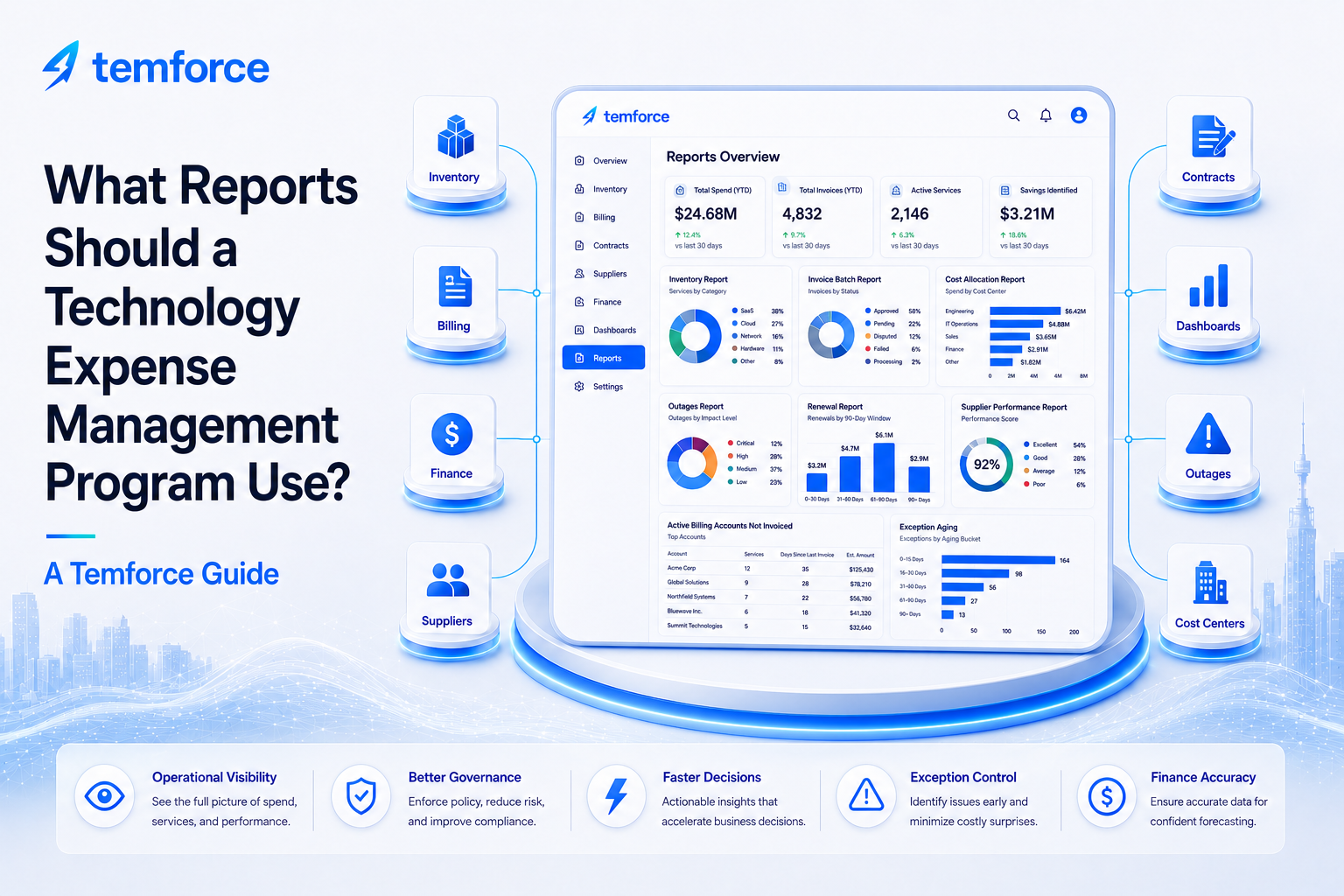
A technology expense management program should use reports that turn inventory, invoices, requests, suppliers, contracts, outages, finance data, cost centers, and tasks into evidence the business can review, export, assign, reconcile, and act on.
Dashboards help teams see what is happening. Reports help teams prove what happened, review details, export data, reconcile charges, assign work, and support operational decisions. A strong TEMOps reporting model should give the business repeatable evidence, not one-off spreadsheets rebuilt every month.
A report should answer a business question and support a next action. If a report does not help validate spend, assign ownership, correct data, manage suppliers, track risk, or support finance, it needs a clearer purpose.
Why TEM reports matter
Technology expense management teams often spend too much time rebuilding the same reports, reconciling different versions of the truth, and explaining why numbers do not match. Reports should create consistency, not confusion.
A strong reporting model gives the business a reliable way to review inventory, invoice validation, billing accounts, cost centers, suppliers, contracts, outages, renewals, and savings activity.
Reports provide the line-level evidence behind inventory health, invoice exceptions, cost allocation, supplier issues, and operating risk.
Recurring reports help teams review ownership gaps, missing data, overdue tasks, billing issues, renewals, and exception aging.
Reports identify inactive services, unmanaged accounts, unallocated charges, missing owners, overdue disconnects, and unresolved disputes.
Standard reports reduce repeated spreadsheet work and help teams spend more time correcting issues instead of rebuilding data.
Reports are where TEMOps becomes auditable. They give finance, IT, procurement, operations, and leadership the detail needed to validate what the program is doing and where action is still needed.
The reports a TEM program should use
A strong reporting model should cover inventory, invoice validation, billing accounts, finance, suppliers, contracts, outages, requests, and savings activity.
| Report | What It Shows | Why It Matters | Action It Should Trigger |
|---|---|---|---|
| Inventory report | Active services, suppliers, owners, locations, billing accounts, lifecycle status, cost centers, and service details. | Inventory is the source of truth for invoice validation, renewals, outages, and allocation. | Correct missing owners, inactive records, stale locations, and incomplete service data. |
| Invoice batch report | Invoice totals, supplier charges, billing accounts, validation status, exceptions, credits, and payment status. | Finance needs invoice evidence that can be reviewed, reconciled, and approved. | Approve valid charges, dispute exceptions, recover credits, and update records. |
| Active billing accounts not invoiced by supplier | Billing accounts expected in inventory that have not appeared on recent supplier invoices. | Missing invoices or billing gaps can affect accruals, forecasting, and supplier accountability. | Follow up with suppliers, finance, and billing owners before spend visibility breaks down. |
| Inventory to inactive cost center report | Active services tied to inactive, outdated, missing, or invalid cost centers. | Cost allocation fails when services are connected to bad finance data. | Update cost center mappings, owners, GL codes, and chargeback rules. |
| Live inventory but inactive user report | Active services, devices, accounts, or subscriptions assigned to inactive users. | Inactive users can hide waste, security risk, and unnecessary recurring spend. | Review ownership, reassign services, disconnect waste, or update inventory. |
| Inventory overlap report | Duplicate services, overlapping suppliers, duplicate accounts, redundant locations, or similar service records. | Overlap can reveal waste, consolidation opportunities, and cleanup needs. | Assign review tasks, validate business need, consolidate, disconnect, or renegotiate. |
| Outages report | Outage history, impacted services, suppliers, locations, duration, escalation status, credits, and resolution notes. | Outage reporting supports supplier accountability and renewal decisions. | Escalate recurring issues, track credits, review supplier performance, and update risk views. |
| Demand forecast report | Expected spend changes, new demand, growth, disconnects, renewals, pending requests, and future-state services. | Forecasting helps finance and operations prepare for technology expense changes. | Plan budgets, review requests, update accruals, and align spend expectations. |
How to use TEM reports in the operating rhythm
Reports should be part of a recurring operating rhythm. The value is not just exporting data. The value is using the report to assign action, correct records, validate spend, and improve control.
Start with the business question
Decide whether the report is meant to validate invoices, clean inventory, support finance, review suppliers, manage renewals, track outages, or identify savings.
Pull the right operating records
Use inventory, invoice, billing account, supplier, contract, request, outage, cost center, and task data to build the report.
Review exceptions and gaps
Look for missing owners, inactive users, invalid cost centers, unmatched invoices, stale inventory, duplicate services, unresolved disputes, and upcoming renewals.
Assign follow-up work
Convert report findings into tasks, owner reviews, supplier follow-ups, finance corrections, disputes, disconnects, or renewal actions.
Update the system of record
Use the report findings to update inventory, finance codes, suppliers, contracts, request history, billing accounts, and reporting classifications.
Track resolution over time
Review the same reports on a recurring basis so the business can see whether exceptions are aging, shrinking, repeating, or being resolved.
What TEM reports should track
Reports should capture enough information to support review, reconciliation, decision-making, and follow-through.
- Service ID, supplier, billing account, invoice number, owner, location, department, cost center, and lifecycle status
- Invoice totals, recurring charges, usage charges, taxes, surcharges, credits, payment status, and validation status
- Inventory completeness, missing owners, inactive services, stale records, duplicate records, and cleanup status
- Cost center mapping, GL codes, chargeback amounts, unallocated spend, invalid finance codes, and allocation exceptions
- Supplier performance, outages, credits, disputes, escalation status, recurring issues, and relationship ownership
- Contract renewals, expiration dates, notice windows, pricing terms, commitments, and contract owners
- Open tasks, overdue tasks, assigned owners, exception aging, resolution status, and next actions
- Savings identified, savings approved, savings realized, avoided cost, disconnect status, and optimization category
If a report identifies an issue but does not create a clear action, owner, or correction path, the report is not finished. It is only a data extract.
Common TEM reporting issues
Reporting problems usually appear when reports are built from disconnected data sources instead of a governed operating model.
Inventory, invoice, finance, supplier, and contract reports can tell different stories when the data is not connected.
Reports lose value when exceptions are not assigned to owners, suppliers, finance, IT, or operations for resolution.
Manual reporting creates inconsistent outputs, version confusion, and recurring work that should be standardized.
Finance teams need reports that connect charges to cost centers, GL codes, owners, departments, and billing accounts.
A report should point to disputes, cleanup, disconnects, cost center corrections, supplier follow-ups, or renewal actions.
Leadership needs reporting that explains risk, savings, exceptions, supplier exposure, inventory health, and governance progress.
Example scenario: a report that exposes recurring waste
A live inventory but inactive user report shows several active services tied to users who are no longer with the company. In a weak process, those charges may continue because each invoice looks normal. In a stronger TEMOps process, the report creates cleanup tasks, owner reviews, disconnect requests, invoice validation checks, and savings tracking.
Instead of asking, “Can someone export the data?” the business asks, “What does the report prove, who owns the exceptions, what should be corrected, and how do we prevent the issue from repeating?”
How Temforce helps with TEM reporting
Temforce helps organizations connect reports to the inventory, invoice, supplier, contract, outage, finance, task, and dashboard records that make technology expense management actionable.
The goal is to move reporting away from disconnected spreadsheets and toward a governed TEMOps process with clear evidence, owners, actions, and outcomes.
Build reports around services, suppliers, billing accounts, owners, locations, cost centers, contracts, and lifecycle status.
Support invoice validation, cost allocation, chargebacks, accruals, credits, disputes, and billing account review.
Turn report findings into tasks, supplier follow-ups, disconnects, owner reviews, renewal planning, and cleanup work.
