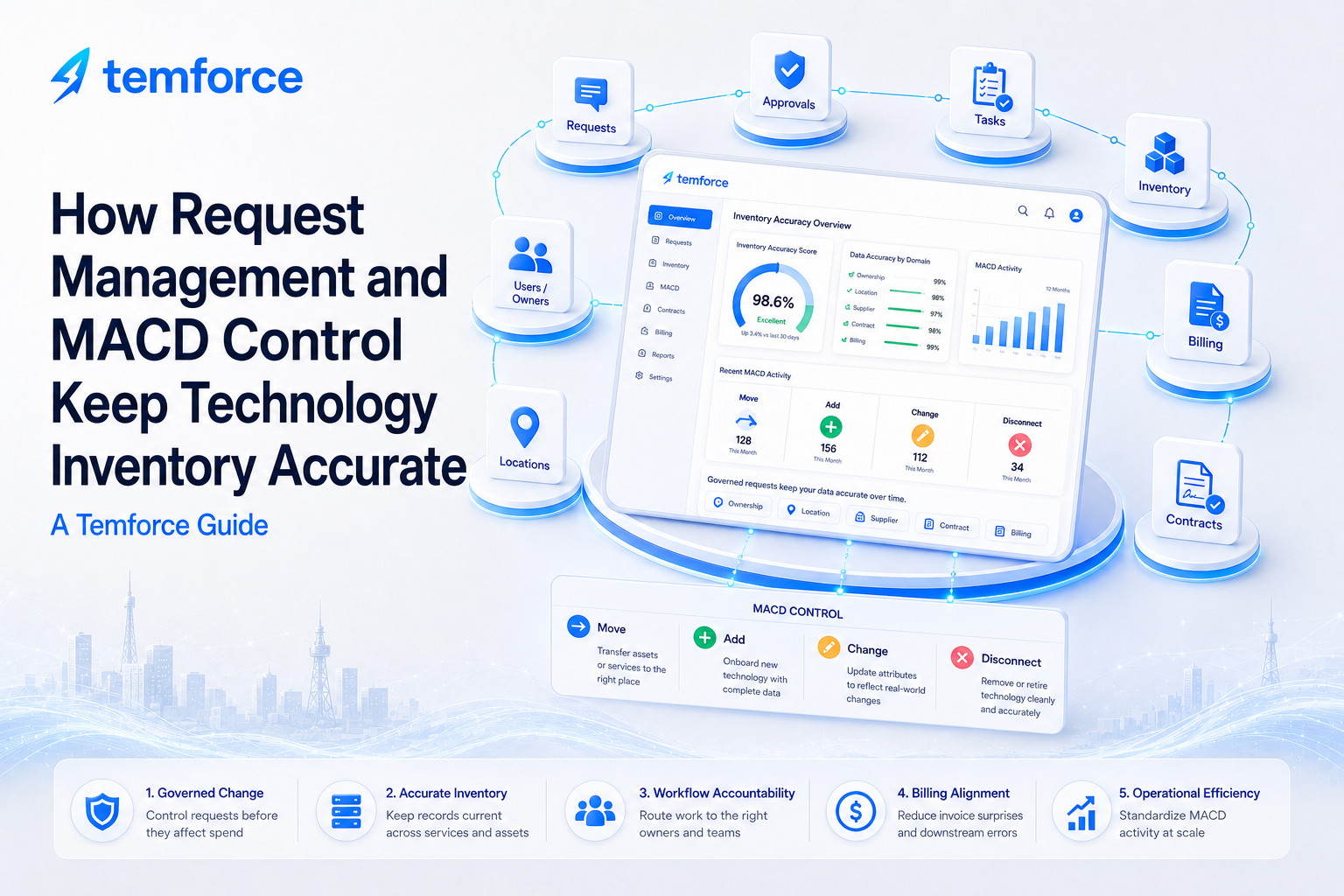
How Request Management and MACD Control Keep Technology Inventory Accurate
May 28, 2026
MACD-Processing
Request management and MACD control are what keep technology inventory accurate after the initial cleanup. Inventory may create the source of truth, but requests, moves, adds, changes, and disconnects are what protect that truth as the business changes.
In technology expense management, request management is the process for capturing, approving, routing, completing, and documenting service changes. MACD control is the discipline that makes sure moves, adds, changes, and disconnects update the inventory, billing, ownership, supplier, contract, and finance records that depend on them.
Inventory does not stay accurate because it was cleaned once. It stays accurate because every request, move, add, change, disconnect, ownership update, location change, and supplier-driven update feeds the system of record.
Why request management matters
Most inventory problems do not appear all at once. They build up quietly through unmanaged change. A service gets ordered outside the process. A user leaves. A circuit moves. A location closes. A supplier changes an account structure. A disconnect is requested but never confirmed. The invoice keeps arriving, and the inventory slowly stops matching reality.
Request management gives the business a controlled way to capture change before it becomes inventory drift, billing confusion, supplier noise, or finance rework.
Requests make service changes visible before they impact inventory, invoices, contracts, cost centers, suppliers, and reporting.
New services, upgrades, disconnects, and ownership changes need clear approvals, assigned owners, and a defined workflow.
MACD control keeps the inventory current by connecting every completed change to the service record and lifecycle status.
When requests update the inventory correctly, teams spend less time chasing missing owners, stale services, and invoice exceptions.
Request management is where inventory accuracy is won or lost. If the request process does not update the inventory, the inventory becomes a historical snapshot instead of an operating record. The strongest TEMOps programs treat requests as the front door to inventory control.
What MACD means in technology expense management
MACD stands for moves, adds, changes, and disconnects. In a TEMOps operating model, MACD is not just a service delivery term. It is the practical workflow that keeps technology inventory, billing, suppliers, finance, and reporting aligned with business change.
| MACD Activity | What It Means | Inventory Impact | Expense Risk If Missed |
|---|---|---|---|
| Move | A service, device, user, circuit, application, or billing responsibility moves to a new location, owner, department, or cost center. | Updates location, owner, department, service address, cost center, and business context. | Charges may be allocated to the wrong team, location, or cost center. |
| Add | A new service, device, user, circuit, application, supplier account, or feature is requested and activated. | Creates a new inventory record with supplier, owner, contract, location, cost, and lifecycle details. | New recurring charges may appear without enough context to validate them. |
| Change | An existing service is upgraded, downgraded, reconfigured, reassigned, renewed, repriced, or modified. | Updates service details, pricing, bandwidth, plan, owner, supplier data, contract terms, or lifecycle notes. | The invoice may no longer match expected charges or contract terms. |
| Disconnect | A service, user, device, circuit, feature, account, or subscription is retired, canceled, or no longer needed. | Updates lifecycle status, disconnect date, final invoice tracking, owner, supplier confirmation, and savings record. | The business may continue paying for services that should have stopped billing. |
The request management workflow
A strong request process should do more than approve work. It should create a clean operational trail from business need to inventory update, supplier action, finance alignment, and invoice validation.
Capture the business request
Document what is being requested, why it is needed, who owns it, what location or user it supports, what supplier may be involved, and what cost center should receive the charge.
Validate ownership and approval
Confirm the business owner, technical owner, finance owner, approver, department, location, and budget context before the request becomes spend.
Route the work to the right team
Assign tasks to IT, procurement, service delivery, finance, supplier management, or operations depending on the request type and impact.
Update the inventory record
Create or update the service record, owner, location, supplier, billing account, cost center, lifecycle status, contract reference, and expected monthly charge.
Confirm supplier and billing changes
Track order IDs, supplier confirmations, disconnect confirmations, activation dates, final billing dates, credits, and expected invoice impact.
Validate the next invoice
Compare the next invoice against the completed request so the business can confirm the charge started, changed, or stopped as expected.
What every request should track
The request record should capture enough detail to support inventory maintenance, invoice validation, supplier follow-up, finance allocation, reporting, and governance.
- Request type, such as new service, move, add, change, disconnect, ownership update, location update, or supplier change
- Business owner, technical owner, requester, approver, department, and cost center
- Supplier, billing account, service ID, circuit ID, phone number, application, device, subscription, or asset reference
- Location, site code, service address, user, team, region, and business unit
- Expected monthly charge, one-time charge, GL code, budget owner, and financial approval status
- Contract reference, renewal impact, pricing notes, term commitment, and supplier order details
- Requested date, approval date, target completion date, actual completion date, and lifecycle status
- Supplier confirmation, disconnect confirmation, final billing expectation, credit expectation, and next invoice validation check
If a request creates, changes, moves, or retires a service that can appear on an invoice, it should update the inventory and create a validation checkpoint for the next billing cycle.
Where request management breaks down
Request management usually breaks down when the request is treated as a ticket instead of an operating control. A ticket may close when the task is complete, but the TEMOps process is not complete until inventory, supplier, finance, and invoice records are updated.
The work may be completed, but the inventory is never updated and finance never receives the cost center or billing impact.
The request may create a new charge, but without an owner the invoice team cannot confirm whether the charge is valid.
Disconnects, activations, credits, and billing changes can fail silently when supplier confirmation is not tied back to the request.
Finance teams struggle to allocate charges when requests do not capture the correct department, GL code, budget owner, or cost center.
A request is not fully complete until the invoice confirms the supplier billed, changed, credited, or stopped billing correctly.
Leaders cannot see request volume, disconnect savings, pending changes, service aging, supplier delays, or operational backlog.
Example scenario: a disconnect request that protects inventory accuracy
A business unit requests a disconnect for a network service tied to a location that is closing. In a weak process, the ticket is submitted, the supplier is contacted, and everyone assumes the service will stop billing. But if the inventory is not updated, the supplier confirmation is not tracked, and the next invoice is not validated, the company may continue paying for the service months after the location is gone.
Instead of asking, “Did someone submit a disconnect?” the business asks, “Was the disconnect approved, completed, confirmed by the supplier, updated in inventory, reflected in finance, and validated on the next invoice?”
How Temforce helps with request and MACD control
Temforce helps organizations connect requests, inventory, tasks, suppliers, finance, contracts, reports, and dashboards so service changes do not disappear into disconnected tickets, spreadsheets, email chains, and supplier portals.
The goal is to make request activity part of the TEMOps operating model, not a separate process that inventory and finance teams have to clean up later.
Connect moves, adds, changes, disconnects, ownership updates, and supplier changes to the inventory records they affect.
Assign follow-up work for approvals, missing data, disconnect confirmations, supplier actions, invoice checks, and cleanup items.
Support cost center accuracy, chargeback visibility, expected invoice impact, savings tracking, and operational reporting.
