
Drive TEM software adoption by turning users into TEMOps operators.
Use this TEM software adoption guide to plan user rollout, workflow adoption, role-based training, support routines, reporting reviews, Boostforce AI usage, ready-built API alignment, savings tracking, and practical TEMOps execution after go-live.
TEM software adoption is where people, process, data, support, and reporting begin working together.
Strong adoption happens when users understand what work belongs in the platform, why the data matters, how workflows should move, when suppliers need action, where AI and APIs can help, how savings are tracked, and how dashboards prove progress.
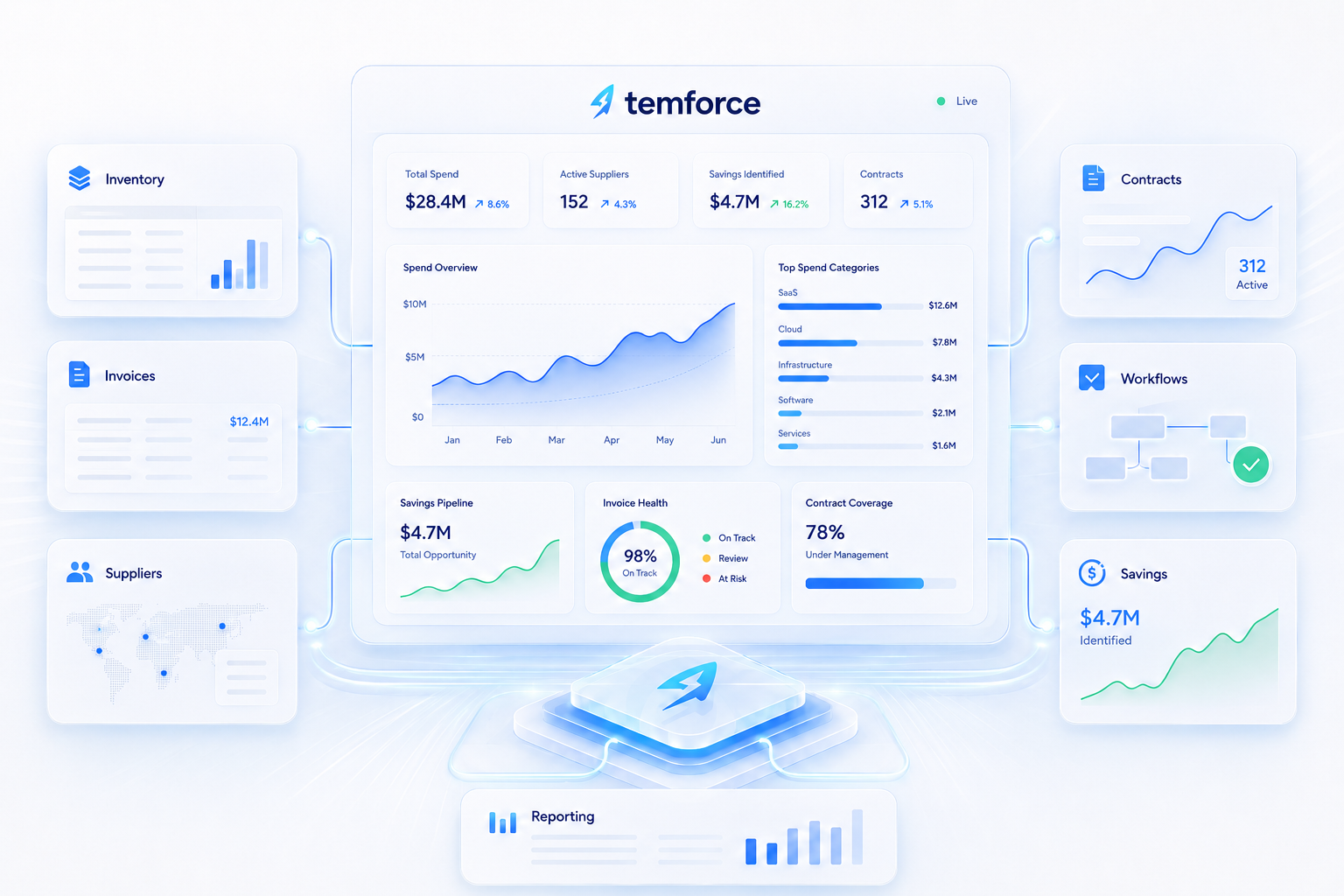
Help users maintain inventory records, billing accounts, suppliers, contracts, owners, cost centers, locations, and lifecycle status.
Move requests, MCAD orders, invoice exceptions, disputes, supplier follow-up, approvals, renewals, disconnects, credits, and recoveries.
Use savings, corrections, recoveries, supplier outcomes, lifecycle progress, support activity, AI insight, APIs, and dashboards to prove outcomes.
A practical TEM software adoption plan has six connected phases.
Adoption should be planned around the work users need to perform, the outcomes leadership needs to see, and the operating rhythm that keeps TEMOps moving.
Define user groups and responsibilities.
Start by identifying which users need access, what each group owns, what workflows they touch, what reports they review, and how their work connects to inventory truth, invoice validation, supplier accountability, lifecycle workflows, savings, and reporting.
Train users around real TEMOps work.
Training should not stop at navigation. Users should learn how to validate invoices, maintain inventory, manage supplier follow-up, review contracts, move lifecycle workflows, use dashboards, ask AI-supported questions, and document savings proof.
Launch workflow adoption.
The platform becomes valuable when work moves through it. Requests, approvals, MCAD orders, disputes, supplier follow-up, renewals, disconnects, credits, recoveries, tasks, meetings, and documents should become part of the operating rhythm.
Use reporting to reinforce behavior.
Dashboards help adoption because they show whether users are maintaining data, moving tasks, validating invoices, following up with suppliers, confirming savings, and closing lifecycle work. Reports should make good operating behavior visible.
Activate AI, APIs, and support routines.
Adoption improves when users get faster answers, cleaner data flows, and visible support. Boostforce AI should help users ask better questions and summarize activity. Ready-built APIs should support connected data. Dedicated support should help teams keep improving.
Measure adoption and improve continuously.
Adoption should be reviewed as part of governance. Teams should look at user activity, workflow completion, data quality, invoice outcomes, supplier response, savings proof, reporting usage, support themes, AI usage, API needs, and improvement opportunities.
Give each team a clear reason to use the platform.
Users adopt TEM software when the platform makes their work clearer, faster, more accountable, and easier to report.
Finance users need invoice status, approvals, credits, recoveries, cost allocation, savings reports, disputes, and executive-ready reporting.
IT users need service visibility, ownership, lifecycle status, request tracking, changes, disconnects, renewals, and technical context.
Telecom users need circuit records, mobile lines, billing accounts, supplier follow-up, MCAD orders, invoice issues, and disconnect tracking.
Procurement users need supplier records, contract visibility, renewals, obligations, escalations, disputes, correction status, and performance reporting.
Operations users need tasks, approvals, meetings, documents, workflow status, follow-up routines, due dates, reporting, and support coordination.
Support users need visibility into customer workflows, configuration needs, user questions, reporting gaps, issue resolution, and improvement themes.
Leadership users need dashboards for spend, savings, risks, supplier outcomes, workflow progress, inventory quality, and TEMOps maturity.
Supplier-facing workflows should support disputes, correction requests, credit follow-up, recovery status, contract questions, and billing actions.
Measure adoption by behavior, not logins alone.
A strong adoption scorecard shows whether users are moving the work that drives TEMOps outcomes.
| Adoption Area | What to Measure | Why It Matters |
|---|---|---|
| Inventory usage | Record updates, owner completion, supplier mapping, billing account matching, lifecycle status, duplicate cleanup, and data quality reviews. | Shows whether the platform is becoming the trusted inventory record behind invoice validation and reporting. |
| Invoice workflow | Invoice review status, exception handling, approval movement, dispute ownership, credit tracking, recovery validation, and billing correction status. | Shows whether invoice validation is moving from review to action to proof. |
| Supplier follow-up | Open supplier issues, escalation aging, correction requests, dispute status, credit commitments, response tracking, and performance reviews. | Shows whether suppliers are being managed with structure and accountability. |
| Lifecycle workflows | Requests, MCAD orders, disconnects, renewals, retirements, approvals, supplier actions, billing impact checks, and completion evidence. | Shows whether lifecycle work is moving through a repeatable operating model. |
| Savings proof | Identified savings, approved savings, realized savings, credits, recoveries, recurring savings, one-time savings, and evidence completion. | Shows whether value is being tracked beyond estimates and connected to reporting evidence. |
| AI, APIs, and reporting | AI usage, API data needs, dashboard usage, report reviews, finance handoffs, support requests, and improvement actions. | Shows whether intelligence, connectivity, and reporting are supporting user behavior and operating control. |
Adoption improves when users see the platform as their operating home.
Temforce helps teams adopt TEM software by connecting user roles, workflows, inventory truth, invoice validation, supplier accountability, lifecycle work, Boostforce AI, ready-built APIs, application customization, dedicated support, savings tracking, dashboards, and reporting.
TEM Software Adoption Guide FAQ.
Use these answers to understand TEM software adoption across user rollout, workflow adoption, training, support, AI, APIs, savings, reporting, and TEMOps execution.
What is TEM software adoption?
TEM software adoption is the process of helping users actively use a Technology Expense Management platform for inventory truth, invoice validation, supplier accountability, lifecycle workflows, savings tracking, dashboards, reporting, AI-supported insight, API-connected data, and support routines.
Why does TEM software adoption matter?
TEM software adoption matters because software value depends on users moving real work through the platform. If users continue managing invoices, suppliers, requests, lifecycle actions, and savings outside the platform, reporting and operating control become weaker.
Who should be included in TEM software adoption?
TEM software adoption should include finance, IT, telecom, procurement, operations, support teams, business owners, leadership, and supplier-facing stakeholders. Each group should understand its role in the TEMOps operating model.
How should TEM software users be trained?
Users should be trained around real operating workflows, not just screens. Training should cover inventory records, invoice validation, supplier follow-up, contract visibility, requests, MCAD order management, lifecycle workflows, savings tracking, dashboards, AI usage, API-connected data, and reporting.
How can adoption be measured?
Adoption can be measured through user engagement, inventory updates, invoice workflow progress, supplier follow-up activity, lifecycle task completion, savings proof, dashboard usage, AI usage, API needs, support requests, and reporting reviews.
How does Temforce support TEM software adoption?
Temforce supports TEM software adoption by connecting inventory truth, invoice validation, supplier accountability, contracts, lifecycle workflows, Boostforce AI, ready-built APIs, application customization, dedicated support, savings tracking, dashboards, and reporting into one TEMOps platform.
Turn user rollout into TEMOps adoption.
Temforce helps teams adopt TEM software with inventory truth, invoice validation, supplier accountability, contract visibility, lifecycle workflows, Boostforce AI, ready-built APIs, application customization, dedicated support, savings tracking, dashboards, reporting, and practical operating guidance.
