
Build TEM dashboards that turn expense data into operating visibility.
Use this TEM software reporting dashboard guide to plan executive dashboards, inventory reports, invoice exception views, supplier performance, lifecycle workflow status, savings proof, Boostforce AI summaries, ready-built API data flows, support reviews, and TEMOps reporting cadence.
TEM reporting should do more than summarize spend. It should show what is true, what needs action, what changed, and what value was proven.
The best TEM dashboards connect inventory truth to invoice validation, supplier accountability, contract visibility, lifecycle workflows, savings tracking, AI-supported insight, API-connected data, and reporting evidence. Leadership should see the story. Operators should see the work.
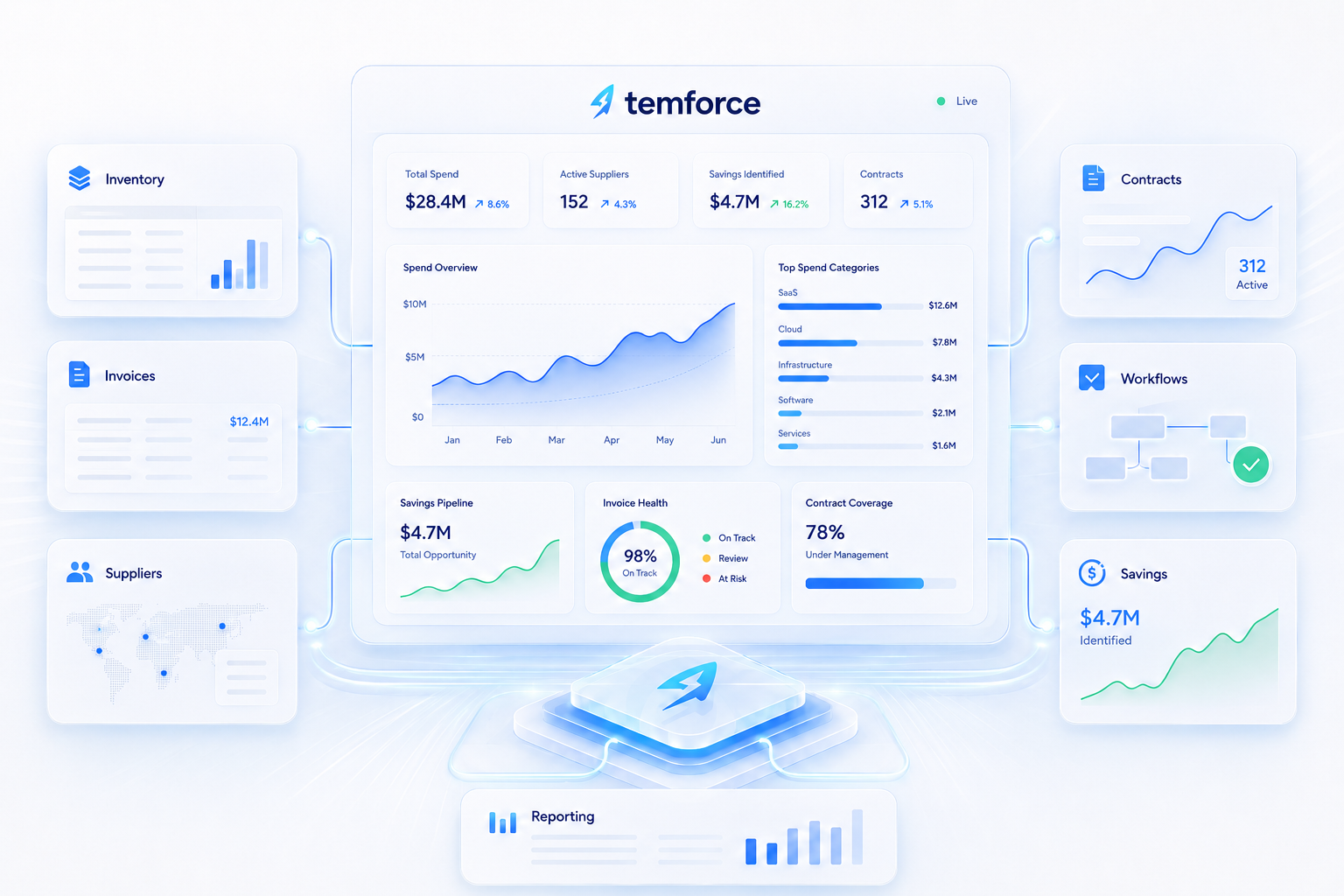
Show inventory, billing accounts, suppliers, contracts, owners, locations, cost centers, lifecycle status, invoice links, and reporting context.
Track invoice exceptions, supplier issues, disputes, credits, recoveries, MCAD orders, renewals, disconnects, and workflow tasks.
Report savings, credits, recoveries, billing corrections, disconnect savings, supplier outcomes, and lifecycle progress.
A TEM reporting model should include six dashboard views.
Different stakeholders need different views. Finance, IT, telecom, procurement, operations, suppliers, support teams, and leadership should all be able to see the information that helps them act.
Executive TEM dashboard.
The executive dashboard should show leadership the big picture: total spend, spend trends, savings, credits, recoveries, open risks, supplier issues, lifecycle progress, invoice exceptions, and TEMOps operating health.
Inventory truth dashboard.
The inventory dashboard should show whether records are complete, owned, billable, connected, and current. This view helps teams find missing owners, unmatched charges, stale services, supplier gaps, contract gaps, and lifecycle issues.
Invoice validation dashboard.
The invoice dashboard should show invoice status, billing account activity, exception types, disputed charges, missing credits, duplicate charges, billing after disconnect, supplier corrections, recoveries, and approval progress.
Supplier and contract dashboard.
The supplier dashboard should show vendor accountability, open issues, contract context, renewal dates, correction requests, escalation status, dispute activity, performance trends, and financial impact.
Lifecycle workflow dashboard.
The lifecycle dashboard should show requests, approvals, MCAD orders, renewals, disconnects, retirements, supplier actions, billing impact, completion status, and savings tied to workflow execution.
Savings and TEMOps performance dashboard.
The savings dashboard should show identified savings, approved savings, realized savings, credits, recoveries, recurring reductions, avoided costs, supplier outcomes, open savings, and evidence-backed reporting.
Track metrics that connect spend, work, and outcomes.
A strong TEM dashboard does not bury users in data. It helps them understand what changed, what needs attention, and where value is being created.
Show spend by supplier, service type, billing account, location, owner, cost center, business unit, and trend period.
Show complete records, missing owners, unmatched charges, supplier gaps, contract gaps, duplicate records, and stale services.
Show invoice issues, duplicate charges, billing after disconnect, missing credits, disputed charges, supplier corrections, and approval status.
Show supplier issues, escalations, dispute aging, credit status, correction requests, contract renewals, and outcomes.
Show requests, MCAD orders, renewals, disconnects, retirements, approvals, supplier actions, due dates, and completion status.
Show identified savings, approved savings, realized savings, credits, recoveries, billing corrections, disconnect savings, and avoided costs.
Use Boostforce AI to summarize activity, surface patterns, explain cost context, and help users ask better operational questions.
Use ready-built APIs to support reporting, finance handoffs, integrations, ecosystem alignment, and connected operating data.
Match each dashboard to the decision it supports.
Dashboards should help users make decisions, move work, and prove outcomes.
| Dashboard View | Decision It Supports | How Temforce Supports the View |
|---|---|---|
| Executive dashboard | Where is spend moving, what savings are being created, what risks exist, and what outcomes are proven? | Temforce connects spend, savings, invoice exceptions, supplier activity, lifecycle status, and reporting into leadership-ready visibility. |
| Inventory dashboard | Which records are complete, which services are unowned, and which charges need inventory validation? | Temforce connects inventory records to billing accounts, suppliers, contracts, owners, locations, cost centers, AI, APIs, and reports. |
| Invoice dashboard | Which invoices have exceptions, disputes, missing credits, duplicate charges, or billing issues? | Temforce connects invoice validation to inventory truth, supplier accountability, disputes, credits, recoveries, and reporting evidence. |
| Supplier dashboard | Which suppliers need follow-up, escalation, correction, contract review, or performance attention? | Temforce connects suppliers to invoices, contracts, disputes, credits, recoveries, correction requests, lifecycle actions, and reports. |
| Workflow dashboard | Which requests, MCAD orders, disconnects, renewals, supplier actions, and tasks need movement? | Temforce connects workflows to owners, due dates, supplier actions, inventory updates, billing impact, savings, and reporting. |
| Savings dashboard | What savings have been identified, approved, realized, recovered, credited, or still pending? | Temforce connects savings tracking to invoices, inventory cleanup, supplier outcomes, lifecycle actions, credits, recoveries, and evidence. |
The best reporting dashboard turns TEM data into operating rhythm.
Temforce helps teams connect dashboards to the work behind the numbers: inventory truth, invoice validation, supplier accountability, contract visibility, lifecycle workflows, Boostforce AI, ready-built APIs, application customization, dedicated support, savings tracking, and reporting.
TEM Software Reporting Dashboard Guide FAQ.
Use these answers to understand TEM dashboards for inventory, invoices, suppliers, workflows, savings, AI, APIs, and reporting.
What should a TEM software reporting dashboard include?
A TEM software reporting dashboard should include spend trends, inventory quality, invoice exceptions, supplier performance, contract visibility, lifecycle workflow status, savings tracking, credits, recoveries, AI-supported summaries, API-connected data, and executive reports.
Why do TEM dashboards need inventory truth?
TEM dashboards need inventory truth because reporting depends on knowing what services, assets, billing accounts, suppliers, owners, locations, contracts, cost centers, and lifecycle statuses exist. Without trusted inventory, invoice validation, supplier reporting, savings tracking, and executive dashboards are weaker.
What is an executive TEM dashboard?
An executive TEM dashboard is a leadership view that summarizes technology and telecom spend, savings, invoice exceptions, supplier issues, lifecycle activity, open risks, credits, recoveries, and TEMOps performance.
How do dashboards support invoice validation?
Dashboards support invoice validation by showing invoice status, exception types, disputed charges, missing credits, duplicate charges, billing after disconnect, supplier corrections, recoveries, approvals, and reporting evidence.
How do AI and APIs support TEM reporting?
Boostforce AI can help users summarize activity, surface answers, explain cost context, and identify patterns. Ready-built APIs can support connected data flows, finance handoffs, reporting integrations, and customer ecosystem alignment.
How does Temforce support TEM reporting dashboards?
Temforce supports TEM reporting dashboards by connecting inventory truth, invoice validation, supplier accountability, contracts, lifecycle workflows, disputes, credits, recoveries, Boostforce AI, ready-built APIs, application customization, dedicated support, savings tracking, dashboards, and reporting.
Turn TEM reports into operating visibility.
Temforce helps teams connect reporting dashboards to inventory truth, invoice validation, supplier accountability, contract visibility, lifecycle workflows, Boostforce AI, ready-built APIs, application customization, dedicated support, savings tracking, and TEMOps execution.
