
TEM Benefits: Why Telecom Expense Management Creates operating control.
Telecom Expense Management helps organizations move beyond bill review by improving inventory accuracy, invoice confidence, supplier accountability, contract governance, workflow execution, savings proof, and executive visibility.
The real benefit is creating a repeatable operating model that connects what exists, what is billed, who owns action, what suppliers owe, what contracts require, and how savings can be proven.
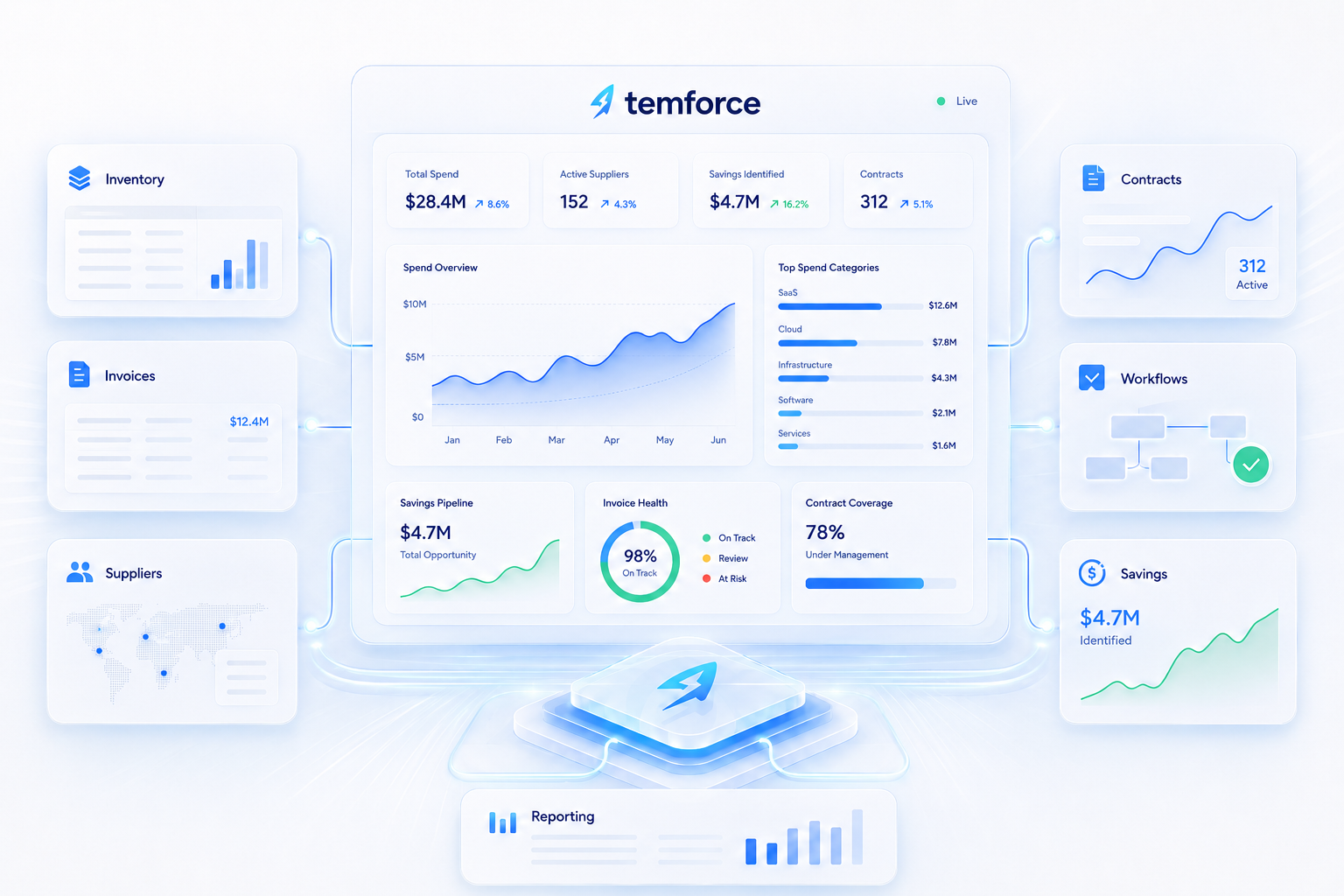
TEM creates value when visibility turns into actionable control.
The strongest TEM programs do more than collect telecom data. They help teams organize the operating record, validate recurring charges, manage supplier activity, track ownership, and prove financial impact.
TEM helps teams manage services, assets, billing accounts, suppliers, locations, owners, cost centers, lifecycle status, and contract context in one operating view.
Invoice review becomes stronger when charges connect to inventory, contracts, suppliers, service categories, approvals, exceptions, disputes, credits, and recoveries.
Track supplier issues, correction requests, billing disputes, credits, contract obligations, escalations, renewals, and outcomes with clearer ownership.
TEM helps teams connect pricing, terms, renewal windows, obligations, amendments, supplier records, inventory, and spend context before decisions are due.
Track credits, recoveries, avoided cost, disconnect savings, optimization actions, supplier corrections, and recurring reductions with evidence leadership can trust.
Shared data and visible workflows reduce confusion across teams that need to understand spend, ownership, approvals, supplier work, and savings activity.
TEM benefits compound when data, workflow, supplier action, and savings proof work together.
Most organizations do not lose control because one invoice is wrong. They lose control because inventory, invoices, contracts, suppliers, approvals, disputes, reports, and savings evidence are scattered across too many disconnected places.
TEM creates value by bringing those pieces together into an operating model that supports better review, better action, and better proof.
TEM creates different value for every team involved in technology expense control.
Finance, IT, Procurement, AP, and program owners all care about different parts of the TEM operating model. The benefit is giving each group the context they need without forcing them to manage the work in separate places.
Finance gets clearer views of recurring spend, budget exposure, cost allocation, credits, recoveries, avoided cost, and measurable outcomes.
IT can see active services, ownership, locations, suppliers, requests, disconnects, renewals, and service changes tied to the operating record.
Procurement gets better context for renewals, sourcing, benchmarking, supplier accountability, pricing terms, obligations, and negotiation support.
AP can route invoices with better supporting context tied to suppliers, billing accounts, approvals, exceptions, disputes, credits, and cost centers.
Common TEM benefits show up as better data, faster work, and measurable outcomes.
These are the practical benefit areas teams usually expect from a stronger TEM program.
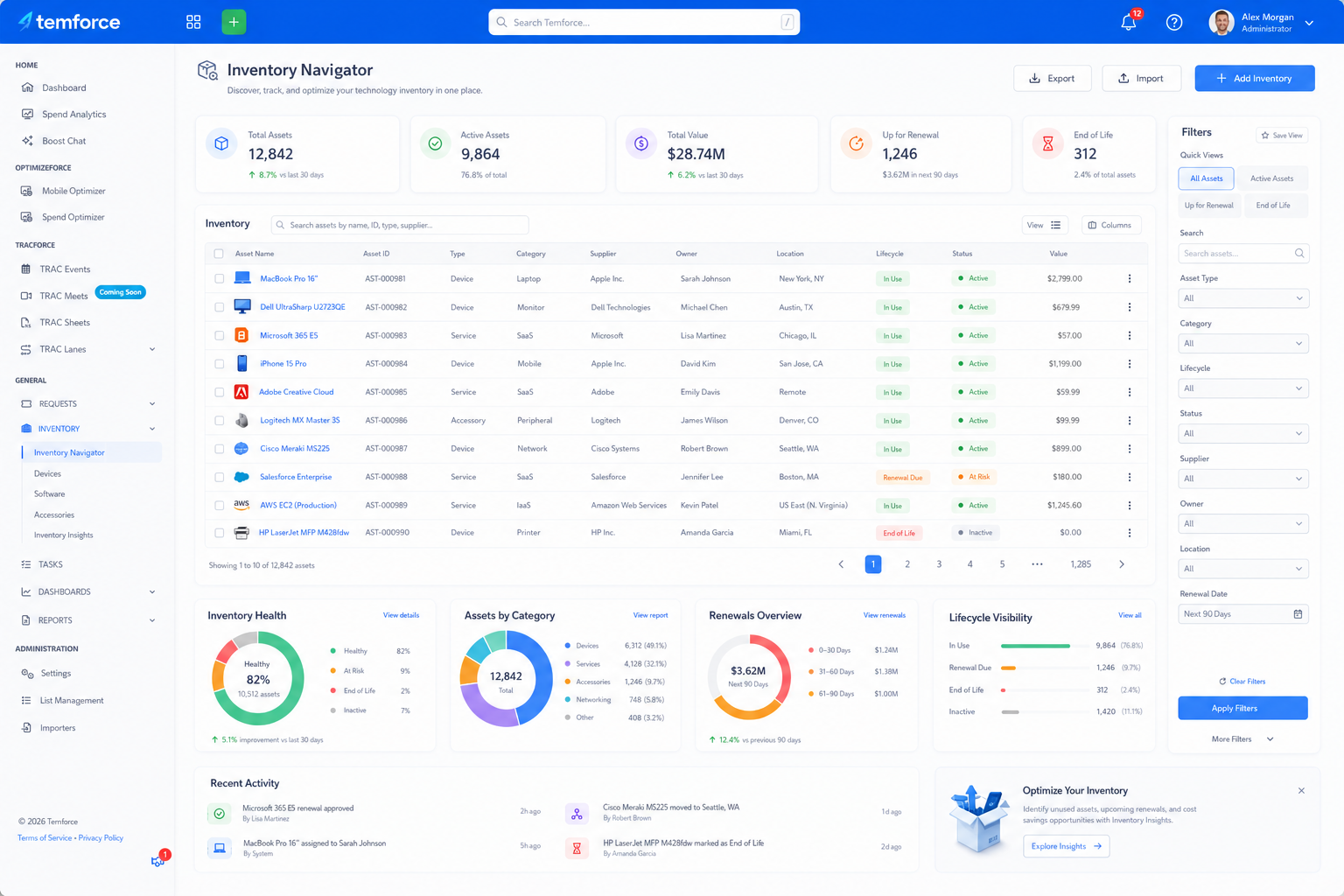
Better inventory reduces downstream expense confusion.
When inventory is clean, invoice validation improves, supplier follow-up gets easier, renewals become more visible, and sourcing teams have better data before negotiation starts.
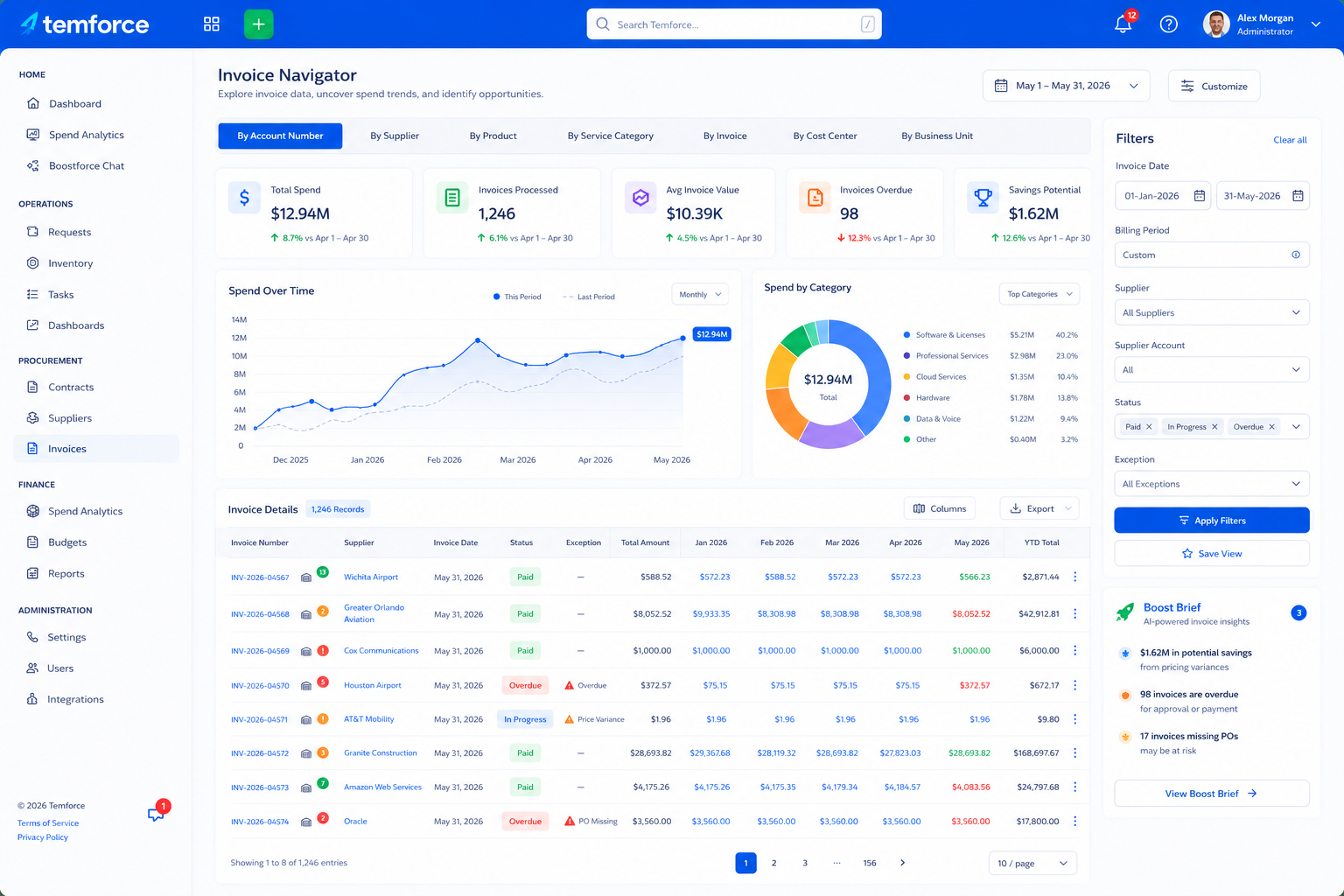
Invoice review becomes stronger when every charge has context.
TEM gives teams a better way to validate recurring charges by connecting invoice records to the inventory, supplier, contract, ownership, dispute, credit, recovery, and reporting context behind the bill.
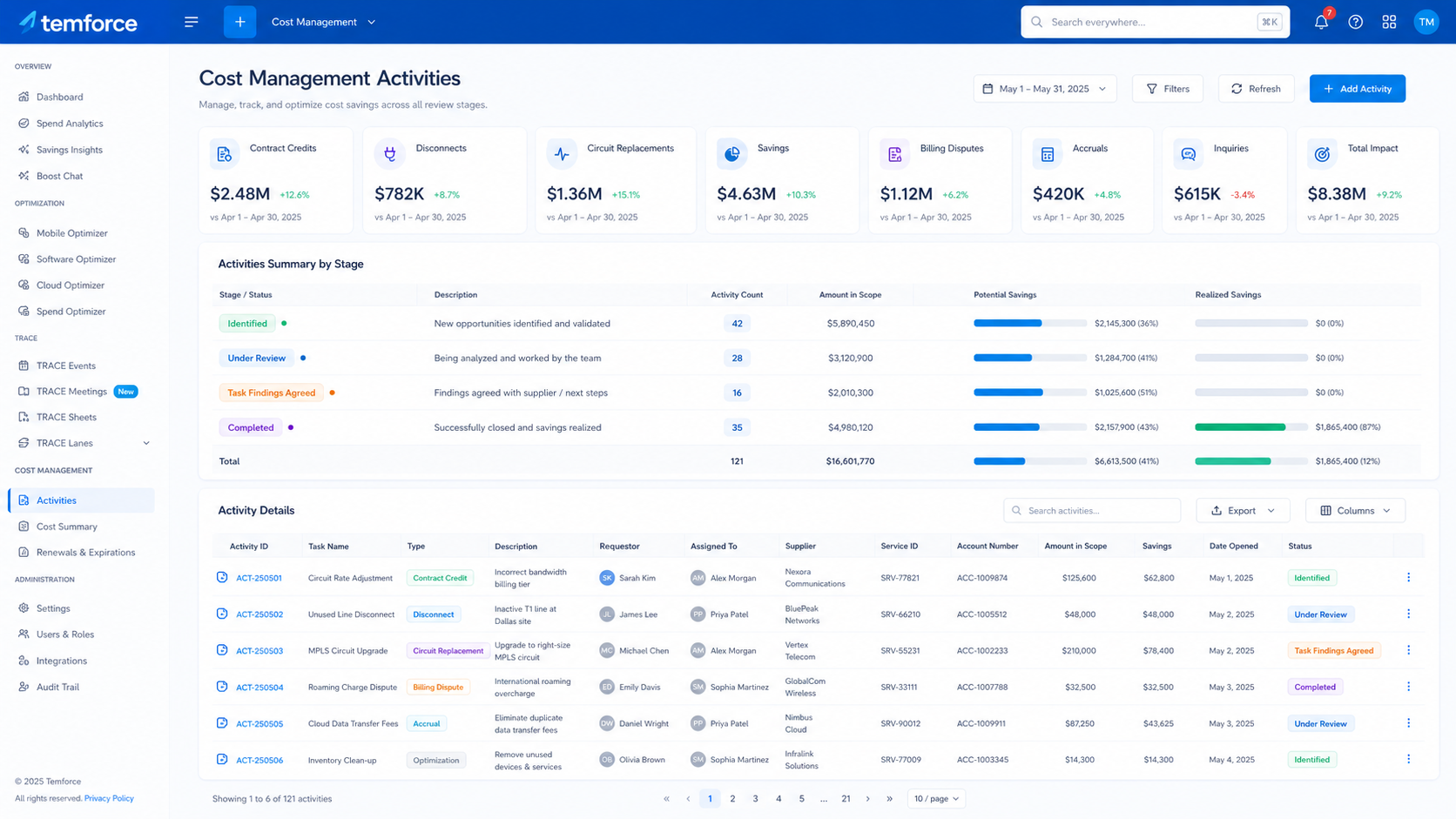
Savings are more credible when they connect to evidence.
A strong TEM program tracks not only what was found, but what action was taken, which supplier responded, what credit was received, what cost was avoided, and what recurring savings can be proven.
Continue the Technology Expense Management guide.
Move through the full guide path from TEM basics into benefits, readiness, solution design, strategy, platform maturity, ROI, and implementation planning.
What Is TEM?
Understand the meaning of Telecom Expense Management and how modern TEM evolved into a broader operating model for technology expense control.
TEM Benefits
See how TEM improves inventory accuracy, invoice control, supplier accountability, savings proof, governance, and executive visibility.
TEM Readiness
Learn what needs to be in place before launching, replacing, or improving a TEM program across data, owners, suppliers, and invoices.
TEM Solution
Understand what a TEM solution should manage and how software, services, workflows, reports, and operating support fit together.
TEM Strategy
Build a stronger operating model for telecom and technology expense control with governance, sourcing, supplier management, and savings proof.
Modern TEM Platform
See what a modern TEM platform should connect across software, services, inventory, invoices, suppliers, workflows, AI, reporting, and TEMOps execution.
TEM ROI
Measure TEM value through recoveries, credits, avoided cost, disconnect savings, supplier correction, time savings, and operating efficiency.
TEM Implementation Plan
See how to roll out TEM in a practical way by aligning inventory, invoices, suppliers, contracts, workflows, owners, and reporting.
TEM Benefits FAQ.
Use these answers to understand how TEM creates operational and financial value.
What are the main benefits of TEM?
The main benefits of TEM include better inventory accuracy, stronger invoice validation, improved supplier accountability, clearer contract governance, better reporting, measurable savings, and stronger operating control.
How does TEM reduce costs?
TEM reduces costs by finding billing errors, unused services, duplicate charges, contract gaps, disconnect opportunities, supplier corrections, and optimization actions that lead to credits, recoveries, avoided cost, or recurring reductions.
Why does TEM improve invoice confidence?
TEM improves invoice confidence by connecting charges to inventory records, suppliers, billing accounts, contracts, owners, locations, exceptions, disputes, credits, and approval workflows.
How does TEM help suppliers stay accountable?
TEM helps supplier accountability by tracking billing issues, correction requests, disputes, credits, renewals, contract obligations, escalation activity, and resolution status.
How does Temforce support TEM benefits?
Temforce supports TEM benefits by connecting software, managed services, inventory truth, invoice control, supplier accountability, workflow execution, savings tracking, Boostforce AI, reporting, and TEMOps learning.
Turn TEM visibility into business value.
Temforce helps teams connect inventory truth, invoice control, supplier accountability, managed services, Boostforce AI, reporting, and TEMOps execution so TEM benefits become easier to realize and prove.
