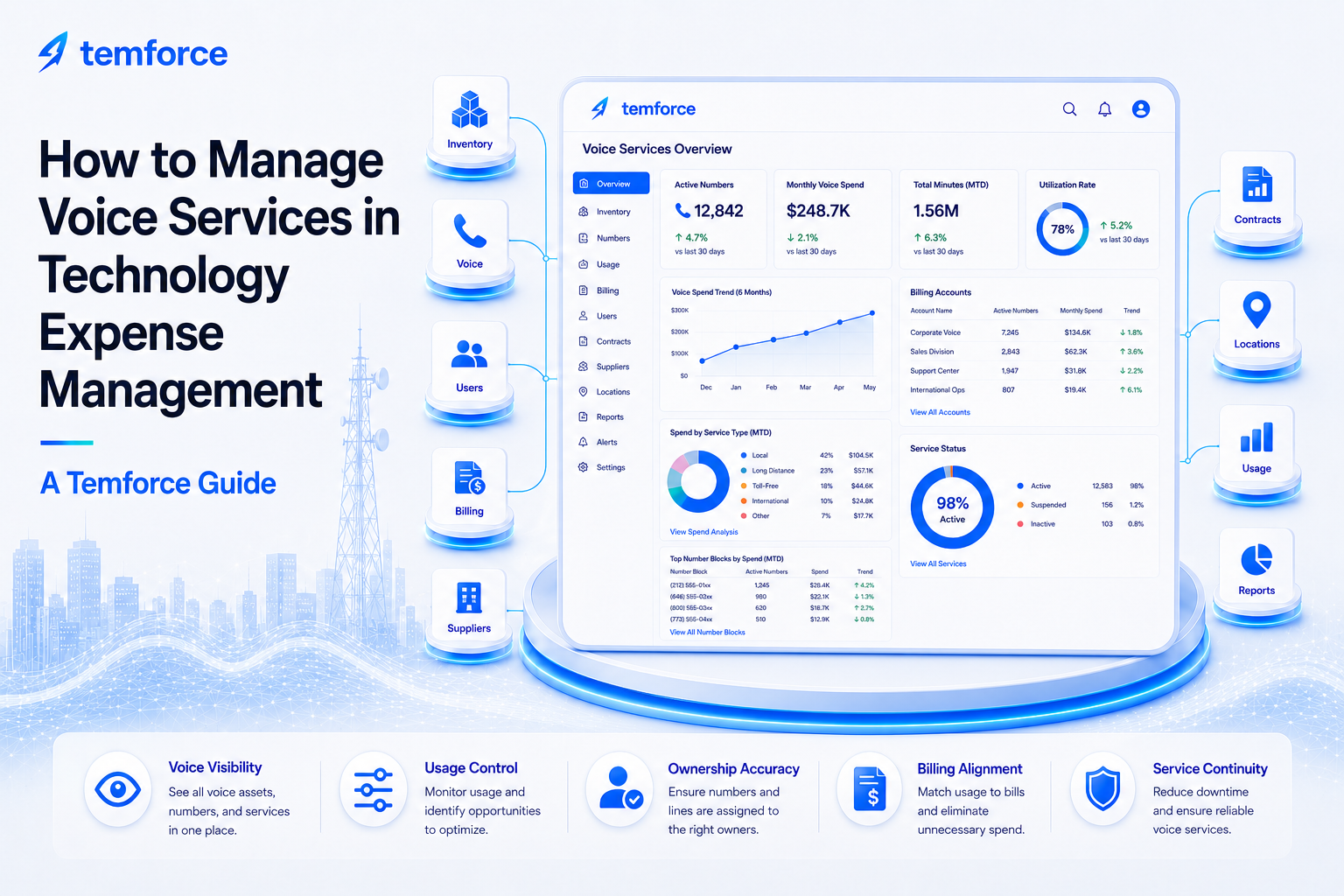
How to Manage Voice Services in Technology Expense Management
May 29, 2026
Cost Control
Voice services remain a critical part of technology expense management because phone numbers, users, call paths, suppliers, billing accounts, locations, contracts, invoices, and outages all need to stay connected. Without voice inventory control, organizations can lose track of what numbers exist, who owns them, what they cost, and whether they are still needed.
Voice management in TEM is the operating discipline of controlling numbers, services, users, locations, suppliers, billing accounts, call usage, contracts, and lifecycle status. It helps the business understand which voice services are active, who uses them, what they cost, how they are billed, and what needs to be changed or disconnected.
Voice spend is easiest to control when every number or service has a clear owner, location, supplier, billing account, service type, lifecycle status, and invoice connection. A phone number without ownership is not just a data gap. It is a recurring cost risk.
Why voice service management matters in TEM
Voice environments can become messy over time. Numbers are assigned, forwarded, ported, disconnected, reassigned, moved between locations, bundled into supplier accounts, or left active after users leave. Without a governed voice process, charges can continue long after the business need disappears.
A strong voice management process connects telecom inventory, invoice validation, supplier relationships, requests, outages, contracts, finance allocation, and reports.
Voice visibility connects phone numbers, extensions, users, locations, suppliers, service types, billing accounts, and cost centers.
Voice services need business owners, technical owners, finance owners, request approval paths, and lifecycle rules.
Voice controls help prevent orphaned numbers, inactive users, stale locations, unused lines, duplicate services, and unsupported charges.
Teams spend less time matching numbers to invoices, users, locations, suppliers, cost centers, and business purpose.
Voice is not just another telecom category. It is often where inventory, billing, user data, locations, suppliers, and usage intersect. When those records are connected, voice spend becomes easier to validate, manage, and reduce.
The voice services management model
A strong voice model should connect numbers and services to the operational records that explain ownership, usage, billing, contracts, locations, and lifecycle status.
| Voice Area | What to Track | Why It Matters | Risk If Missing |
|---|---|---|---|
| Phone number inventory | Phone number, extension, service type, user, department, owner, location, supplier, and lifecycle status. | Creates a reliable record of what numbers exist and who owns them. | Numbers may continue billing without a known user, owner, or business purpose. |
| Voice billing accounts | Supplier, invoice, billing account, account number, rate plan, recurring charge, usage charge, taxes, and fees. | Billing account structure affects how voice charges are validated and allocated. | Charges may be approved without being tied to active numbers or services. |
| Usage and activity | Call usage, traffic patterns, unused numbers, forwarding, voicemail, call paths, and inactive user indicators. | Usage helps identify waste, underused services, routing issues, and cleanup opportunities. | The business may keep paying for numbers or services that are not being used. |
| Location and site context | Service address, site code, local contact, region, business unit, E911 relevance, and physical or logical location. | Location context supports outage response, compliance review, service validation, and cost allocation. | Teams may not know where a number is used or who is impacted by a change. |
| Requests and MACD control | New number requests, disconnects, ownership changes, porting, location moves, routing changes, and supplier actions. | Requests keep the voice inventory current as numbers move, change, or disconnect. | Voice inventory drifts away from reality when changes are not governed. |
| Contracts and supplier context | Supplier contracts, rate cards, renewal dates, commitments, service terms, support contacts, and escalation paths. | Supplier and contract data support invoice validation, renewals, disputes, and outage response. | The organization may miss pricing errors, renewal risks, credits, or supplier accountability issues. |
How to manage voice services in a TEMOps operating model
Voice service management should be part of the recurring TEMOps operating rhythm. The goal is to keep voice records accurate, billable charges validated, and changes governed from request through invoice confirmation.
Build the voice inventory
Capture phone numbers, extensions, users, owners, locations, suppliers, billing accounts, service types, and lifecycle status.
Connect voice charges to invoices
Match recurring charges, usage charges, taxes, fees, credits, and billing account data to active voice records.
Review ownership and usage
Identify inactive users, unused numbers, orphaned services, stale departments, disconnected sites, and unclear business purpose.
Govern voice requests
Use request workflows to manage new numbers, moves, adds, changes, disconnects, porting, and ownership updates.
Track supplier actions
Document supplier tickets, disconnect confirmations, porting status, billing corrections, outage actions, and credit follow-up.
Confirm results through reporting
Use reports and dashboards to confirm voice inventory accuracy, invoice outcomes, savings, open tasks, and unresolved issues.
What voice service records should track
Voice service records should capture enough detail to support ownership, billing validation, request control, outage response, compliance, finance allocation, and cost reduction.
- Phone number, extension, service type, user, business owner, technical owner, department, and lifecycle status
- Supplier, billing account, invoice, account number, recurring charge, usage charge, taxes, fees, and credits
- Location, site code, service address, local contact, business unit, cost center, GL code, and allocation rule
- Rate plan, contract reference, renewal date, pricing terms, supplier support path, and escalation contact
- Usage activity, inactive user status, forwarding, voicemail, call path, device association, and number assignment status
- Request history, MACD activity, disconnect status, porting status, ownership changes, and supplier confirmations
- Outage history, service impact, ticket numbers, SLA exposure, credits requested, and credits received
- Reporting category, dashboard category, cleanup status, savings status, and next action
If a phone number or voice service appears on an invoice, it should have an owner, location, supplier, billing account, lifecycle status, and business purpose.
Common voice service management issues
Voice problems usually appear when phone numbers, users, billing accounts, suppliers, contracts, requests, and invoices are not connected.
Phone numbers may remain active after users leave, departments change, or services are no longer needed.
Supplier invoices may include recurring charges for numbers, features, or services that are not tied to active records.
Teams may not know which site, user, or business unit depends on a voice number or service.
Adds, disconnects, ownership changes, and porting events may happen without updating the voice inventory.
Supplier actions may be requested but not validated against the next invoice or tracked through completion.
Waste continues when reports do not show inactive users, unused numbers, duplicate services, or stale billing records.
Example scenario: inactive users with active phone numbers
A report shows several phone numbers assigned to users who are no longer active. In a weak process, those numbers may keep billing because no one owns the cleanup. In a stronger TEMOps process, the numbers are reviewed against inventory, invoices, request history, location data, supplier records, and business need.
Instead of asking, “Do we still use this number?” the business asks, “Who owns this number, where is it used, what supplier bills it, what charge will change, and how do we confirm the disconnect or reassignment?”
How Temforce helps with voice service management
Temforce helps organizations connect voice services to the inventory, invoice, request, supplier, outage, contract, finance, report, and dashboard records that keep voice spend controlled.
The goal is to move voice management away from scattered phone lists and supplier bills, and toward a governed TEMOps process with clear ownership, billing validation, lifecycle control, and measurable outcomes.
Connect phone numbers, users, locations, suppliers, billing accounts, contracts, cost centers, and lifecycle status.
Match voice charges to active records, expected rates, usage, supplier accounts, credits, disputes, and disconnect activity.
Track voice adds, changes, disconnects, ownership updates, supplier actions, savings outcomes, and unresolved cleanup work.
