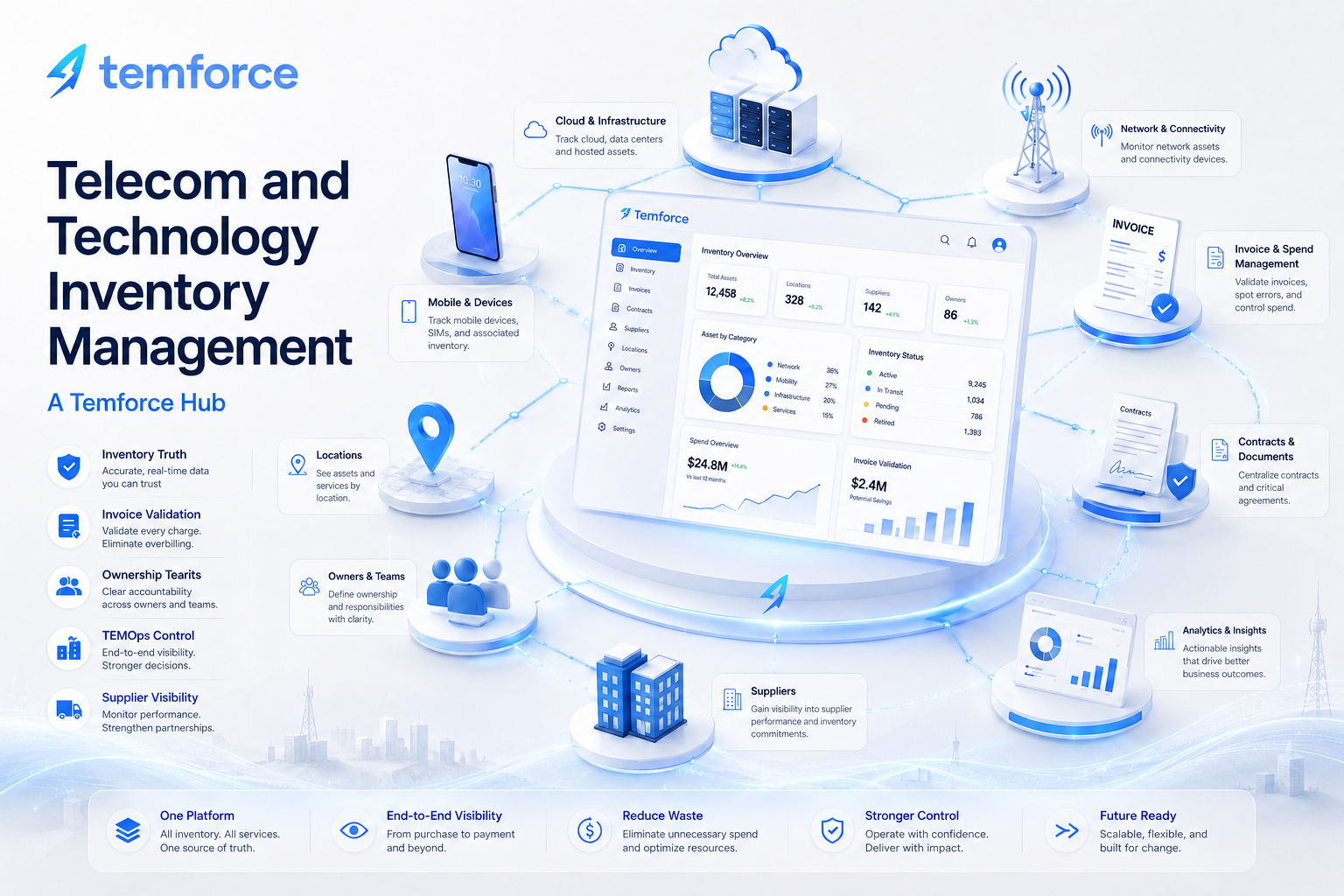
Telecom and Technology Inventory Management
May 26, 2026
Inventory
Inventory is the foundation of technology expense management. When your organization can trust what it owns, who owns it, what it costs, where it belongs, and whether it should still be active, invoice validation, supplier management, contract governance, reporting, and cost control all get stronger.
Telecom and technology inventory management is the process of organizing, validating, maintaining, and governing the services, assets, suppliers, billing accounts, users, locations, contracts, cost centers, and lifecycle status that drive recurring technology spend.
Inventory is the control layer. If the inventory is weak, invoice validation, supplier management, contract governance, reporting, and cost control all become harder to trust.
Why inventory management matters
Most technology expense problems do not begin with the invoice. They begin with unclear inventory. Services get ordered, employees leave, locations close, suppliers change billing, contracts renew, and recurring charges continue because no one has a trusted inventory to validate against.
An invoice shows what was billed. Inventory helps prove whether the charge is valid, assigned, approved, correctly priced, and still needed.
Services without clear owners become recurring risk. If no one owns a service, no one is accountable for validating or disconnecting it.
Structured inventory connects services to suppliers, contracts, users, locations, departments, cost centers, and lifecycle status.
Inventory truth is not just having a list of telecom services. It is having a trusted operating record that connects each service to ownership, billing, supplier context, location, cost center, lifecycle status, and business purpose. Structure is the enemy of waste. When inventory is clear, waste has fewer places to hide.
What a strong inventory should track
A useful telecom and technology inventory should include enough structure to support invoice validation, cost allocation, supplier management, reporting, cleanup, and ongoing governance.
| Inventory Area | Examples to Track | Why It Matters |
|---|---|---|
| Service and asset details | Service type, phone number, circuit ID, application, device, plan, feature, status | Shows what exists and whether it is active, inactive, disconnected, retired, or unknown. |
| Supplier and account data | Carrier, vendor, billing account, customer number, invoice source, supplier contact | Connects inventory to billing, support, disputes, and supplier governance. |
| Ownership and business context | Business owner, technical owner, assigned user, department, approver, cost center | Creates accountability for validation, changes, approvals, and disconnect decisions. |
| Location and user data | Service address, site, location code, assigned user, department, business unit | Helps identify services tied to closed locations, moved teams, or departed users. |
| Financial and contract context | Monthly charge, GL code, contract reference, renewal date, pricing notes, commitment | Supports invoice validation, renewal planning, cost allocation, and contract review. |
| Lifecycle status | Active, pending, disconnected, retired, under review, unknown, last reviewed date | Turns inventory into an operating tool instead of a static list. |
Start here: inventory management resources
Use this collection to move from messy inventory to a stronger TEMOps foundation. Each resource answers a specific search problem and points to a practical next step.
Learn the starting framework for building a structured telecom and technology inventory across services, suppliers, owners, locations, contracts, and cost centers.
Read the guideSee the core fields every technology inventory should include, including technology services, telecom services, applications, assets, suppliers, billing accounts, ownership, location, financial context, and lifecycle status.
See what to includeDownload the starter Excel template to begin organizing services, suppliers, billing accounts, owners, locations, cost centers, and cleanup opportunities.
Get the templateLearn what inventory data should be organized before invoice validation, including suppliers, accounts, owners, services, locations, cost centers, and lifecycle status.
See what to trackLearn why invoice validation depends on accurate inventory and why invoice review alone is not enough to confirm that charges are valid.
Read the articleUnderstand the difference between supplier billing data and internal inventory truth, and why confusing the two creates blind spots.
Compare the differenceLearn how to consolidate sources, standardize categories, identify missing owners, match invoices, and flag cleanup candidates.
Start cleanupSee how inaccurate inventory creates wasted spend, weak validation, late fees, poor allocation, supplier confusion, and contract risk.
Understand the costLearn why spreadsheets are useful for starting cleanup, but often break down when telecom and technology inventory becomes an operating process.
Learn when to scaleLearn how to keep inventory accurate through orders, disconnects, invoice exceptions, ownership changes, location updates, and renewals.
Maintain the inventoryRequest a Temforce review to identify inventory gaps, ownership issues, billing blind spots, lifecycle risk, and cleanup opportunities.
Request a reviewFind your inventory problem
Not every visitor is at the same stage. Use the path below to guide your next step.
“We do not know what to track.”
Start with the field checklist and template. You need a clean structure before inventory can support invoice validation or reporting.
“Our invoices include charges no one recognizes.”
Read the invoice validation and invoice data articles. The problem may not be the invoice alone. It may be missing inventory truth.
“Our spreadsheets are messy and conflicting.”
Start with the cleanup guide, then review the centralized inventory article to understand when spreadsheets stop being enough.
“We cleaned it up once, but it got messy again.”
Read the maintenance guide. Cleanup creates the baseline. Maintenance creates the control.
“We need help finding the gaps.”
Request an Inventory Truth Review so Temforce can help identify where ownership, billing, lifecycle, and structure gaps may be creating risk.
Example scenario: when inventory gaps become invoice waste
A company may see a recurring circuit charge every month and assume it is valid because it appears on the invoice. But if the inventory does not show the current location, business owner, cost center, contract reference, and lifecycle status, the team may not realize the circuit belongs to a closed office or a service that should have been disconnected months ago.
Instead of asking, “Did the supplier bill us?” the better question is, “Did the supplier bill us correctly for a service we still own, use, approve, and expect to pay for?”
How Temforce helps organizations build inventory truth
Temforce helps organizations move beyond fragmented spreadsheets and invoice-only visibility by creating a more structured way to manage telecom and technology inventory, suppliers, invoices, contracts, users, locations, cost centers, ownership, and lifecycle status.
For organizations building a modern TEMOps program, inventory is the place to start. Once the inventory is structured and trusted, every other part of technology expense management becomes easier to manage.
Centralize service, supplier, owner, location, cost center, and lifecycle context so the business can see what exists.
Strengthen invoice review by comparing billed charges against expected services, ownership, contract context, and status.
Build a cleaner foundation for supplier management, contract governance, reporting, cost allocation, and ongoing control.
