
TEM Strategy: How to Build a Stronger Operating Model for technology expense control.
A TEM strategy helps organizations move beyond reactive bill review by connecting inventory, invoices, suppliers, contracts, sourcing, workflows, reporting, savings proof, and governance into one repeatable operating model.
It is about creating the structure, ownership, supplier accountability, data confidence, reporting rhythm, and execution discipline needed to control technology expense over time.

What is a TEM strategy?
A TEM strategy defines how an organization will govern technology and telecom expense across data, workflows, suppliers, invoices, contracts, sourcing, reporting, and savings. It turns scattered activity into a structured operating model.
Clarify which suppliers, invoices, services, billing accounts, countries, business units, workflows, and expense categories are in scope for TEM control.
Assign ownership for inventory, approvals, invoice exceptions, supplier issues, disputes, contracts, renewals, reporting, and savings accountability.
Create a cadence for invoice review, supplier follow-up, reporting, savings tracking, renewal planning, workflow review, and leadership updates.
TEM strategy fails when it stays in the slide deck instead of becoming operating action.
Most organizations know they need better control. The hard part is connecting the strategy to the records, workflows, suppliers, invoices, contracts, reporting, and people responsible for execution.
Temforce helps turn strategy into a TEMOps operating model by connecting software, services, AI, reporting, approved APIs, and practical execution support.
A modern TEM strategy should be built around six operating pillars.
A strong strategy connects the work required to create visibility, control, governance, supplier accountability, financial proof, and continuous improvement.
Inventory strategy should define how services, assets, accounts, suppliers, owners, locations, contracts, and lifecycle status are maintained.
Invoice strategy should connect billing review to inventory, contracts, suppliers, approvals, exceptions, disputes, credits, and recoveries.
Supplier strategy should define escalation paths, issue tracking, correction requests, dispute management, renewal preparation, and performance visibility.
Contract strategy should manage renewal windows, pricing terms, obligations, amendments, commitments, sourcing triggers, and supplier leverage.
Workflow strategy should define how requests, approvals, MACD activity, disconnects, disputes, exceptions, renewals, and supplier tasks move forward.
Savings strategy should connect findings to actions, credits, recoveries, avoided cost, supplier corrections, disconnect savings, and recurring reductions.
Build strategy around the operating questions that determine TEM success.
The best TEM strategy is practical. It clarifies scope, ownership, data, workflow, supplier governance, financial measurement, and reporting before teams are buried in reactive work.
| Strategy area | Question to answer | Why it matters |
|---|---|---|
| Scope | Which suppliers, invoices, services, countries, business units, and workflows are included? | Scope determines data requirements, rollout priorities, staffing, reporting, and the first areas of measurable control. |
| Ownership | Who owns inventory accuracy, invoice approval, supplier follow-up, disputes, renewals, and savings proof? | Clear ownership prevents work from falling between Finance, IT, Procurement, AP, business owners, and suppliers. |
| Data | Which inventory, invoice, supplier, contract, owner, and cost fields are required to operate? | Data strategy helps teams focus on records that support validation, workflow, reporting, and decision-making. |
| Workflow | How will requests, approvals, disputes, exceptions, disconnects, renewals, and supplier actions move? | Workflow strategy turns TEM from a reporting exercise into visible operating execution. |
| Supplier governance | Which suppliers require regular review, escalation, contract tracking, issue management, or sourcing preparation? | Supplier strategy helps teams improve accountability, reduce risk, recover value, and prepare for negotiation. |
| Reporting | What does leadership need to see monthly or quarterly to trust the program? | Reporting strategy connects spend, exceptions, savings, issues, renewals, supplier work, and open actions to executive visibility. |
TEM strategy becomes real when it connects records, workflows, and financial outcomes.
Temforce helps teams operationalize strategy by connecting the data and action layers behind technology expense management.
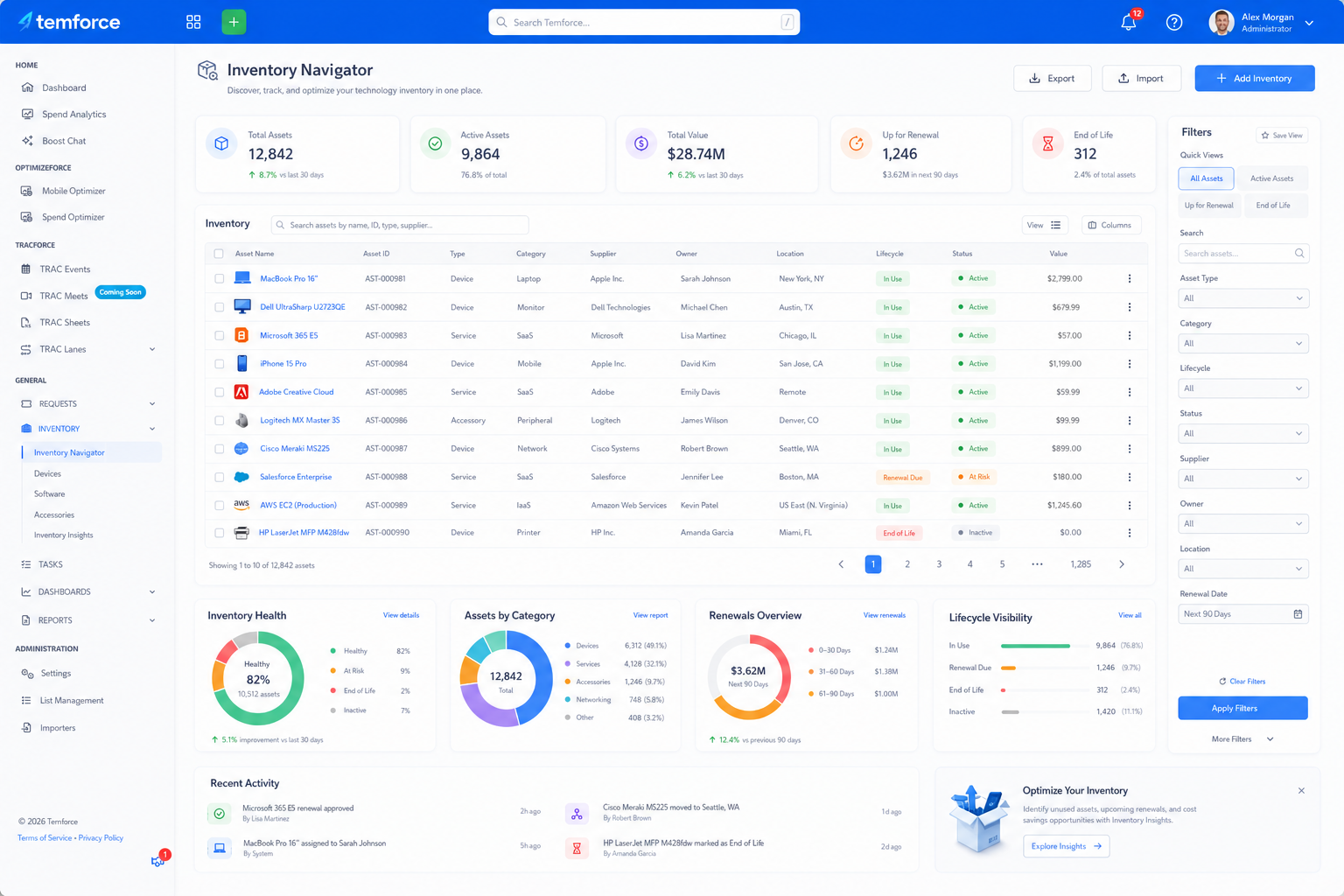
Build strategy on a trusted operating record.
Inventory strategy gives teams a controlled view of what exists, who owns it, who bills it, where it belongs, what contract governs it, and whether it should still be active.
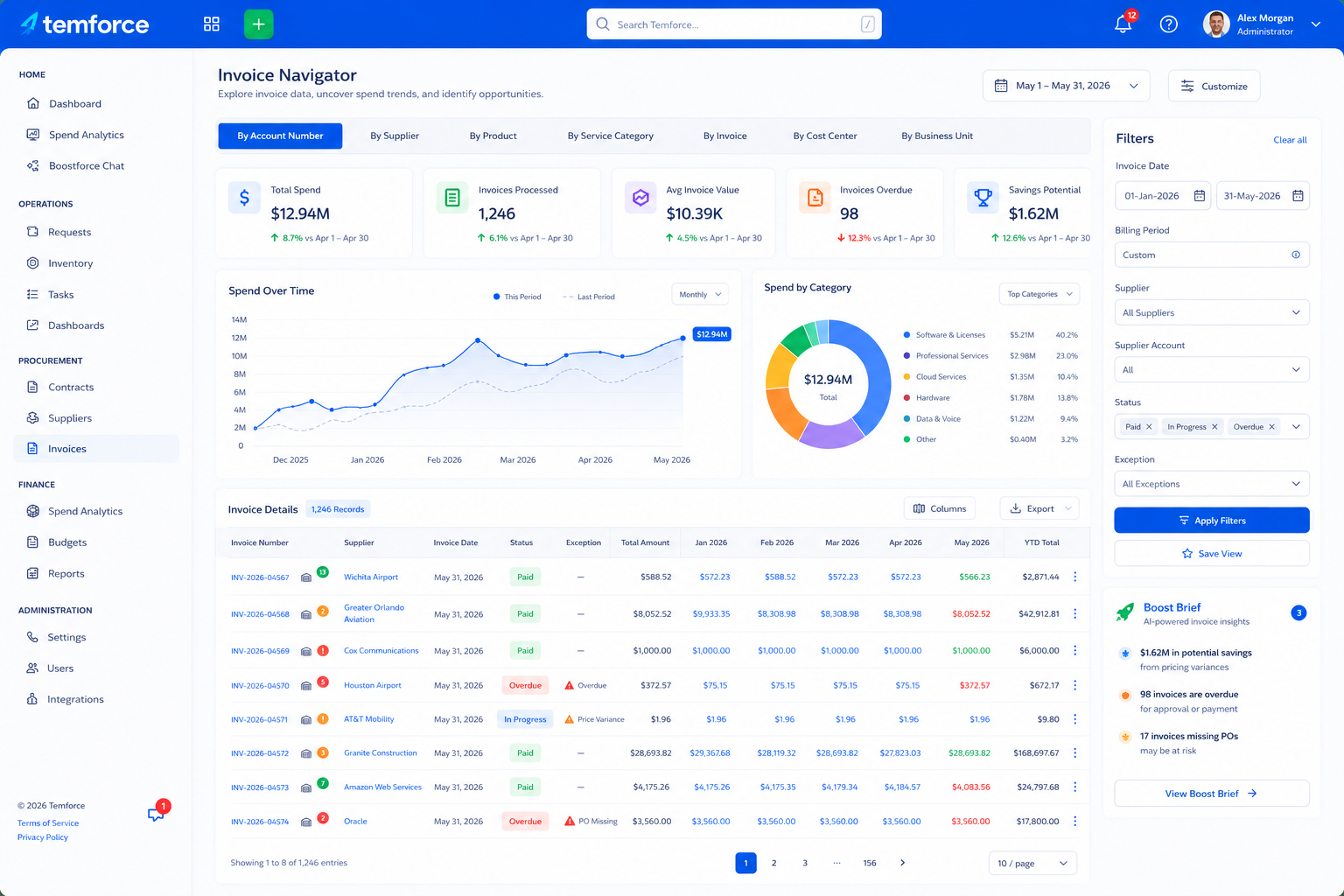
Connect invoice review to the controls that make it defensible.
Invoice strategy should define how billing will be received, validated, approved, disputed, allocated, reported, and connected to credits, recoveries, and supplier corrections.
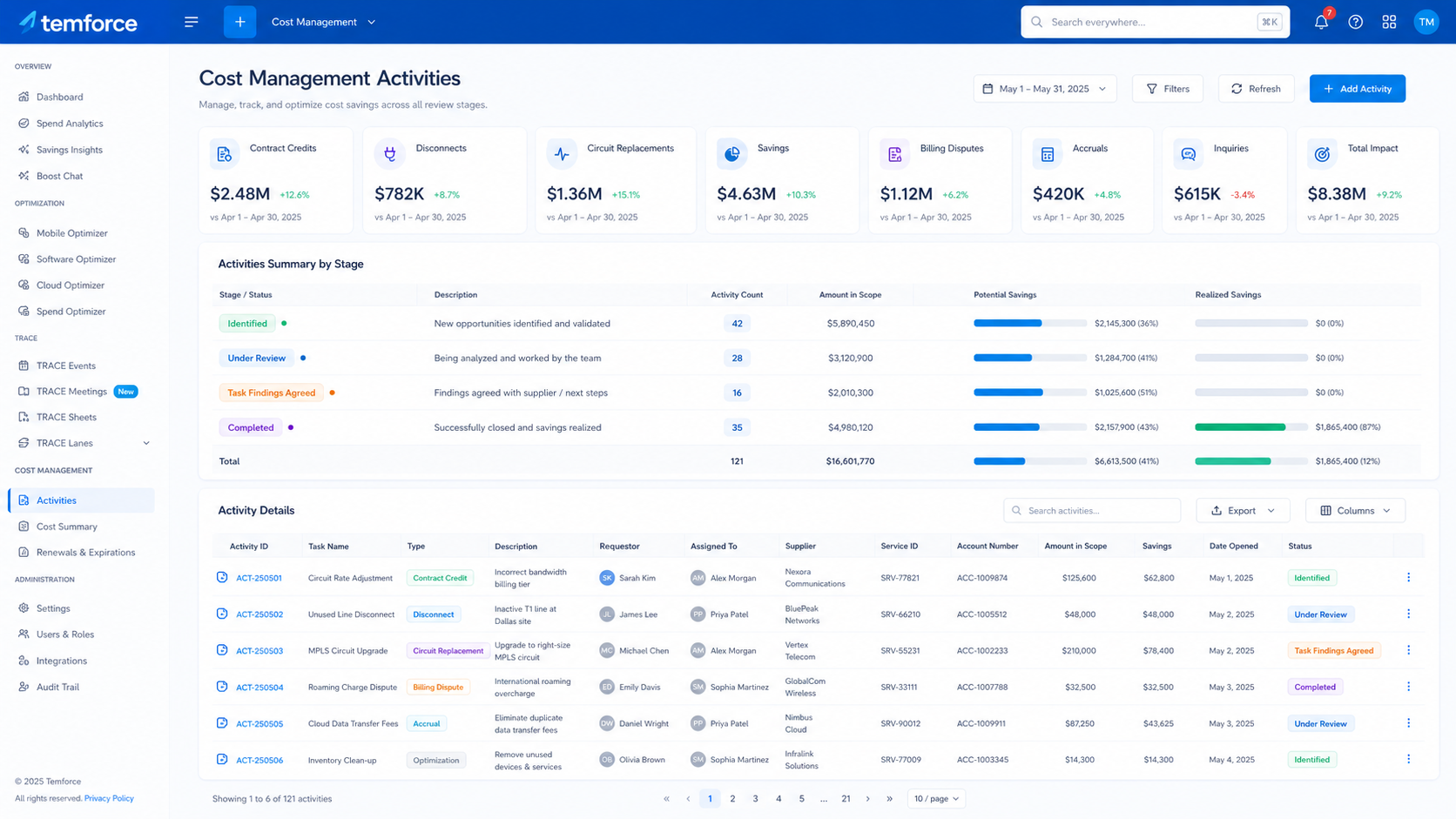
Track the path from finding to proven value.
Savings strategy should define how opportunities are identified, assigned, pursued, validated, reported, and connected to actual financial outcomes.
Continue the Technology Expense Management guide.
Move through the full guide path from TEM basics into benefits, readiness, solution design, strategy, platform maturity, ROI, and implementation planning.
What Is TEM?
Understand the meaning of Telecom Expense Management and how modern TEM evolved into a broader operating model for technology expense control.
TEM Benefits
See how TEM improves inventory accuracy, invoice control, supplier accountability, savings proof, governance, and executive visibility.
TEM Readiness
Learn what needs to be in place before launching, replacing, or improving a TEM program across data, owners, suppliers, and invoices.
TEM Solution
Understand what a TEM solution should manage and how software, services, workflows, reports, and operating support fit together.
TEM Strategy
Build a stronger operating model for telecom and technology expense control with governance, sourcing, supplier management, and savings proof.
Modern TEM Platform
See what a modern TEM platform should connect across software, services, inventory, invoices, suppliers, workflows, AI, reporting, and TEMOps execution.
TEM ROI
Measure TEM value through recoveries, credits, avoided cost, disconnect savings, supplier correction, time savings, and operating efficiency.
TEM Implementation Plan
See how to roll out TEM in a practical way by aligning inventory, invoices, suppliers, contracts, workflows, owners, and reporting.
TEM Strategy FAQ.
Use these answers to understand how to build a stronger Telecom Expense Management strategy and operating model.
What is a TEM strategy?
A TEM strategy defines how an organization will manage telecom and technology expenses across inventory, invoices, suppliers, contracts, workflows, sourcing, reporting, savings proof, and governance.
Why does TEM strategy matter?
TEM strategy matters because recurring telecom and technology spend is difficult to control without clear ownership, trusted data, workflow discipline, supplier accountability, contract visibility, and measurable savings proof.
What should be included in a TEM strategy?
A TEM strategy should include scope, inventory governance, invoice validation, supplier management, contract governance, sourcing triggers, workflow ownership, reporting cadence, savings measurement, and implementation planning.
How is TEM strategy different from TEM software?
TEM software provides the platform to manage data, workflows, invoices, suppliers, contracts, reporting, and savings. TEM strategy defines how the organization will use the platform, services, people, and process to create control.
How does Temforce support TEM strategy?
Temforce supports TEM strategy with SaaS software, managed services, inventory management, invoice control, supplier accountability, contract context, sourcing support, workflow execution, savings tracking, reporting, Boostforce AI, approved API access, and TEMOps learning.
Turn TEM strategy into TEMOps execution.
Temforce helps teams connect technology expense strategy to the operating work behind inventory truth, invoice control, supplier accountability, contract governance, sourcing support, workflow execution, savings proof, reporting, AI, and managed services.
