Why Active Billing Accounts Not Invoiced by Supplier Matter in Technology Expense Management
May 31, 2026
Cost Control
Active billing accounts not invoiced by supplier matter in technology expense management because missing invoices can hide accrual exposure, supplier delays, service activity, billing account errors, and finance close risk. When an account is active but no invoice appears, the organization needs a clear way to investigate what is missing and why.
A missing invoice is not always good news. It may mean a supplier is late, a billing account was changed, a service has moved, an account is dormant, a disconnect was successful, or finance needs an accrual. Active billing accounts not invoiced by supplier create an important control report because they show where expected financial activity is missing.
Every active billing account should have a clear invoicing expectation. If the account is active but no invoice arrives, the account should be reviewed for supplier status, inventory support, accrual exposure, payment impact, and lifecycle accuracy.
Why active billing accounts not invoiced matter in TEM
Supplier billing accounts can remain active even when invoice activity changes. Some accounts stop invoicing because services were disconnected. Others stop invoicing because the supplier changed the account structure, delayed a bill, consolidated accounts, moved charges elsewhere, or failed to generate an invoice.
The risk is that finance may assume there is no spend, while the business may still have active services, expected charges, or future supplier true-up exposure.
Compare active billing accounts to expected invoices, supplier history, inventory, account status, and prior-period spend.
Missing invoice exceptions need owners, supplier follow-up, finance review, accrual decisions, and lifecycle resolution.
Controls help identify delayed invoices, account consolidations, supplier billing gaps, and unexpected future charges.
Teams spend less time comparing supplier portals, invoice history, account lists, and finance accrual spreadsheets.
Active billing accounts not invoiced by supplier is a powerful exception report because it helps finance and TEM teams identify both risk and opportunity. A missing invoice can signal a cleanup win, but it can also signal a financial blind spot.
The active account not invoiced control model
A strong control model connects active billing account records to expected invoice activity, supplier follow-up, inventory status, accrual review, and financial reporting.
| Control Area | What to Track | Why It Matters | Risk If Missing |
|---|---|---|---|
| Billing account status | Supplier, account number, parent account, active status, owner, and lifecycle category. | Confirms whether the account is expected to generate invoices. | Old or changed accounts may be treated as active without business purpose. |
| Invoice expectation | Expected invoice date, billing cycle, prior-period invoice history, average spend, and last invoice received. | Shows whether the account is missing normal invoice activity. | Missing invoices may not be noticed until finance close or supplier follow-up. |
| Inventory support | Active services, locations, users, circuits, devices, subscriptions, and service lifecycle status. | Helps determine whether missing invoice activity makes sense. | Active services may exist without current billing visibility. |
| Supplier explanation | Supplier ticket, account consolidation, delayed invoice, migrated account, account closure, or portal status. | Supplier follow-up explains why invoice activity changed. | Teams may assume no invoice means no exposure. |
| Finance and accrual impact | Expected amount, accrual requirement, variance, cost center, GL code, owner, and close status. | Finance needs to know whether missing invoices affect the period. | Expense may be understated or future true-ups may surprise the business. |
| Resolution outcome | Confirmed closed, invoice received, accrual posted, account corrected, supplier issue resolved, or monitor next cycle. | Turns the exception into a controlled outcome. | The same missing invoice exception may repeat every month. |
How to manage active accounts not invoiced in a TEMOps operating model
Active account not invoiced reporting should be part of the recurring finance and invoice control cadence. The goal is to explain every active account with missing invoice activity.
Start with active billing accounts
Review the billing account tracker for accounts marked active, pending closure, under review, or expected to bill.
Compare against invoice activity
Match active accounts to current-period invoices, prior-period invoices, supplier invoice history, and expected billing cycles.
Validate inventory and service status
Check whether services, users, locations, subscriptions, circuits, devices, or assets still support the account.
Assign supplier follow-up
Route missing invoice exceptions to supplier owners, finance owners, or TEM owners for explanation and resolution.
Decide finance treatment
Determine whether the account needs an accrual, monitoring, closure, correction, or further supplier escalation.
Report the outcome
Show missing invoice count, expected exposure, accrual needs, confirmed closures, supplier delays, and unresolved exceptions.
What active account not invoiced reports should track
These reports should capture enough detail to explain missing invoice activity, support accrual decisions, and assign follow-up.
- Supplier, billing account number, parent account, account type, owner, lifecycle status, and active status
- Expected invoice date, expected billing cycle, last invoice date, last invoice amount, and prior-period average
- Current-period invoice status, missing invoice flag, received invoice flag, duplicate flag, and consolidated account flag
- Active services, locations, users, circuits, devices, subscriptions, and inventory support status
- Expected amount, accrual estimate, cost center, GL code, business unit, finance owner, and period impact
- Supplier ticket, supplier response, account migration note, billing delay note, and escalation status
- Resolution status, next action, task owner, due date, closure evidence, and monitor-next-cycle flag
- Dashboard category, exception aging, reporting period, and executive summary note
If a billing account is active but no invoice appears, the account should either be explained, accrued, corrected, closed, or monitored with a clear owner.
Common active account not invoiced issues
These issues usually appear when billing account tracking, invoice intake, inventory status, supplier records, and finance close are disconnected.
Supplier invoices may be delayed, moved, consolidated, or missing without a clear explanation.
Billing accounts may remain active in the tracker even after supplier closure, migration, or consolidation.
Inventory may show active services even though the supplier account stopped billing.
Missing invoices can create uncertainty around expected expense, accruals, and period close accuracy.
Teams may not know whether the supplier delayed the invoice, moved charges, closed an account, or made an error.
Leadership may see lower spend without understanding whether the decrease is real or temporary.
Example scenario: an active supplier account with no current invoice
A supplier account normally bills every month, but no invoice appears this period. The account is still active, and inventory still shows services tied to the billing account. In a weak process, the missing invoice may go unnoticed until finance close. In a stronger TEMOps process, the account is flagged, the expected amount is reviewed, supplier follow-up is assigned, and finance decides whether an accrual is needed.
Instead of asking, “Did spend go down?” the business asks, “Why did this active account stop invoicing, what services are still tied to it, and what financial exposure remains?”
How Temforce helps with active account not invoiced reporting
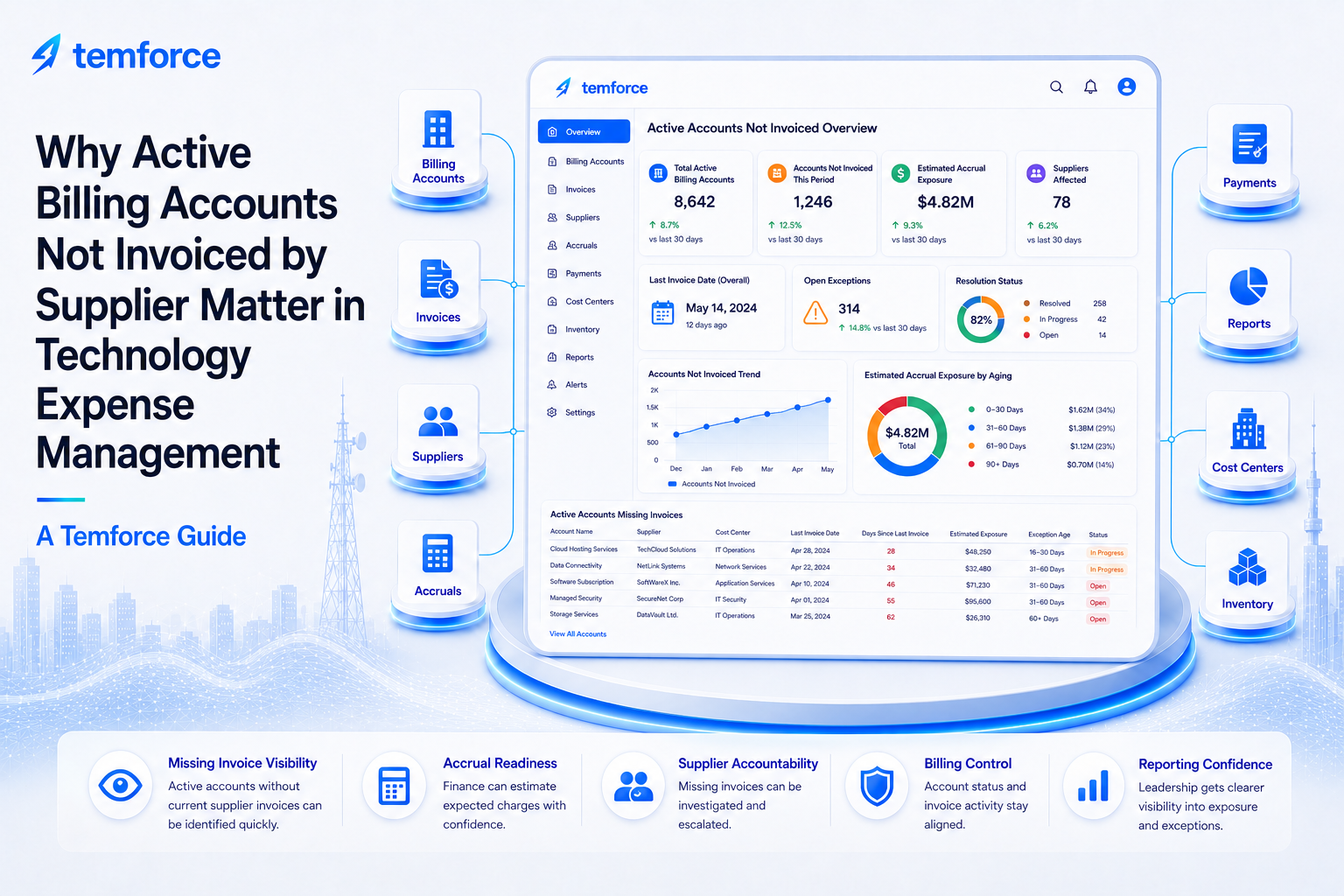
Temforce helps organizations connect active billing account reporting to invoice intake, supplier follow-up, inventory status, accrual review, payment control, cost centers, reports, and dashboards.
The goal is to move missing invoice investigation away from manual spreadsheet comparisons and toward a governed TEMOps process with clear visibility, ownership, accrual control, and reporting confidence.
Track active accounts, expected invoice activity, supplier status, account owners, inventory support, and lifecycle status.
Identify missing invoices, delayed supplier bills, consolidated accounts, accrual exposure, and open follow-up tasks.
Report missing invoice exposure, accrual recommendations, supplier explanations, account corrections, and close impact.
