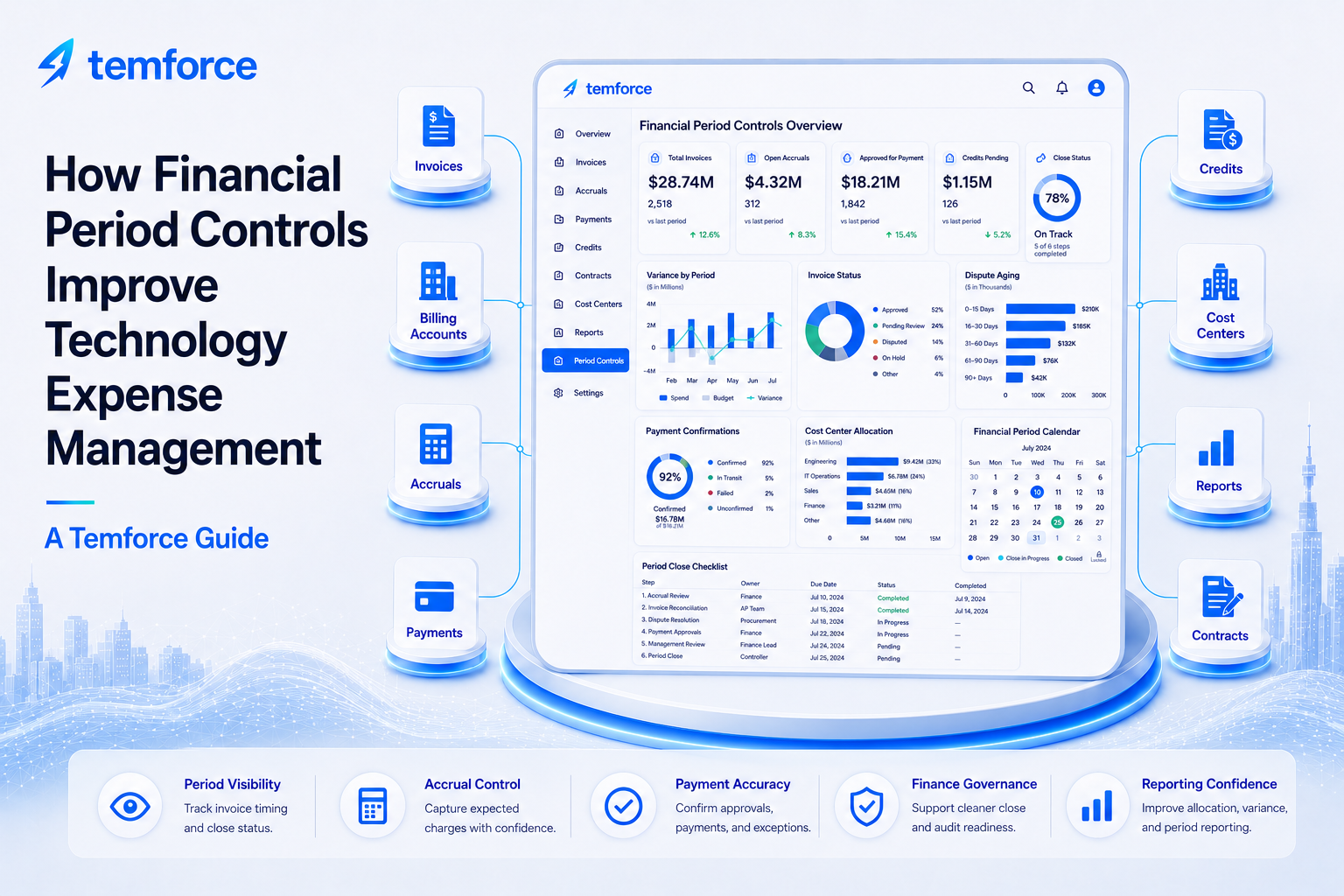
How Financial Period Controls Improve Technology Expense Management
May 30, 2026
Cost Control
Financial period controls improve technology expense management by helping organizations manage invoice timing, accruals, payment confirmation, credits, disputes, cost allocation, chargebacks, and reporting within a clear monthly close process. When period controls are missing, TEM data may be accurate operationally but still difficult for finance to trust.
A TEM program does not end when invoices are reviewed. Finance still needs to know which invoices belong to the period, which bills are missing, what should be accrued, what charges are disputed, what credits are expected, what has been paid, and how costs should be allocated.
Financial period control turns TEM from a bill review activity into a finance-ready operating process. Every month should have a clear view of invoice status, accrual exposure, payment confirmation, cost allocation, disputes, credits, and reporting outcomes.
Why financial period controls matter in TEM
Telecom and technology invoices arrive across different dates, formats, suppliers, billing accounts, currencies, service periods, and payment workflows. Without financial period controls, teams can approve invoices late, miss accruals, duplicate charges, delay credits, misallocate spend, or report incomplete numbers.
Strong period controls help TEM, finance, accounting, procurement, and business owners work from a shared monthly view of what has been received, what is expected, what has changed, and what still needs action.
Period controls show invoice status, missing bills, expected charges, accrual needs, payments, credits, disputes, and variances.
Every invoice, accrual, dispute, credit, allocation issue, and payment confirmation needs an owner and resolution path.
Month-end controls reduce the risk of missing invoices, stale accruals, unsupported payments, and unexplained variances.
Finance and TEM teams spend less time chasing invoice status, supplier updates, account owners, and allocation answers.
The strongest TEM programs treat financial period control as an operating rhythm. Inventory, invoices, billing accounts, disputes, credits, cost centers, payment confirmations, and reports should all support a cleaner monthly close.
The financial period control model
A strong period control model connects invoice operations to finance close activities so teams can explain what happened in the period and what still needs follow-up.
| Period Control Area | What to Track | Why It Matters | Risk If Missing |
|---|---|---|---|
| Invoice receipt status | Expected invoices, received invoices, missing invoices, billing periods, supplier, account, and due dates. | Finance needs to know which invoices are available and which invoices are still outstanding. | Missing invoices can create accrual gaps, late approvals, and incomplete spend reporting. |
| Invoice approval status | Approved, pending review, disputed, rejected, corrected, escalated, or waiting on owner approval. | Approval status helps finance understand what can move forward for payment. | Invoices may be paid late or approved without proper validation. |
| Accrual exposure | Expected charges, prior-period averages, missing invoices, open services, contract commitments, and supplier trends. | Accrual controls help finance estimate costs when invoices have not arrived. | Expense may be understated or overstated during close. |
| Payment confirmation | Payment file status, payment date, amount paid, supplier reference, payment exception, and posting confirmation. | Payment tracking helps confirm invoices moved from approval to actual payment. | Teams may lose visibility after approval and struggle to answer supplier payment questions. |
| Disputes and credits | Disputed amounts, credit requests, credit expected date, credit received, supplier response, and resolution status. | Disputes and credits affect current and future period reporting. | Credits may be missed, delayed, or reported before they are actually received. |
| Cost allocation and chargebacks | Cost centers, GL codes, allocation rules, business units, owners, chargeback files, and exception status. | Period reporting depends on accurate allocation of approved and accrued spend. | Charges may be posted to the wrong team, budget, project, or department. |
How to manage financial period controls in a TEMOps operating model
Financial period control should be part of the recurring TEMOps cadence. The goal is to know what has happened, what has not happened, what is expected, and what needs action before the period closes.
Define the period calendar
Establish invoice receipt windows, review deadlines, approval timing, payment cutoffs, accrual deadlines, and reporting dates.
Track expected invoices
Use supplier and billing account history to identify which invoices should arrive and which invoices are missing.
Validate invoices before approval
Review invoice charges against inventory, contracts, billing accounts, credits, cost centers, and expected spend.
Capture accrual requirements
Identify missing invoices, expected charges, supplier trends, unresolved disputes, and known commitments that may require accrual.
Confirm payments and credits
Track payment confirmations, credit receipts, dispute outcomes, supplier responses, and invoice corrections.
Report period outcomes
Show approved spend, accrued spend, open invoices, disputes, credits, payment status, cost center exceptions, and variance explanations.
What financial period controls should track
Period control records should capture enough detail to support finance close, invoice approval, accruals, payment tracking, allocation, and reporting.
- Financial period, invoice period, supplier, billing account, invoice number, invoice date, due date, and received date
- Invoice status, approval status, dispute status, correction status, payment status, and close status
- Expected invoice amount, actual invoice amount, recurring charges, usage charges, taxes, fees, credits, and variances
- Accrual amount, accrual reason, missing invoice flag, prior-period reference, reversal status, and finance owner
- Cost center, GL code, business unit, department, owner, allocation rule, and chargeback status
- Disputed amount, credit requested, credit received, supplier response, supplier ticket, and resolution date
- Payment file status, payment confirmation, payment date, posting reference, and supplier payment inquiry status
- Reporting category, dashboard status, exception aging, close blocker, and next action
If finance cannot tell whether an invoice is received, approved, accrued, paid, disputed, credited, or allocated, the period is not fully controlled.
Common financial period control issues
Period control issues usually appear when invoice operations and finance close activities are managed in disconnected tools, inboxes, spreadsheets, or supplier portals.
Finance may not know which supplier invoices are missing until close is already at risk.
Invoice reviews, owner approvals, disputes, and corrections can delay payment if the status is not tracked clearly.
Missing invoices, open services, supplier delays, or unresolved usage charges may create incomplete accruals.
Supplier credits can be discussed, promised, or requested without being validated against an actual invoice.
Missing owners, stale cost centers, invalid GL codes, or unclear allocation rules can weaken period reporting.
Reports lose credibility when invoices, accruals, disputes, payments, and credits are not tied to the same period view.
Example scenario: a missing invoice during month-end close
A supplier invoice normally arrives every month, but it has not been received before close. In a weak process, finance may not notice until reporting is already incomplete. In a stronger TEMOps process, the expected invoice is flagged, the billing account is reviewed, prior-period charges are used to support an accrual estimate, and the missing invoice remains open until received and reconciled.
Instead of asking, “Did the invoice come in?” the business asks, “Was this invoice expected, what amount should be accrued, who owns the follow-up, what supplier account is affected, and how will we reconcile it when it arrives?”
How Temforce helps with financial period controls
Temforce helps organizations connect financial period controls to the invoice, billing account, inventory, supplier, contract, payment, dispute, credit, cost center, report, and dashboard records that support TEM finance governance.
The goal is to move financial close support away from scattered status checks and toward a governed TEMOps process with clear invoice timing, accrual visibility, payment tracking, credit validation, and period reporting.
Track expected invoices, missing invoices, received invoices, accrual needs, invoice status, and period close blockers.
Support payment confirmation, supplier inquiries, disputed charges, credit tracking, correction status, and invoice reconciliation.
Connect period activity to cost centers, GL codes, allocations, chargebacks, variances, dashboards, and close reporting.
