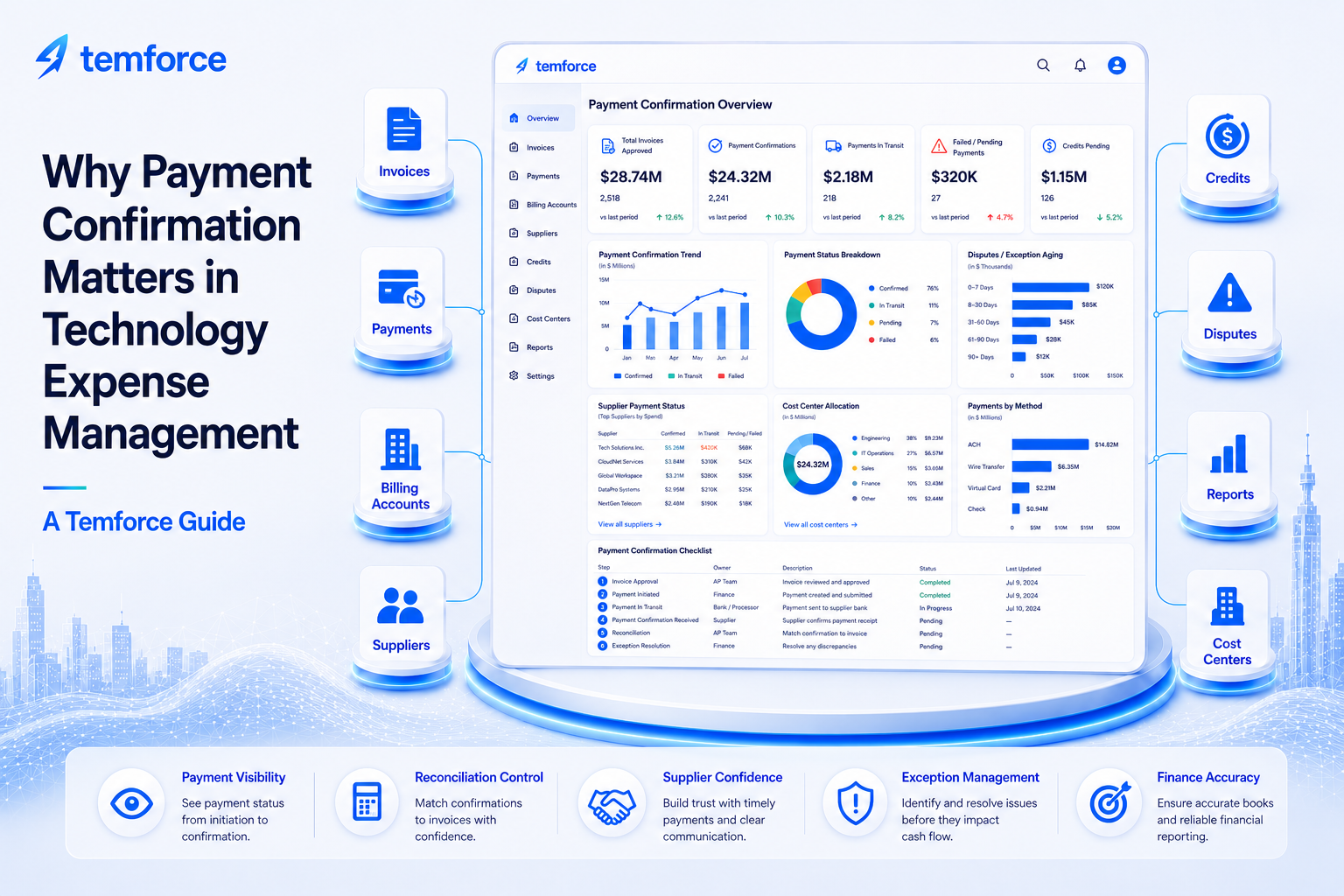
Why Payment Confirmation Matters in Technology Expense Management
May 30, 2026
Cost Control
Payment confirmation matters in technology expense management because invoice approval is not the same as payment certainty. TEM teams, finance, suppliers, and business owners need to know which invoices were approved, which payments were issued, which suppliers were paid, which items failed, and which disputes, credits, or payment exceptions still need follow-up.
A TEM process should not lose visibility after invoice approval. Payment confirmation is the finance control that proves whether approved technology invoices actually moved through payment, posted correctly, and remained aligned to supplier balances, disputes, credits, billing accounts, and reporting.
Invoice approval answers, “Can this be paid?” Payment confirmation answers, “Was this paid correctly, to the right supplier, for the right amount, in the right period, with the right exceptions tracked?”
Why payment confirmation matters in TEM
Technology invoices often move through multiple systems before payment. TEM may validate the invoice, finance may approve it, accounting may release payment, treasury may issue the file, and the supplier may apply funds to an account. Any break in that chain can create supplier escalations, late fees, service interruption risk, duplicate work, or inaccurate reporting.
Strong payment confirmation gives teams a clear view of the final payment status after invoice review, approval, dispute resolution, and close activity.
Payment confirmation connects invoices, suppliers, billing accounts, payment dates, paid amounts, and posting references.
Payment issues need owners, status, exception reasons, supplier follow-up, finance review, and resolution tracking.
Confirmation helps catch missed payments, duplicate payments, incorrect amounts, unapplied payments, and aging supplier balances.
Teams spend less time researching whether an invoice was approved, paid, held, rejected, disputed, credited, or short-paid.
Payment confirmation is where invoice validation becomes finance execution. It gives the organization confidence that approved invoices did not simply leave TEM, but were completed through payment, supplier application, exception handling, and reporting.
The payment confirmation model
A strong payment confirmation model connects invoice approvals to payment outcomes, supplier account status, credit tracking, dispute handling, and financial reporting.
| Payment Area | What to Track | Why It Matters | Risk If Missing |
|---|---|---|---|
| Payment file status | Payment batch, payment file, approved invoices, release date, amount, supplier, and payment method. | Shows whether approved invoices were included in payment processing. | Invoices may be approved but never included in a released payment file. |
| Supplier payment application | Supplier reference, remittance details, account number, invoice number, applied amount, and supplier confirmation. | Confirms that the supplier applied payment to the correct account and invoice. | Suppliers may treat invoices as unpaid even after payment was issued. |
| Payment exceptions | Rejected payments, short pays, duplicate payments, partial payments, holds, bank issues, and unapplied cash. | Exceptions need fast ownership because they can affect supplier balances and service continuity. | Payment issues may become late fees, escalations, service holds, or supplier disputes. |
| Disputes and credits | Disputed amounts, approved holdbacks, expected credits, received credits, rejected charges, and remaining balances. | Payment decisions should reflect disputes and credits accurately. | The organization may overpay, underpay, or lose track of credit recovery. |
| Finance coding | Cost center, GL code, business unit, allocation rule, chargeback status, and posting reference. | Payment confirmation supports accurate financial posting and downstream reporting. | Paid spend may be difficult to reconcile to allocation, budget, or reporting views. |
| Reporting and reconciliation | Paid, unpaid, approved, held, disputed, credited, failed, and reconciled status by supplier and period. | Reporting shows whether the invoice-to-payment cycle is complete. | Leadership may see incomplete spend, unresolved exceptions, or inaccurate payment status. |
How to manage payment confirmations in a TEMOps operating model
Payment confirmation should be part of the monthly TEMOps cadence. The goal is to ensure validated invoices are approved, paid, applied, reconciled, and reported with clear exception handling.
Start with approved invoices
Identify invoices approved for payment, including supplier, billing account, invoice number, amount, due date, and approval status.
Import or capture payment confirmation
Bring in payment file status, payment date, paid amount, payment reference, remittance data, and posting details.
Match payments to invoices
Reconcile payment confirmation against approved invoices, supplier accounts, billing accounts, and expected amounts.
Identify exceptions
Flag unpaid invoices, short-paid invoices, duplicate payments, rejected payments, held invoices, and unapplied supplier payments.
Assign follow-up tasks
Route exceptions to finance, AP, suppliers, TEM owners, or business owners with due dates and resolution tracking.
Report completion
Show paid, unpaid, disputed, credited, held, failed, and reconciled status by supplier, billing account, cost center, and period.
What payment confirmation records should track
Payment confirmation records should capture enough detail to support invoice reconciliation, supplier response, finance posting, auditability, and monthly reporting.
- Supplier, billing account, invoice number, invoice date, due date, approved amount, and approval status
- Payment batch, payment file, payment method, payment date, payment amount, and remittance reference
- Paid status, unpaid status, short-pay status, duplicate status, rejected status, hold status, and reconciled status
- Supplier confirmation, supplier applied date, supplier account reference, and unapplied payment status
- Disputed amount, credit expected, credit received, holdback amount, and remaining balance
- Cost center, GL code, business unit, allocation rule, chargeback status, and finance posting reference
- Exception owner, next action, due date, resolution note, and closure evidence
- Reporting period, dashboard status, payment aging, supplier aging, and period close impact
If an invoice was approved, the TEM process should be able to show whether it was paid, when it was paid, how much was paid, where it was applied, and what exceptions remain open.
Common payment confirmation issues
Payment confirmation issues usually appear when invoice approval, AP payment files, supplier portals, payment status, and TEM reporting are disconnected.
Teams may assume an approved invoice was paid even though it was held, rejected, missed, or excluded from the payment file.
Suppliers may show an unpaid balance because a payment was misapplied, short-paid, delayed, or missing remittance detail.
Expected credits may be discussed or approved but not reflected in the payment outcome or invoice history.
Failed payments, missing payments, duplicate payments, and holds need ownership before they become supplier escalations.
Without payment confirmation, finance may struggle to connect invoice approval, payment posting, allocation, and reporting.
Dashboards lose value when invoices are shown as approved but not connected to payment confirmation and reconciliation status.
Example scenario: an approved invoice that supplier says is unpaid
A supplier escalates an unpaid balance for an invoice the business believes was approved. In a weak process, teams search email, AP systems, payment files, supplier portals, and spreadsheets to determine what happened. In a stronger TEMOps process, the invoice approval, payment batch, payment date, remittance reference, billing account, supplier application status, and exception owner are connected.
Instead of asking, “Was this invoice approved?” the business asks, “Was it paid, was it applied correctly, was anything held or disputed, and who owns the open exception?”
How Temforce helps with payment confirmation
Temforce helps organizations connect payment confirmations to the invoice, supplier, billing account, dispute, credit, finance, cost center, report, and dashboard records that support stronger TEM payment control.
The goal is to move payment confirmation away from scattered AP status checks and toward a governed TEMOps process with clear payment visibility, exception ownership, supplier accountability, and reporting confidence.
Connect approved invoices to payment files, payment dates, remittance references, supplier accounts, and paid status.
Track unpaid invoices, rejected payments, duplicate payments, partial payments, holdbacks, supplier questions, and unapplied payments.
Connect payment status to cost centers, GL codes, disputes, credits, chargebacks, reporting periods, and dashboard views.
