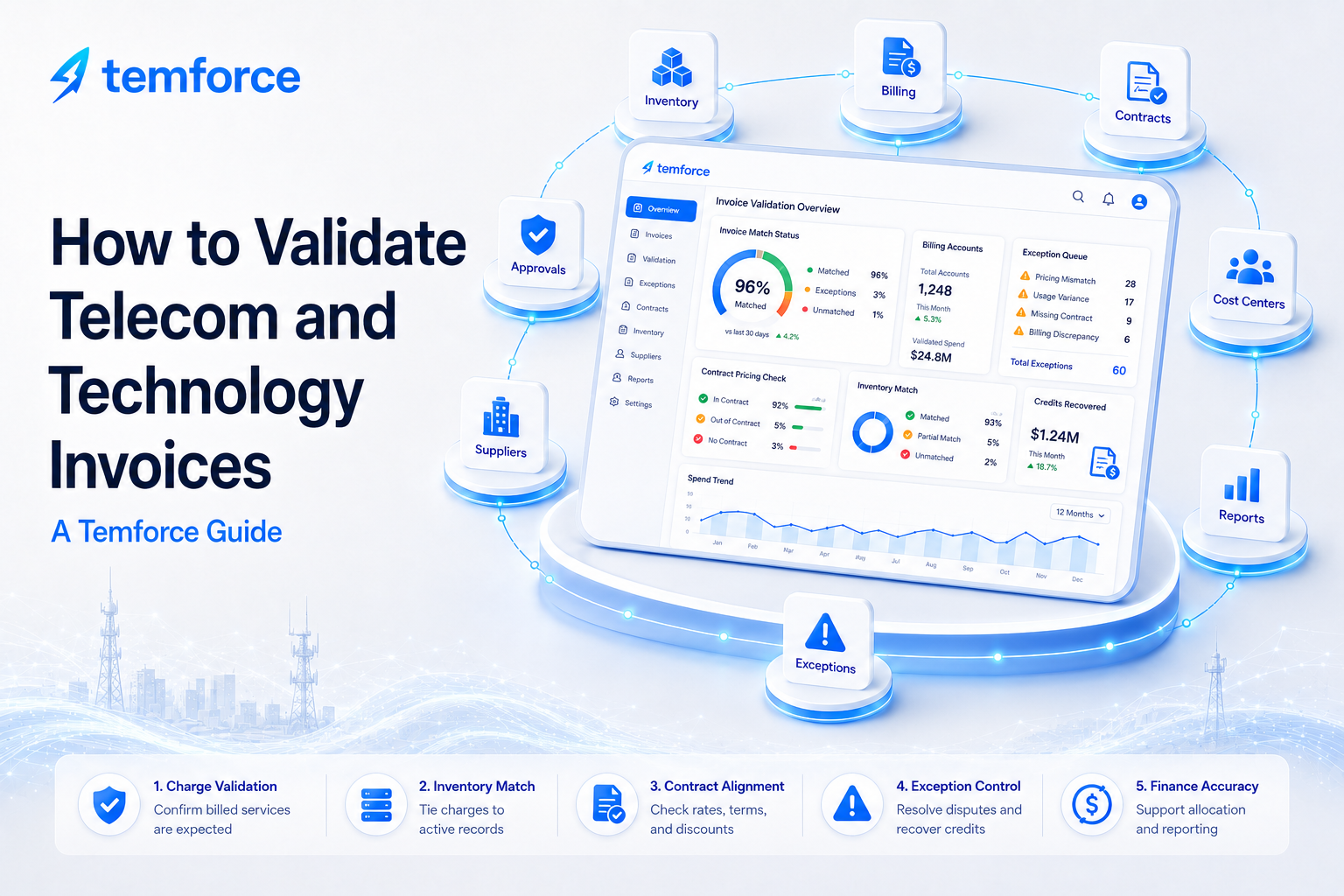
How to Validate Telecom and Technology Invoices
May 28, 2026
Inventory
Telecom and technology invoice validation is the process of confirming that every billed charge is expected, approved, active, correctly priced, assigned to the right owner, tied to the right supplier, and aligned to the inventory, contract, billing account, and cost center records that support it.
Invoice validation is not just checking whether a supplier sent a bill. It is the operating discipline of comparing invoice charges against what the business actually owns, uses, approved, contracted, allocated, and expects to pay.
A telecom or technology invoice cannot be validated in isolation. It must be validated against inventory truth, request history, supplier records, contract terms, cost centers, ownership, lifecycle status, and expected billing behavior.
Why invoice validation matters
Most recurring technology spend does not fail all at once. It drifts through small errors that repeat every month. A disconnected service keeps billing. A supplier rate changes without context. A charge moves to the wrong cost center. A contract discount is missed. A request is completed, but the invoice does not reflect the change.
A strong invoice validation process gives the business a structured way to find those issues before they become accepted spend.
Invoice validation connects billed charges to inventory, suppliers, accounts, services, owners, locations, and cost centers.
Exceptions, disputes, approvals, credits, missing owners, and billing changes need a repeatable workflow and clear accountability.
Validating invoices against inventory and contracts helps stop inactive, duplicate, mispriced, or unsupported charges from continuing.
When invoice validation is structured, teams spend less time hunting through spreadsheets, emails, supplier portals, and old approvals.
Invoice validation is where inventory truth becomes financial control. If the invoice team cannot connect a charge to an active service, owner, supplier, contract, cost center, and request history, the business is not validating the invoice. It is approving a bill with limited context.
The invoice validation model
A reliable invoice validation process should test each charge against several operating records. The goal is not only to find mistakes. The goal is to understand why the mistake happened and prevent it from repeating.
| Validation Area | What to Check | Why It Matters | Common Issue Found |
|---|---|---|---|
| Inventory match | Confirm the billed service exists in inventory and is active. | Inventory confirms whether the organization recognizes the service. | Charges for unknown, stale, inactive, or disconnected services. |
| Owner and location | Confirm the service has a valid owner, department, location, and business purpose. | Ownership helps determine whether the charge should still be paid. | Charges with no owner, wrong location, or unclear business need. |
| Billing account | Confirm the supplier account, billing account, BAN, or customer number is expected. | Billing account structure affects validation, allocation, disputes, and reporting. | Charges appearing on the wrong account or under an unmanaged account. |
| Contract and pricing | Compare rate, discount, term, commitment, feature, plan, and service type against contract expectations. | Contract context helps verify whether the supplier charged the correct amount. | Missing discounts, incorrect rates, wrong plans, or unapproved changes. |
| Request and MACD history | Check whether a move, add, change, disconnect, or ownership update explains the invoice change. | Request history helps explain new charges, removed charges, credits, and billing changes. | Requests completed without correct billing impact or inventory update. |
| Finance allocation | Confirm the charge maps to the correct cost center, GL code, department, project, or business unit. | Finance needs accurate allocation to support chargeback, accrual, and reporting. | Charges assigned to the wrong cost center or unassigned spend. |
| Exception and credit tracking | Track disputes, billing errors, credits, refunds, supplier follow-ups, and resolution status. | Validation is incomplete if exceptions are found but not resolved. | Credits promised but not received, disputes aging without closure. |
How to validate telecom and technology invoices
A strong invoice validation workflow should move from intake to matching, exception review, resolution, and operating improvement.
Collect the invoice and billing account data
Capture the supplier, invoice number, billing account, invoice period, service details, total charges, taxes, fees, credits, and recurring charges.
Match charges to inventory
Compare each billed service or charge to inventory records, including service ID, location, owner, supplier, billing account, lifecycle status, and expected cost.
Validate against requests and lifecycle changes
Review recent moves, adds, changes, disconnects, activations, ownership changes, supplier updates, and pending requests that may explain invoice movement.
Check contract and pricing expectations
Compare charges to contracted rates, discounts, plans, terms, renewals, commitments, features, and supplier pricing expectations.
Confirm finance allocation
Validate cost center, department, GL code, project code, business unit, owner, and chargeback logic before approving payment or allocation.
Resolve exceptions and track credits
Assign disputes, supplier follow-ups, missing inventory updates, credits, billing corrections, approvals, and cleanup actions to the right owner.
Update the operating records
Use invoice findings to improve inventory, request workflows, supplier records, contracts, finance allocation, reports, and dashboards.
What invoice validation should track
Invoice validation should capture enough information to support payment confidence, exception resolution, financial allocation, supplier accountability, and ongoing operating control.
- Supplier name, billing account, invoice number, invoice date, invoice period, and payment status
- Service ID, circuit ID, phone number, subscription ID, device ID, asset ID, application, or other service identifier
- Inventory match status, lifecycle status, owner, location, department, business unit, and cost center
- Recurring charges, usage charges, one-time charges, taxes, surcharges, credits, fees, and adjustments
- Expected monthly charge, prior month charge, contract rate, discount, plan, feature, and pricing basis
- Recent request, move, add, change, disconnect, renewal, or supplier action that explains charge movement
- Exception type, dispute owner, supplier follow-up, credit expectation, resolution date, and final outcome
- Approved amount, rejected amount, recovered amount, avoided cost, and reporting classification
If a charge cannot be connected to an active inventory record, valid owner, expected supplier account, correct cost center, and approved business need, it should be treated as an exception until the business can confirm it.
Common invoice validation issues
The same types of invoice issues tend to repeat when inventory, requests, contracts, suppliers, and finance data are not connected.
A service appears on the invoice, but there is no matching inventory record, owner, location, or business justification.
A disconnect was requested or expected, but the supplier continues to bill and no credit has been confirmed.
The billed rate does not match the contract, renewal, pricing schedule, or agreed supplier terms.
The charge is valid, but the cost center, GL code, department, owner, or allocation path is wrong.
A request was completed, but the invoice does not reflect the approved change, disconnect, credit, upgrade, or downgrade.
The supplier acknowledged an issue, but the credit, correction, or billing adjustment has not appeared on the invoice.
Example scenario: validating a recurring network charge
A supplier invoice includes a recurring network charge for a location that recently moved. In a weak process, the charge may be approved because it looks familiar. In a stronger TEMOps process, the invoice team checks the charge against inventory, the move request, location records, billing account, supplier confirmation, contract rate, cost center, and lifecycle status.
Instead of asking, “Is this supplier invoice close to what we usually pay?” the business asks, “Is every charge valid, expected, active, correctly priced, properly owned, accurately allocated, and supported by inventory and request history?”
How Temforce helps with invoice validation
Temforce helps organizations connect invoice validation to the operating records that determine whether a charge should be paid, questioned, allocated, disputed, corrected, or removed.
The goal is to move invoice validation away from manual review and toward a governed TEMOps process where inventory, requests, suppliers, contracts, finance, reports, and dashboards work together.
Match invoice charges to services, suppliers, billing accounts, owners, locations, cost centers, contracts, and lifecycle status.
Track disputes, missing credits, supplier corrections, invoice exceptions, approvals, and cleanup actions through assigned work.
Support cost allocation, billing account tracking, spend analytics, invoice batch reporting, accruals, and operating visibility.
