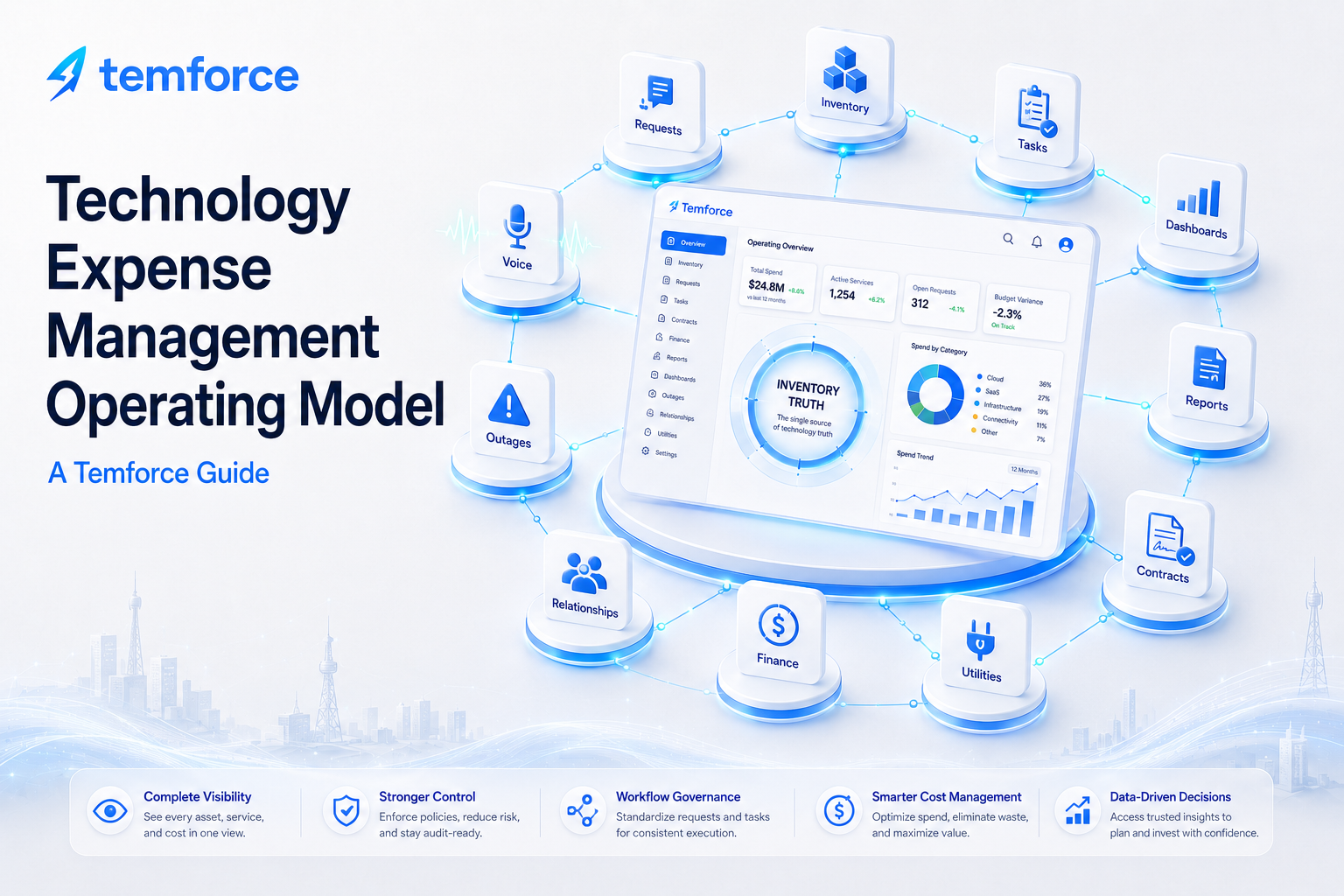
A technology expense management operating model defines how an enterprise manages requests, inventory, tasks, dashboards, voice, outages, relationships, finance, cost management, contracts, reports, and utilities around a trusted inventory foundation. Inventory creates truth. The operating model turns that truth into action.
A technology expense management operating model is the structure, process, data, roles, workflows, dashboards, and governance used to manage telecom, mobility, cloud, SaaS, network, voice, collaboration, and other recurring technology expenses.
Inventory creates truth. Requests keep that truth current. Tasks turn exceptions into work. Finance connects costs to accountability. Contracts expose commitments. Reports and dashboards turn the operating model into visibility and control.
Why the operating model matters
Many organizations have technology expense data, but they do not have operating control. Invoices are reviewed late, inventory updates fall behind, requests happen outside a governed workflow, renewals surprise the business, outages are handled reactively, and finance teams struggle to allocate charges with confidence.
A TEM operating model creates a practical structure for turning recurring expense data and operational activity into decisions, accountability, and action.
Requests, inventory, tasks, dashboards, outages, relationships, finance, cost management, contracts, reports, and utilities become visible as connected operating activity instead of disconnected data points.
Every service request, invoice exception, supplier issue, renewal, outage, disconnect, report, and cost allocation issue has a clearer owner, workflow, and resolution path.
Cleanup is not enough. The operating model keeps inventory, requests, invoices, suppliers, contracts, finance data, and reporting aligned as the business changes.
When the operating model is clear, teams spend less time chasing owners, rebuilding reports, reconciling conflicting spreadsheets, and re-explaining the same expense issues every month.
Most technology expense waste survives because the work is disconnected. A service is requested in one place, billed in another, assigned to an owner somewhere else, tied to a supplier contract no one is tracking, and reported after the fact. A TEMOps operating model gives the organization one way to see, request, approve, assign, validate, report, and govern the work.
The Temforce operating model
The core operating model is built around the enterprise work areas that make technology expense management repeatable. Inventory is the foundation, but the surrounding capabilities are what keep the inventory useful, current, and connected to business action.
| Operating Capability | Temforce Areas | What It Controls | Inventory Connection |
|---|---|---|---|
| Demand and MACD control | Requests, Tasks, Inventory | Moves, adds, changes, disconnects, new services, ownership updates, location changes, lifecycle changes, and approvals. | Keeps inventory accurate as the business changes. |
| Inventory truth | Inventory, Relationships, Utilities | Services, assets, sites, suppliers, owners, locations, billing accounts, technical records, and lifecycle status. | Creates the trusted system of record for every downstream process. |
| Work management and governance | Tasks, Requests, Reports | Follow-ups, exceptions, approvals, cleanup actions, issue tracking, audit trails, and governance activity. | Turns inventory findings and invoice exceptions into assigned work. |
| Invoice and financial control | Finance, Cost Management, Reports | Invoices, billing accounts, accruals, credits, payment confirmations, cost centers, chargebacks, GL coding, and financial reporting. | Connects services and charges to financial ownership and accountability. |
| Supplier and contract control | Relationships, Contracts, Outages | Supplier records, contacts, contract terms, renewals, expirations, service commitments, outages, and escalation paths. | Connects inventory to supplier accountability, renewal risk, and service impact. |
| Dashboards and operating visibility | Dashboards, Reports | Inventory health, spend trends, invoice exceptions, renewals, outages, cost performance, request activity, and executive visibility. | Turns inventory, invoice, supplier, contract, and finance data into operating insight. |
| Service category operations | Voice, Inventory, Finance, Dashboards | Voice usage, network services, mobile services, cloud, SaaS, power, and category-specific expense controls. | Extends the operating model into the service categories that drive technology spend. |
| Utilities and data maintenance | Utilities, Inventory, Finance | Sites, maps, pricing tools, imports, supporting data, administrative workflows, and data quality maintenance. | Supports the data structure required to keep the operating model clean. |
How the Temforce areas work together
Each operating area has its own role, but the value comes from how they connect around inventory truth.
Requests control new services, moves, adds, changes, disconnects, ownership changes, and location updates before they create inventory drift.
Inventory provides the structured record of services, assets, suppliers, owners, sites, billing accounts, cost centers, and lifecycle status.
Tasks turn findings into action, including cleanup items, invoice exceptions, supplier follow-ups, disconnects, and governance activity.
Dashboards show inventory health, spend analytics, contract renewals, outage summaries, request activity, and executive-level operating insight.
Outage management uses inventory, supplier, location, contact, and service data to support faster response and stronger escalation.
Relationships connect services to suppliers, contacts, owners, users, teams, locations, and the people responsible for decisions.
Finance manages invoices, billing accounts, credit recovery, accruals, payment confirmations, financial periods, and spend analytics.
Cost management uses inventory, invoice, supplier, and contract data to identify waste, savings opportunities, and performance trends.
Contracts connect supplier commitments, renewal dates, expirations, pricing, documents, and obligations to the services being managed.
Reports provide exportable evidence for inventory, invoices, outages, accruals, billing accounts, inactive users, overlap, and cost analysis.
Utilities such as maps, sites, and pricing tools support the operational data needed to keep TEM accurate and usable.
Voice management extends the operating model into voice usage, services, billing, inventory, reporting, and category-specific controls.
Ready to see how Temforce supports the operating model?
Request a Temforce demo to see how requests, inventory, tasks, dashboards, outages, relationships, finance, cost management, contracts, reports, and utilities work together around one TEMOps operating layer.
Build the operating model one capability at a time
The operating model can be expanded into focused resource areas. These are the next logical content paths after the inventory hub.
Start with inventory truth. Learn how structured inventory supports request management, invoice validation, supplier governance, renewals, chargebacks, and TEMOps control.
Visit the inventory hubLearn how moves, adds, changes, disconnects, service requests, ownership updates, and supplier-driven changes keep inventory current.
Control requestsSee how invoice validation depends on inventory, billing accounts, supplier records, contracts, approvals, and ownership.
Validate invoicesSee the dashboards and metrics that help track spend, inventory accuracy, request activity, invoice exceptions, renewals, supplier performance, and governance.
Track dashboardsLearn how clean inventory helps teams manage renewals, commitments, supplier exposure, contract terms, and negotiation opportunities.
Manage renewalsLearn how service IDs, supplier contacts, locations, owners, and escalation paths support faster outage response.
Support outagesPublish note: if any future support pages are not live yet, keep this hub in draft or update those card links as each support page is published.
The TEMOps operating rhythm
A technology expense management operating model should not rely on one-time cleanup projects. It needs a recurring rhythm that keeps request activity, inventory, tasks, invoices, suppliers, contracts, finance, dashboards, reports, and governance aligned.
Request and MACD control
Review new requests, moves, adds, changes, disconnects, ownership updates, location changes, and supplier-driven updates so inventory remains current as the business changes.
Inventory maintenance
Update orders, disconnects, new services, billing accounts, suppliers, ownership changes, cost centers, locations, and lifecycle status.
Invoice and finance review
Review invoices against inventory, expected charges, billing accounts, contract terms, ownership, credits, accruals, payment confirmations, and exceptions.
Task and exception management
Assign follow-up work for cleanup items, disputes, invoice exceptions, supplier actions, disconnects, missing owners, inactive users, and reporting gaps.
Supplier, outage, and relationship review
Review supplier performance, outages, contacts, escalation paths, service issues, disputes, credits, and relationship ownership.
Contract and renewal planning
Use inventory, supplier, contract, and spend data to prepare for renewals before the business is locked into avoidable commitments.
Dashboard and report review
Review spend trends, savings actions, invoice exceptions, inventory accuracy, request activity, renewal risk, supplier exposure, outages, and TEMOps maturity.
Example scenario: inventory truth becomes operating control
A company identifies a recurring supplier charge tied to a network service. In a weak operating model, the invoice may be approved because the charge looks familiar. In a stronger TEMOps model, the charge is compared against the approved request, inventory record, supplier relationship, contract terms, cost center, location, outage history, task activity, and reporting context.
Instead of asking, “Did the supplier bill us?” the business asks, “Is this a valid charge for a service we requested, approved, still own, use, allocate, report on, and expect to pay for?”
How Temforce helps organizations move from data to control
Temforce helps organizations connect requests, inventory, tasks, dashboards, voice, outages, relationships, finance, cost management, contracts, reports, and utilities into a more governed TEMOps process.
The goal is not just to organize data. The goal is to create repeatable operating control over telecom, mobility, cloud, SaaS, network, voice, collaboration, and other recurring technology expenses.
Bring requests, inventory, tasks, finance, contracts, reports, and dashboards together instead of managing them in disconnected spreadsheets and inboxes.
Use inventory truth to validate invoices, support outages, manage renewals, allocate costs, assign owners, and identify waste.
Turn operational work into dashboards, reports, insights, and governance rhythms that leaders can actually use.
Not sure where your TEM operating gaps are hiding?
Request a TEMOps Review to identify request management gaps, inventory drift, invoice validation weaknesses, supplier blind spots, renewal risk, chargeback issues, dashboard gaps, and governance opportunities.
Build the skills behind the operating model
Temforce Academy helps learners build practical TEMOps skills across inventory management, request management, invoice validation, supplier control, contract governance, reporting, and operational discipline.
