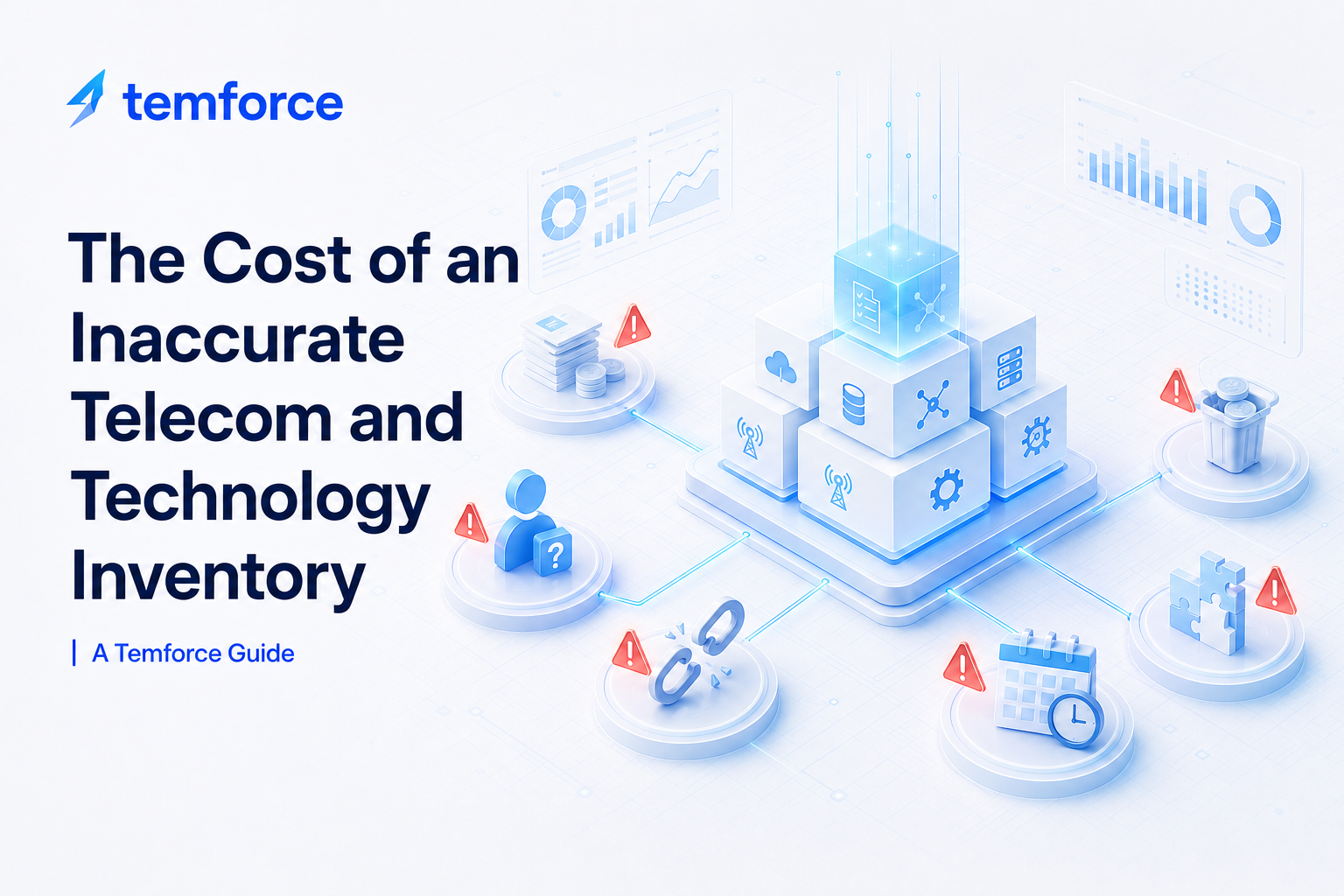
The Cost of an Inaccurate Telecom and Technology Inventory
May 26, 2026
Inventory
An inaccurate telecom and technology inventory creates more than messy reporting. It can lead to recurring waste, weak invoice validation, incorrect cost allocation, missed disconnects, contract risk, and decisions based on data no one fully trusts.
The cost of an inaccurate telecom and technology inventory is often hidden inside recurring invoices. The waste may not look dramatic on one bill, but it compounds month after month when services remain active without clear ownership, status, or business purpose.
Where inaccurate inventory creates cost
Inaccurate inventory makes it harder to know whether a charge is valid, whether a service is still needed, and who should approve or challenge it.
The result is not just operational frustration. It is real financial leakage through unused services, licenses, assets, and applications, delayed disconnects, weak disputes, bad allocation, and supplier confusion.
Common cost drivers caused by inaccurate inventory
The most expensive inventory problems are usually the ones that repeat quietly.
- Services tied to closed locations or retired assets that continue billing.
- Mobile lines, SaaS seats, devices, and services assigned to departed employees or inactive users.
- Circuits, features, cloud services, SaaS seats, devices, or accounts with no clear business owner.
- Duplicate services created during migrations, moves, or supplier changes.
- Charges that cannot be matched to contracts, pricing terms, or approved services.
- Cost centers that are outdated, missing, or assigned to the wrong department.
- Supplier disputes that fail because the organization lacks supporting inventory evidence.
Structure is the enemy of waste. When inventory is clear, waste has fewer places to hide. When inventory is inaccurate, recurring charges can survive because no one has enough context to challenge them.
A location closes, but several telecom and technology services remain active on the invoice. The charges are not large enough to trigger immediate executive attention, but they continue every month. Without accurate location and lifecycle status in the inventory, the business may pay for unused services, licenses, assets, and applications long after they should have been disconnected.
How to reduce the cost of inaccurate inventory
The first step is not chasing every possible error. It is identifying the inventory gaps most likely to create recurring cost exposure.
Identify unowned recurring services
Find services that have no business owner, technical owner, assigned user, or department accountability.
Review inactive locations and users
Compare inventory to current sites, employee lists, device records, and service status to find stale records.
Match charges to contracts and cost centers
Use contract references, pricing notes, and cost center data to identify charges that may be misallocated or overpriced.
Prioritize cleanup by monthly impact
Focus first on recurring, high-cost, unknown, and duplicate records that can produce savings or risk reduction.
How Temforce helps
Temforce helps organizations identify where inventory gaps may be creating unnecessary spend. By connecting inventory to invoices, suppliers, contracts, locations, users, and cost centers, teams can find the records that need review.
The goal is not just to reduce one invoice. It is to create a stronger operating layer that prevents the same waste from returning.
Inaccurate telecom and technology inventory cost FAQ
How does inaccurate telecom and technology inventory create waste?
It allows unused, unowned, duplicated, or outdated services to keep billing because the business cannot easily prove they are no longer needed.
Is the biggest cost always the monthly charge?
No. The cost also includes lost time, weak disputes, poor allocation, delayed disconnects, bad reporting, and renewal decisions based on incomplete data.
How do you find the most expensive inventory gaps?
Start with recurring high-cost services, closed locations, missing owners, unknown accounts, stale users, and invoice charges that cannot be matched to trusted records.
The bottom line
An inaccurate telecom and technology inventory is expensive because it weakens control. It makes waste harder to find, disputes harder to support, and ownership harder to enforce.
The organizations that reduce this cost are the ones that treat inventory as an operating control, not just a spreadsheet.
Download the Free TemplateLast updated: May 25, 2026
