How to Create a Telecom and Technology Inventory That Actually Works
May 26, 2026
Inventory
Inventory is the foundation of technology expense management. If your organization cannot clearly see what it owns, who owns it, what it costs, where it belongs, and whether it should still be active, invoice validation, supplier management, reporting, and cost control all get harder.
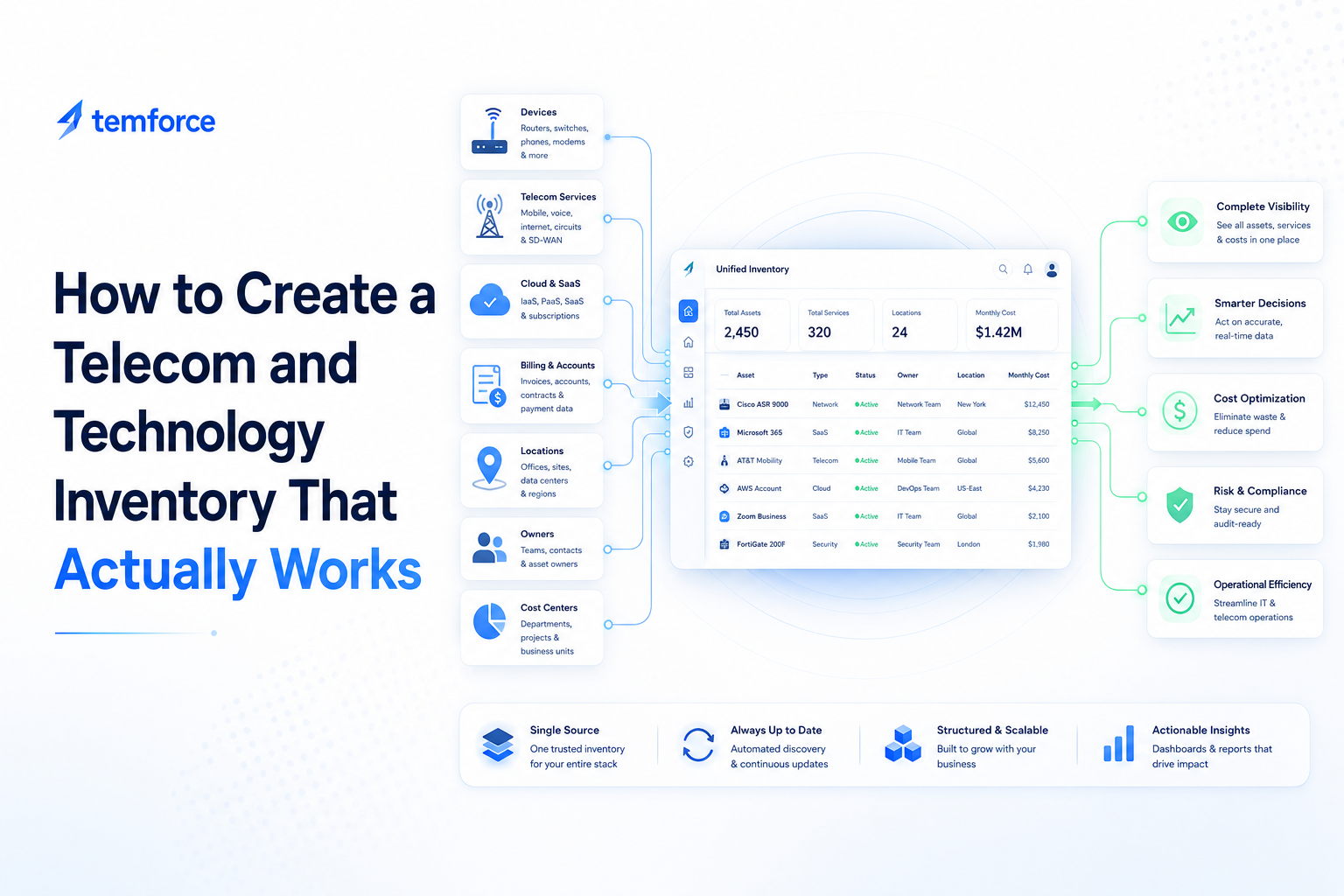
To create a telecom and technology inventory that actually works, you need a structured record of the services, assets, vendors, users, locations, contracts, and charges your organization owns, pays for, and manages. This includes telecom services, mobility, network circuits, SaaS applications, cloud services, collaboration tools, hardware, suppliers, cost centers, and operational ownership.
Most technology expense problems do not start with the invoice. They start before the invoice arrives. Services get ordered, employees change roles, locations close, vendors renew contracts, mobile lines go unused, applications remain active, and charges continue month after month because no one has a trusted inventory to validate against.
A telecom and technology inventory is a centralized record of an organization’s technology services, suppliers, billing accounts, contracts, users, locations, cost centers, and lifecycle status. It gives IT, finance, procurement, and operations a shared view of what exists, who owns it, and whether it should still be active.
Inventory truth is not just having a list of telecom services. It is having a trusted operating record that connects each service to ownership, billing, supplier context, location, cost center, lifecycle status, and business purpose. Structure is the enemy of waste. When inventory is clear, waste has fewer places to hide.
Why telecom and technology inventory matters
A strong inventory helps your organization answer the questions that drive technology expense control: what are we paying for, who owns it, where does it belong, what contract governs it, and should it still be active?
- What telecom, mobility, network, SaaS, cloud, collaboration, and hardware services are we paying for?
- Who owns each service, application, circuit, device, or vendor relationship?
- Which locations, departments, users, contracts, and cost centers are tied to each charge?
- Are these services still active, needed, approved, and correctly billed?
- Which suppliers, accounts, platforms, and departments are driving spend?
Inventory is the control layer. If the inventory is weak, invoice validation, supplier management, contract governance, reporting, and cost control all become harder to trust.
What should be included in a telecom and technology inventory?
A useful inventory should include enough structure to help your team connect services, costs, vendors, owners, and business context.
| Inventory Area | Examples to Capture | Why It Matters |
|---|---|---|
| Service or asset details | Service type, asset type, application name, phone number, circuit ID, device, plan, status | Helps identify what exists and whether it is active, inactive, disconnected, retired, or unknown. |
| Supplier and account data | Carrier, vendor, software provider, cloud provider, billing account, invoice source | Connects inventory to billing, support, supplier management, and dispute activity. |
| Ownership and business context | Business owner, technical owner, assigned user, department, location, cost center | Clarifies accountability and helps finance, IT, and procurement understand who is responsible. |
| Financial and contract context | Monthly charge, cost center, contract reference, renewal date, commitment, pricing notes | Supports cost allocation, renewal planning, contract review, and invoice validation. |
| Lifecycle status | Active, pending, disconnected, retired, under review, unknown, last reviewed date | Helps teams identify cleanup opportunities and avoid paying for stale services. |
How to create a telecom and technology inventory
Define what the inventory needs to support
Start by identifying the business purpose: invoice validation, cost allocation, supplier management, contract tracking, renewal planning, service cleanup, or executive reporting.
Gather data from the main source systems
Pull data from invoices, vendor portals, contracts, procurement files, AP systems, SaaS admin tools, cloud billing portals, mobile tools, network records, and existing spreadsheets.
Standardize categories, owners, and status
Use consistent naming rules, service categories, ownership fields, and lifecycle values so the inventory can be trusted across IT, finance, procurement, and operations.
Connect inventory to invoices, contracts, and cost centers
A charge should be tied to a supplier, account, service, location, owner, cost center, and contract whenever possible.
Create a review and maintenance rhythm
Inventory is not a one-time cleanup. It needs recurring review for unknown records, disconnected services, stale users, location changes, contract renewals, and supplier billing changes.
A company may see a recurring circuit charge every month and assume it is valid because it appears on the invoice. But if the inventory does not show the current location, business owner, cost center, contract reference, and lifecycle status, the team may not realize the circuit belongs to a closed office or a service that should have been disconnected months ago.
How Temforce helps
Temforce helps organizations move beyond fragmented spreadsheets and disconnected billing data by creating a more structured way to manage telecom and technology inventory, invoices, suppliers, contracts, users, locations, cost centers, and ownership.
That means better inventory visibility, stronger invoice validation, cleaner reporting, improved supplier accountability, and more disciplined control over technology spend.
The bottom line
A telecom and technology inventory that actually works is not just a spreadsheet. It is the starting point for better control over technology spend.
Start with the inventory. Create a baseline. Clean up obvious gaps. Assign ownership. Connect the data to invoices, contracts, suppliers, locations, and cost centers. Then build the operating rhythm that keeps it current.
Request an Inventory Truth ReviewLast updated: May 25, 2026
