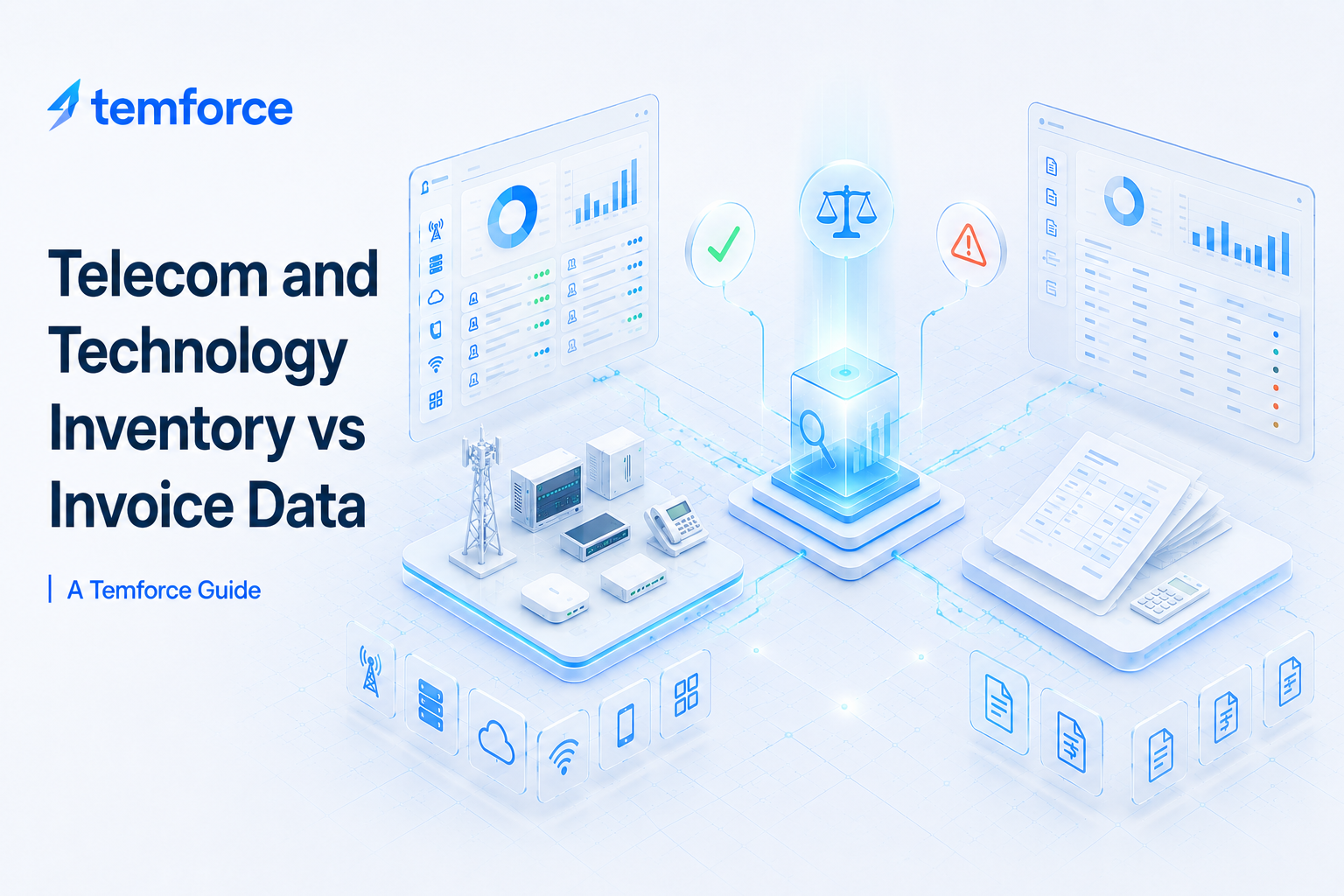
Telecom and Technology Inventory vs Telecom and Technology Invoice Data
May 26, 2026
Inventory
Telecom and technology inventory and invoice data are related, but they are not the same thing. Invoice data shows what was billed. Inventory should show what the organization owns, uses, manages, and expects to pay for across telecom, mobility, network, SaaS, cloud, and other technology services.
Teams often treat invoice exports as inventory because the data is easy to access. But telecom and technology invoice data is not the same as inventory truth. It is one source of evidence, not the complete operating record.
Why the difference matters
Supplier invoice data is built for billing. It may not include the internal owner, current user, business purpose, site status, cost center accuracy, or lifecycle decision.
Inventory data should bring those missing pieces together so the organization can decide whether a charge is valid, needed, and aligned to the business.
How to compare invoice data and inventory data
The easiest way to separate the two is to ask who created the data and what decision it supports.
- Invoice data shows what the supplier billed, when it was billed, and under which account.
- Inventory data shows what the business believes it owns, uses, assigns, and expects to pay for.
- Invoice data may include service identifiers, charges, taxes, fees, and billing account details.
- Inventory data should include owners, users, locations, cost centers, contract context, and lifecycle status.
- Invoice data supports payment review. Inventory data supports validation, governance, cleanup, reporting, and control.
Invoice data is a supplier view of billing. Inventory truth is the organization’s operating view of ownership, use, context, and control. TEMOps needs both, but they cannot be treated as interchangeable.
A mobile line appears on the carrier invoice with a valid monthly plan charge. The invoice data may be accurate, but the inventory shows the assigned employee left the company months ago. Without the inventory record, the charge could continue because the invoice alone does not show business need.
How to reconcile invoice data with inventory data
The goal is not to choose one source. The goal is to make each source play the right role.
Use invoice data as evidence
Treat supplier billing as a source of charge detail, not the final proof of validity.
Use inventory as the control record
Maintain internal ownership, location, cost center, contract, and lifecycle context in the inventory.
Compare differences regularly
Flag charges that bill but do not appear in inventory, and inventory records that appear active but do not bill as expected.
Resolve ownership and status gaps
Unknown or unowned records should become review items, not hidden exceptions.
How Temforce helps
Temforce helps organizations connect invoice data and inventory data into a more reliable technology expense management process. The goal is not more spreadsheets. The goal is better operational truth.
When the two sources are reconciled, teams can validate invoices more effectively, find stale services faster, and improve supplier accountability.
Telecom and technology inventory and invoice data FAQ
Can invoice data be used to build inventory?
Yes, invoice data is a useful starting source, but it must be enriched with owners, locations, cost centers, contracts, and lifecycle status.
Which source should be trusted more?
Neither should be accepted blindly. Invoice data and inventory data should be reconciled so differences become review items.
What happens if invoice data is treated as inventory?
Teams may miss unused services, incorrect ownership, closed locations, duplicate services, and charges that are no longer needed.
The bottom line
Telecom and technology invoice data and inventory data serve different purposes. One shows billing. The other should show operational truth.
When organizations understand the difference, they can stop approving familiar charges and start validating them against the business context that actually matters.
Request an Inventory Truth ReviewLast updated: May 25, 2026
