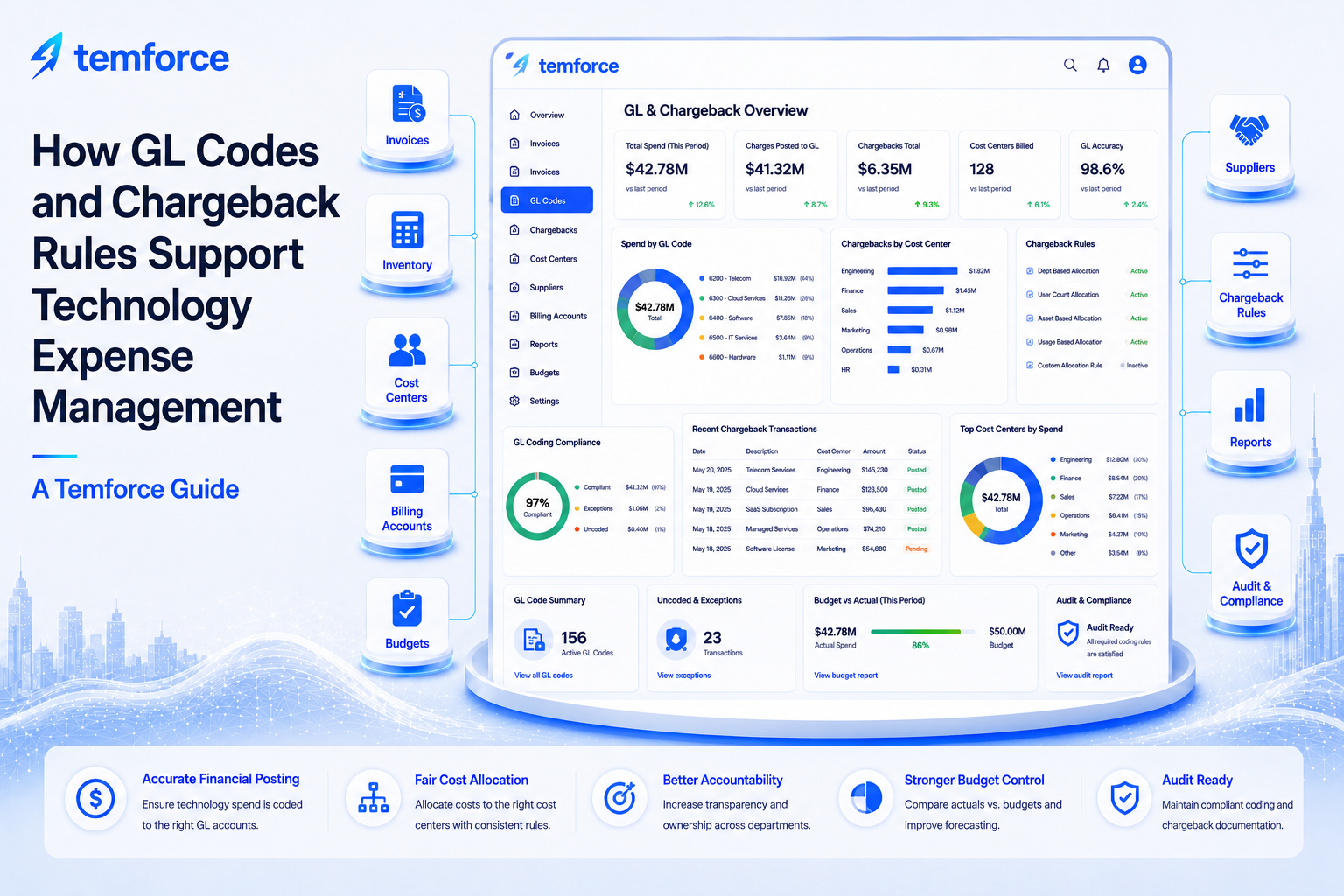
How GL Codes and Chargeback Rules Support Technology Expense Management
May 31, 2026
Inventory
GL codes and chargeback rules support technology expense management by connecting technology invoices to the financial structure that explains where spend belongs. When GL coding, cost centers, allocation rules, and chargeback logic are clear, finance teams can post expenses accurately, business owners can understand their charges, and TEM teams can reduce reporting confusion.
Technology expense management is not complete when an invoice is validated. The expense still needs to land in the right financial category, cost center, business unit, department, or chargeback model. GL codes and chargeback rules create the bridge between operational TEM activity and finance-ready reporting.
A technology charge should be traceable from invoice to service, from service to owner, from owner to cost center, and from cost center to financial reporting.
Why GL codes and chargeback rules matter in TEM
Technology expenses often span multiple suppliers, billing accounts, services, locations, business units, and departments. Without controlled GL coding and chargeback rules, expenses may be posted inconsistently, allocated incorrectly, or reported in ways that business leaders cannot easily understand.
A strong GL and chargeback model helps TEM, finance, IT, procurement, and business owners work from the same cost logic.
GL and chargeback visibility connects invoices, services, billing accounts, cost centers, departments, business units, and owners.
Every charge should follow a clear coding rule, allocation method, approval path, and ownership model.
Controls help identify missing codes, stale cost centers, incorrect allocations, orphaned charges, and budget variance.
Teams spend less time manually recoding invoices, rebuilding allocation files, and explaining inconsistent charges.
GL codes and chargeback rules turn technology expense data into finance-ready information. They help organizations explain costs, assign accountability, and support more confident financial reporting.
The GL code and chargeback rule model
A strong model connects invoice charges to financial posting, ownership, allocation logic, and reporting outcomes.
| Finance Control Area | What to Track | Why It Matters | Risk If Missing |
|---|---|---|---|
| GL code assignment | Expense category, supplier, service type, charge type, GL code, and posting rule. | Ensures expenses are posted to the correct financial account. | Spend may be reported under the wrong category or financial line. |
| Cost center mapping | Cost center, department, business unit, owner, location, user, and service relationship. | Connects technology spend to the business area responsible for it. | Charges may be difficult to explain or allocated to the wrong group. |
| Chargeback rules | Direct charge, shared allocation, usage-based rule, headcount rule, location rule, or fixed percentage. | Creates consistency in how spend is distributed across the business. | Shared services may be allocated inconsistently or disputed by departments. |
| Invoice allocation | Invoice line, billing account, allocation amount, allocation percentage, GL code, and chargeback destination. | Shows how invoice dollars move from supplier bill to finance reporting. | Invoice totals may not reconcile to cost center or GL reporting. |
| Approval and exception handling | Missing code, invalid cost center, allocation exception, owner approval, and correction status. | Prevents incomplete or incorrect records from moving into finance close. | Finance may need to manually correct errors late in the close process. |
| Reporting outcome | Posted amount, allocated amount, variance, budget impact, owner, reporting period, and reconciliation status. | Connects TEM data to finance reporting and budget accountability. | Leaders may not trust spend reports or chargeback results. |
How to manage GL codes and chargeback rules in a TEMOps operating model
GL codes and chargeback rules should be part of the recurring TEMOps finance cadence. The goal is to make sure every technology charge has a clean financial destination and a defensible allocation method.
Define the financial structure
Identify GL codes, cost centers, departments, business units, finance owners, and chargeback categories used for technology spend.
Map services to owners
Connect inventory records, billing accounts, locations, users, service categories, and suppliers to the right financial owners.
Create allocation rules
Define direct-charge, usage-based, location-based, headcount-based, shared, and fixed-percentage chargeback logic.
Apply rules to invoice data
Use coding and allocation rules to distribute invoice charges across cost centers, GL codes, departments, and business units.
Review exceptions
Flag missing GL codes, inactive cost centers, unassigned owners, unmatched services, invalid allocations, and chargeback disputes.
Report finance outcomes
Show allocated spend, budget variance, chargeback totals, unresolved coding exceptions, and reconciliation status.
What GL code and chargeback records should track
GL and chargeback records should capture enough detail to support posting accuracy, cost allocation, budget review, and finance reporting.
- Supplier, invoice, billing account, service type, charge type, product category, and expense category
- GL code, GL description, cost center, department, business unit, finance owner, and approval owner
- Direct owner, user, location, inventory record, service owner, and billing account relationship
- Chargeback rule, allocation method, allocation percentage, allocated amount, shared service logic, and exception status
- Budget amount, actual amount, variance, forecast impact, accrual impact, and reporting period
- Missing code flag, inactive cost center flag, orphaned charge flag, disputed allocation flag, and correction status
- Posting status, reconciliation status, approval status, close status, export status, and audit evidence
- Dashboard category, executive summary, next action, task owner, due date, and resolution note
If a technology charge cannot be tied to a GL code, cost center, owner, and allocation rule, it should be treated as a finance control exception.
Common GL code and chargeback rule issues
GL and chargeback issues usually appear when invoice data, inventory ownership, billing accounts, finance structures, and allocation rules are disconnected.
Invoices may contain charges that cannot be posted cleanly because the GL rule is missing, stale, or unclear.
Outdated owners, inactive cost centers, or missing department mappings can create budget confusion.
Without clear rules, shared telecom, cloud, SaaS, network, or infrastructure costs may be split inconsistently.
Business owners may challenge charges when allocation logic, service ownership, or usage evidence is unclear.
Missing or invalid coding can delay close, create rework, and reduce confidence in period reporting.
When TEM and finance structures differ, reports may show conflicting spend, variance, and chargeback results.
Example scenario: a shared network invoice needs allocation
A network invoice includes charges used by multiple departments across several locations. In a weak process, finance may split the cost manually or post it to a default cost center. In a stronger TEMOps process, the invoice charges are tied to inventory, locations, usage rules, cost centers, GL codes, and owners so the allocation is consistent, explainable, and ready for reporting.
Instead of asking, “Where should this cost go?” the business asks, “Which rule applies, which records support it, who owns the cost, and how does the allocation reconcile?”
How Temforce helps with GL codes and chargeback rules
Temforce helps organizations connect GL codes and chargeback rules to invoices, billing accounts, inventory, cost centers, departments, suppliers, contracts, reports, and dashboards.
The goal is to move financial coding and allocation away from manual spreadsheet work and toward a governed TEMOps process with clear rules, ownership, exceptions, and reporting confidence.
Connect supplier charges, invoice lines, service categories, and billing accounts to the right GL codes and cost centers.
Apply direct, shared, usage-based, location-based, and fixed allocation rules with clear ownership and exception handling.
Report allocated spend, unmatched charges, budget variance, chargeback exceptions, posting status, and reconciliation outcomes.
