How Demand Forecasting Improves Technology Expense Management
May 30, 2026
Cost Control
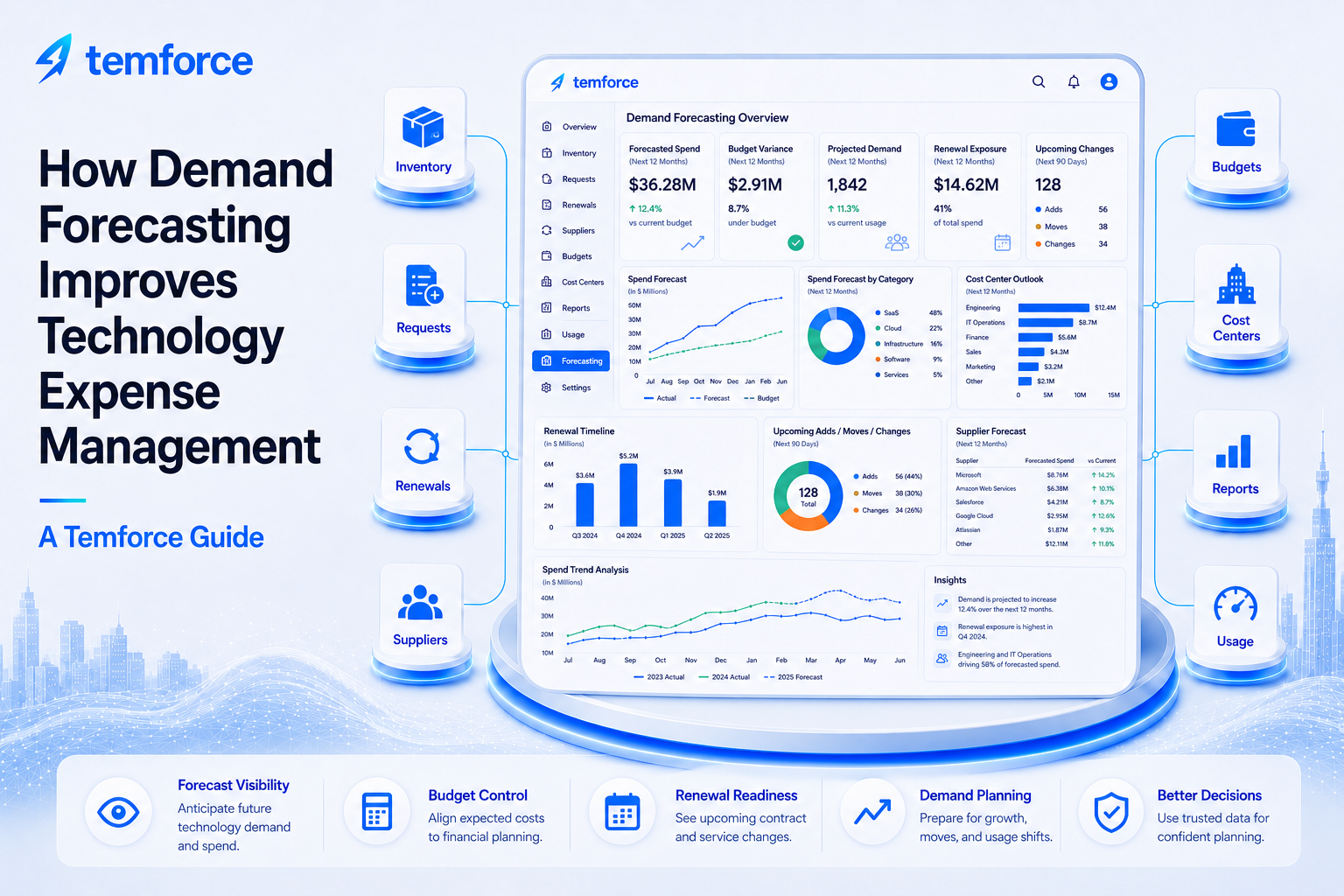
Demand forecasting improves technology expense management by helping organizations anticipate spend, service growth, contract exposure, renewal pressure, budget changes, usage shifts, and future demand before they become invoice surprises. It turns TEM data into planning intelligence.
Many TEM programs are good at explaining what was billed last month. Stronger programs also help predict what is likely to happen next. Demand forecasting connects operational demand to financial planning so technology expense decisions are made with better timing and stronger context.
Forecasting is not guessing. It is the disciplined use of inventory, invoice, contract, supplier, request, usage, and finance data to anticipate future spend and operational demand.
Why demand forecasting matters in TEM
Technology expense environments change constantly. Locations open and close, users move, circuits are upgraded, mobile demand shifts, cloud costs grow, contracts renew, suppliers change prices, projects create new demand, and invoices reflect those changes after decisions have already been made.
A strong demand forecast helps teams see ahead of those changes and align spending decisions with business needs, budget expectations, and operational capacity.
Forecasting connects historical invoices, active inventory, growth signals, contract changes, usage trends, and expected demand.
Forecast changes need owners, assumptions, source data, timing, business justification, and review cadence.
Forecast controls help identify upcoming increases, renewals, project demand, unmanaged growth, and supplier cost changes.
Teams spend less time rebuilding spend forecasts from spreadsheets, invoices, supplier portals, and disconnected reports.
Demand forecasting helps TEM move from reactive cost review to proactive planning. It gives finance, IT, procurement, and business leaders a better view of what spend is likely to happen and why.
The demand forecasting model
A strong TEM forecast model connects operational drivers to financial outcomes so the business can plan spend with more confidence.
| Forecast Area | What to Track | Why It Matters | Risk If Missing |
|---|---|---|---|
| Invoice trend | Historical spend, recurring charges, usage charges, taxes, fees, supplier trends, and billing account patterns. | Invoice history establishes the financial baseline for forecasting. | Forecasts may ignore actual spend patterns and recurring cost behavior. |
| Inventory demand | Active services, pending requests, planned adds, disconnects, upgrades, locations, users, and lifecycle status. | Inventory shows what demand exists and what changes are likely to affect spend. | Forecasts may miss service growth, cleanup, migrations, or disconnect impact. |
| Contract and renewal exposure | Renewal dates, commitments, price changes, rate cards, minimums, expirations, and supplier terms. | Contract events often create major future spend changes. | Renewals and pricing changes may surprise finance and procurement. |
| Project and business demand | New sites, expansions, migrations, seasonal demand, hiring plans, device changes, and technology projects. | Business activity drives future technology expense. | Budgets may not reflect planned work or growth activity. |
| Supplier and market changes | Supplier rate increases, contract changes, service migrations, credits, disputes, service quality, and outages. | Supplier behavior can affect both forecast accuracy and risk planning. | Forecasts may miss supplier-driven increases, credits, or service changes. |
| Budget and variance control | Forecast amount, budget amount, variance, assumption notes, owner, period, category, and approval status. | Variance tracking turns forecasts into accountable planning tools. | Forecasts may become static numbers without explanation or ownership. |
How to manage demand forecasting in a TEMOps operating model
Demand forecasting should be part of the recurring TEMOps cadence. The goal is to use trusted operational records to anticipate spend, explain variance, and support better planning decisions.
Start with the spend baseline
Review historical invoice data, recurring charges, billing accounts, supplier trends, and category-level spend patterns.
Connect forecast drivers
Tie forecast assumptions to inventory, requests, contracts, renewals, usage, locations, suppliers, cost centers, and business plans.
Identify demand changes
Capture planned adds, disconnects, moves, upgrades, renewals, supplier changes, project demand, and seasonal activity.
Assign assumptions and owners
Document who owns each assumption, what data supports it, what period it affects, and what confidence level applies.
Compare forecast to actuals
Review actual invoices against forecast amounts, identify variance, explain changes, and adjust assumptions over time.
Report forecast outcomes
Show forecast spend, actual spend, variance, upcoming demand, renewal exposure, budget impact, and open planning actions.
What demand forecasting records should track
Forecast records should capture enough detail to explain future spend, support budget planning, and connect projections to operational activity.
- Forecast period, supplier, category, billing account, service type, cost center, business unit, and forecast owner
- Historical invoice baseline, expected recurring charges, expected usage charges, taxes, fees, credits, and supplier trend
- Inventory count, active services, pending adds, pending disconnects, upgrades, migrations, and lifecycle changes
- Contract renewal date, price change, commitment level, minimum spend, supplier term, and negotiation status
- Business demand driver, project name, site change, hiring plan, seasonal change, and capacity assumption
- Forecast amount, budget amount, actual amount, variance amount, variance percent, and explanation
- Confidence level, assumption source, approval status, review date, next action, and open task
- Dashboard category, reporting period, planning risk, opportunity, and executive summary note
If a forecast number cannot be tied to an inventory record, invoice trend, contract event, supplier change, business plan, or documented assumption, it should be reviewed before it drives a decision.
Common demand forecasting issues
Forecasting issues usually appear when budgets, invoices, inventory, contracts, suppliers, requests, and business plans are managed separately.
Teams may forecast spend without current inventory, billing account, contract, usage, or request data.
Forecast numbers lose credibility when the business cannot explain the assumptions behind them.
Renewals, minimums, price increases, and supplier terms can create major variance if they are not part of the forecast.
New locations, projects, users, device demand, or connectivity changes may not be visible until invoices increase.
Forecasts do not improve when actual invoices are not reviewed against forecast assumptions and variance drivers.
Without forecast reporting, leaders may see last month’s spend but miss upcoming exposure, demand, or budget pressure.
Example scenario: a new location creates unplanned spend
A new site opens and requires connectivity, voice services, mobility support, security services, and supplier installation work. In a weak process, the additional spend appears later across multiple invoices. In a stronger TEMOps process, the location, requests, inventory additions, supplier orders, contracts, expected billing accounts, and forecast impact are connected before the invoices arrive.
Instead of asking, “Why did spend increase?” the business asks, “What demand is coming, what records support it, what period will it affect, and how should finance plan for it?”
How Temforce helps with demand forecasting
Temforce helps organizations connect demand forecasting to the inventory, invoice, supplier, contract, renewal, request, finance, cost center, report, and dashboard records that support stronger TEM planning.
The goal is to move forecasting away from disconnected spreadsheets and toward a governed TEMOps planning process with clear assumptions, trusted data, actual-to-forecast comparison, and better decision support.
Connect forecast assumptions to invoices, active inventory, pending requests, contract terms, renewals, usage, and supplier data.
Track owners, assumptions, confidence levels, approval status, review dates, forecast periods, and follow-up tasks.
Report actual-to-forecast variance, upcoming demand, renewal exposure, budget pressure, and planning opportunities.
