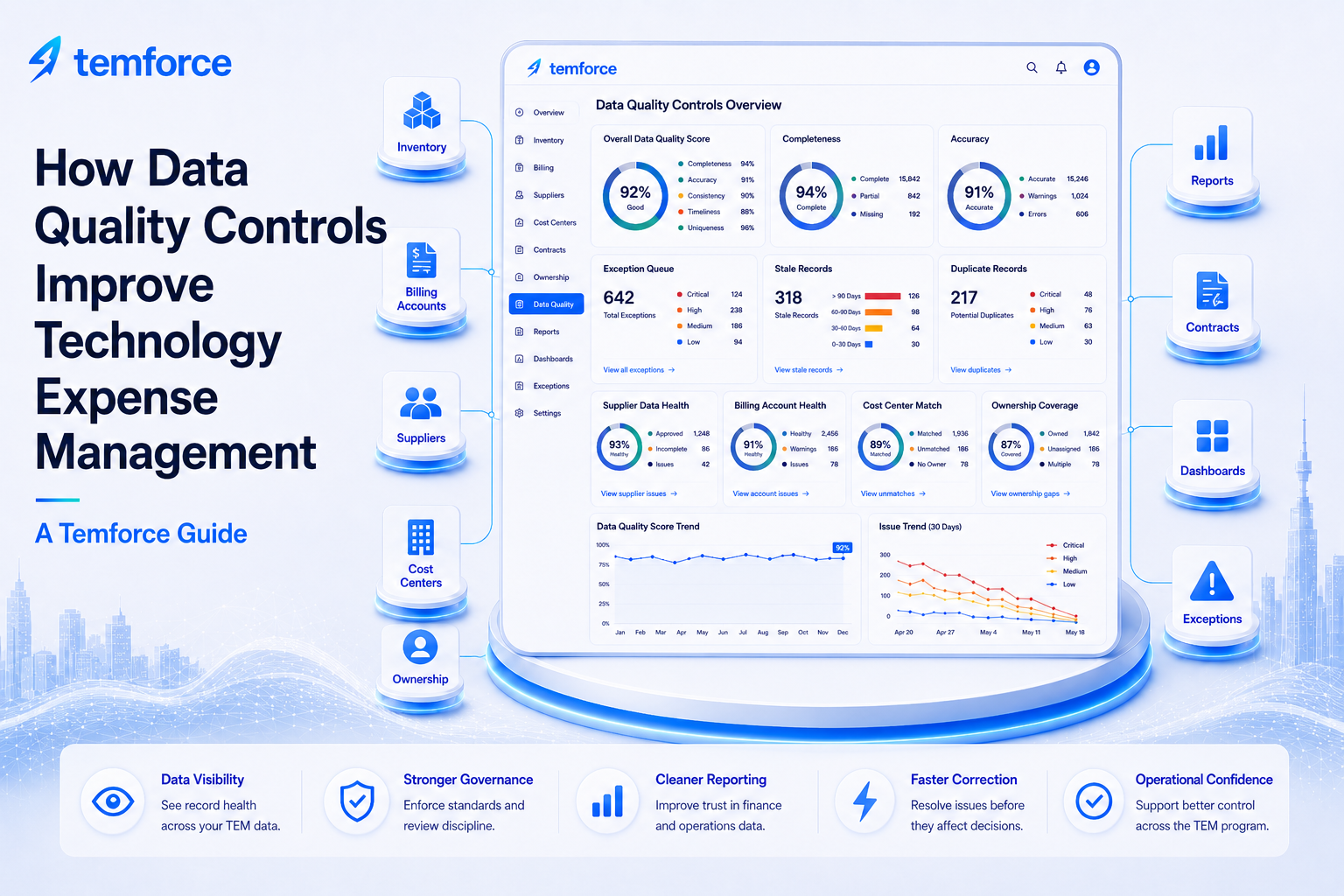
How Data Quality Controls Improve Technology Expense Management
June 1, 2026
Cost Control
Data quality controls improve technology expense management by keeping inventory, invoices, billing accounts, suppliers, contracts, cost centers, owners, reports, dashboards, and workflows accurate enough to support confident decisions. When TEM data is clean, teams can validate charges faster, reduce waste, assign work clearly, and trust the reports they use to manage spend.
TEM data changes constantly. New services are added, invoices arrive, users move, cost centers change, suppliers update accounts, contracts renew, and locations open or close. Data quality controls help organizations manage that change without losing trust in the records that support technology expense decisions.
Clean TEM data is not created once. It is maintained through validation rules, review cadence, ownership, exception queues, task workflows, and governance reporting.
Why data quality controls matter in TEM
Technology expense management depends on connected records. A service record may need a supplier, billing account, contract, owner, location, cost center, GL code, lifecycle status, and invoice relationship. If any of those fields are missing or wrong, invoice validation, reporting, chargebacks, supplier reviews, and savings actions become harder.
Data quality controls help teams identify bad data before it becomes bad decisions.
Quality controls reveal missing owners, stale inventory, invalid cost centers, duplicate records, and unmatched billing accounts.
Each data domain needs an owner, standard, review process, exception path, and completion evidence.
Controls help prevent small record issues from turning into billing errors, reporting gaps, and recurring cleanup projects.
Teams spend less time questioning the data and more time resolving exceptions, managing suppliers, and improving outcomes.
Data quality is the foundation of TEMOps confidence. When the records are trusted, invoice validation, finance reporting, supplier management, and executive dashboards become more actionable.
The TEM data quality control model
A strong data quality model defines which fields and relationships matter, how they are validated, who owns them, and how issues get corrected.
| Control Area | What to Check | Why It Matters | Risk If Missing |
|---|---|---|---|
| Completeness | Required fields, owners, suppliers, account numbers, locations, cost centers, GL codes, and lifecycle status. | Ensures records have the minimum information needed for TEM work. | Records may be visible but not actionable. |
| Accuracy | Correct owners, active services, valid billing accounts, accurate supplier names, current locations, and confirmed costs. | Supports invoice validation, reporting, and business accountability. | Teams may approve charges or make decisions from incorrect data. |
| Relationship integrity | Links between inventory, invoices, billing accounts, suppliers, contracts, cost centers, requests, and tasks. | Shows whether TEM records explain one another. | Invoices may not match inventory, contracts, or finance reporting. |
| Freshness | Last reviewed date, last invoice date, last owner confirmation, last usage update, and next review date. | Shows whether records are current enough to trust. | Stale data may hide unused services, old owners, or closed locations. |
| Exception handling | Missing data, duplicate records, inactive accounts, unmatched invoices, invalid allocations, and aging cleanup items. | Turns data problems into tracked work. | Data issues may repeat without ownership or closure. |
| Reporting confidence | Data quality score, dashboard health, unresolved exceptions, trend direction, and governance outcome. | Helps leaders understand whether reports are trustworthy. | Dashboards may look polished but rest on weak data. |
How to manage data quality controls in a TEMOps operating model
Data quality controls should be part of the recurring TEMOps operating rhythm. The goal is to detect problems, assign owners, correct records, and report improvement.
Define data standards
Identify required fields, approved values, naming standards, ownership rules, finance mappings, and relationship requirements.
Run validation checks
Check inventory, invoices, billing accounts, suppliers, contracts, cost centers, locations, and owners for missing or invalid data.
Identify relationship gaps
Flag records that do not connect properly, including invoices without inventory, services without owners, or accounts without suppliers.
Assign cleanup work
Route data quality exceptions to the right TEM, finance, IT, supplier, or business owner with due dates and priority.
Validate corrections
Confirm that corrected records update the appropriate inventory, invoice, billing, supplier, finance, and reporting views.
Report data health
Show data quality score, open exceptions, stale records, resolved issues, trend direction, and governance outcomes.
What TEM data quality controls should track
Data quality controls should track the record health indicators that determine whether TEM data can be trusted.
- Required field completion, missing owner count, missing supplier count, missing billing account count, and missing cost center count
- Duplicate services, duplicate billing accounts, duplicate suppliers, duplicate locations, and duplicate invoice records
- Invalid cost centers, inactive GL codes, stale owner assignments, closed locations, and retired services still billing
- Invoices without inventory, inventory without invoice activity, contracts without supplier links, and accounts without active owners
- Last reviewed date, next review date, aging exception count, unresolved data issues, and cleanup task status
- Data quality score, dashboard confidence level, trend direction, governance review result, and executive summary
- Task owner, due date, blocker, escalation status, correction note, closure evidence, and audit trail
- Savings impact, risk reduction, avoided spend, recovered credits, and operational improvement outcome
If a report depends on a field, that field should have a quality control. If a workflow depends on a relationship, that relationship should be validated.
Common TEM data quality issues
Data quality issues usually appear when records are imported, updated, or reviewed without clear standards and ownership.
Records may lack owners, cost centers, suppliers, billing accounts, locations, or lifecycle status.
Invoices may not match inventory, billing accounts may not tie to suppliers, or services may lack contract context.
Old owners, closed locations, inactive cost centers, and retired services may remain in active reporting.
Duplicate services, suppliers, accounts, and locations make invoice matching and reporting harder.
Invalid cost centers, stale GL codes, and unclear allocations weaken reporting confidence.
Data issues continue when no owner, due date, task, or closure evidence exists.
Example scenario: a report shows spend by cost center, but the mapping is stale
A dashboard shows technology spend by cost center, but several services are still assigned to a department that no longer exists. In a weak process, the report may be questioned after finance review. In a stronger TEMOps process, inactive cost center controls flag the issue, ownership is assigned, records are corrected, and reporting confidence improves before leadership reviews the dashboard.
Instead of asking, “Can we trust this report?” the business asks, “Which controls confirm the records behind this report are complete, current, connected, and reviewed?”
How Temforce helps with data quality controls
Temforce helps organizations connect data quality controls to inventory, invoices, suppliers, billing accounts, contracts, cost centers, tasks, governance reviews, reports, and dashboards.
The goal is to move data quality away from one-time cleanup efforts and toward a governed TEMOps process with rules, ownership, exception tracking, review cadence, and reporting confidence.
Track missing fields, stale records, duplicate data, invalid mappings, unmatched invoices, and relationship gaps.
Assign data quality exceptions to owners with due dates, escalation paths, resolution notes, and closure evidence.
Report data quality score, exception aging, governance status, dashboard confidence, and improvement outcomes.
