How Billing and Credit Recovery Improve Technology Expense Management
May 30, 2026
Cost Control
Billing and credit recovery improve technology expense management by turning invoice exceptions, supplier disputes, incorrect charges, missed credits, and billing errors into tracked recovery actions. The goal is not just to find billing issues. The goal is to recover value, confirm credits, prevent repeat errors, and strengthen financial control.
Billing and credit recovery is the part of TEMOps that protects the organization after a billing error is found. It connects validation findings to supplier disputes, credit tracking, invoice correction, finance reporting, and confirmed recovery.
A billing error is not fully resolved when it is identified. It is resolved when the supplier confirms it, the credit is issued, the invoice reflects the correction, the financial impact is reported, and the root cause is addressed.
Why billing and credit recovery matter in TEM
Technology invoices can contain incorrect rates, charges for disconnected services, missing credits, duplicate services, billing account errors, late fee issues, tax and surcharge problems, and pricing that does not match the contract. Finding these issues is only the first step.
A strong recovery process gives TEM, finance, procurement, suppliers, and business owners a shared way to move from invoice exception to confirmed credit and lasting correction.
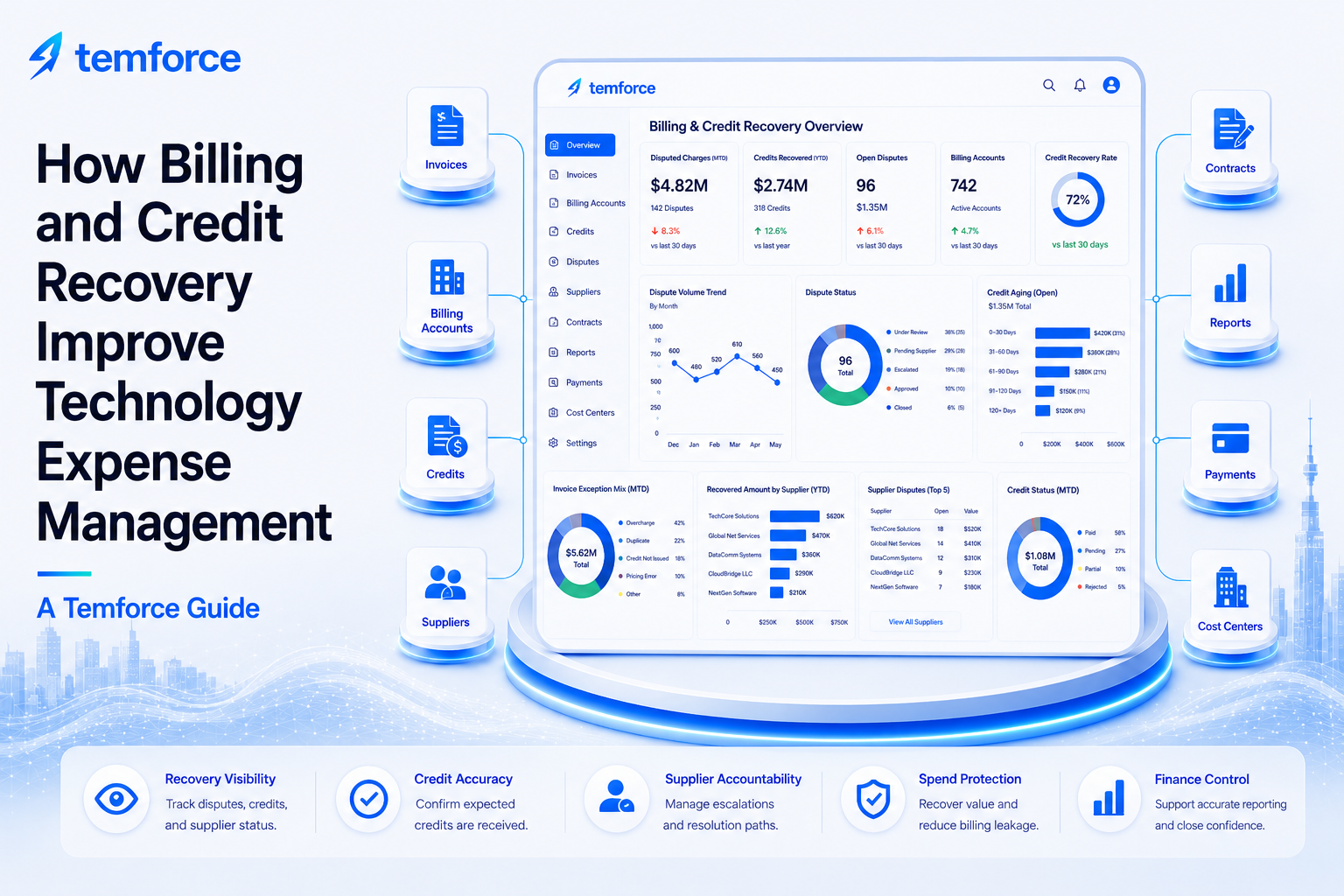
Recovery visibility connects invoice exceptions, disputed amounts, credit status, supplier actions, billing accounts, and reporting.
Every dispute, credit request, supplier follow-up, and invoice correction needs a clear owner, due date, and status.
Recovery controls help ensure supplier credits are requested, approved, received, matched to invoices, and reported accurately.
Teams spend less time chasing old disputes, supplier emails, invoice notes, credit memos, and payment questions.
Credit recovery is where TEM savings become measurable. If an overcharge is found but the credit is never confirmed, the business has identified leakage but has not recovered value.
The billing and credit recovery model
A strong recovery model connects billing errors to supplier action, invoice correction, credit confirmation, payment handling, and financial reporting.
| Recovery Area | What to Track | Why It Matters | Risk If Missing |
|---|---|---|---|
| Invoice exception | Exception type, supplier, invoice, billing account, amount, service, charge, and validation source. | Creates the starting record for recovery activity. | Errors may be discussed but never converted into tracked recovery actions. |
| Dispute status | Dispute date, owner, supplier ticket, disputed amount, supplier response, next action, and aging. | Shows whether the issue is moving toward resolution. | Supplier disputes may age without ownership or escalation. |
| Credit tracking | Credit requested, credit approved, credit expected, credit received, credit memo, and applied invoice. | Confirms whether financial recovery actually happened. | Credits may be promised but never received or applied correctly. |
| Root cause | Contract mismatch, inventory mismatch, disconnect failure, supplier error, rate issue, duplicate billing, or account issue. | Helps prevent the same billing error from repeating. | The same issue may continue across future invoices. |
| Payment impact | Holdback amount, payment adjustment, paid amount, supplier balance, payment confirmation, and remaining exposure. | Recovery activity should align to payment and supplier balance handling. | The organization may overpay, underpay, or create supplier balance disputes. |
| Reporting outcome | Recovered amount, avoided amount, open recovery pipeline, aging, supplier category, and finance period. | Shows the financial impact of the recovery process. | Leadership may not see confirmed savings or unresolved recovery exposure. |
How to manage billing and credit recovery in a TEMOps operating model
Billing and credit recovery should be managed as a controlled workflow from exception discovery through supplier resolution and credit confirmation.
Identify the billing exception
Use invoice validation, reports, contract checks, inventory matches, billing account reviews, and supplier analysis to identify recoverable issues.
Create a recovery record
Capture the supplier, invoice, charge, amount, billing account, service, owner, reason, and expected recovery outcome.
Submit and track the dispute
Document supplier tickets, communications, dispute dates, escalation contacts, requested credits, and next actions.
Confirm the credit
Match supplier-approved credits to actual credit memos, invoices, account balances, payment adjustments, and received amounts.
Correct the source issue
Update inventory, contracts, rates, billing accounts, requests, supplier records, or reporting so the same issue does not repeat.
Report recovery outcomes
Show recovered credits, avoided spend, open recovery pipeline, aging disputes, supplier performance, and recurring error patterns.
What billing and credit recovery records should track
Recovery records should capture enough detail to prove the issue, manage supplier follow-up, confirm the credit, and report the outcome.
- Supplier, billing account, invoice number, billing period, charge type, service, amount, and exception reason
- Disputed amount, credit requested, credit approved, credit expected, credit received, and remaining exposure
- Supplier ticket, dispute date, supplier contact, response date, escalation path, owner, due date, and aging
- Contract reference, expected rate, billed rate, inventory match, disconnect status, and root cause category
- Payment status, holdback status, applied credit invoice, credit memo, supplier balance, and payment confirmation
- Cost center, GL code, business unit, reporting period, recovered amount, avoided amount, and finance owner
- Task status, next action, blocker, resolution note, validation date, and closure evidence
- Recurring issue flag, supplier performance category, dashboard status, and prevention action
If a billing error is worth disputing, it is worth tracking until the credit is confirmed and the root cause is corrected.
Common billing and credit recovery issues
Recovery issues usually appear when invoice validation, supplier disputes, credit memos, payment handling, and reporting are disconnected.
Invoice exceptions may be identified but not assigned to a person responsible for supplier follow-up.
Supplier credits can be discussed or approved without being matched to an actual invoice or credit memo.
Teams may not know whether to hold, short-pay, pay, or adjust an invoice while a dispute is open.
A credit may be recovered once, but future invoices may continue to bill incorrectly if the source issue is not corrected.
Supplier recovery slows down when the business cannot show invoice detail, expected pricing, inventory status, or dispute history.
Leadership may see exceptions found, but not credits recovered, credits pending, aging disputes, or avoided spend.
Example scenario: a disconnected service that is still billing
A telecom service was requested for disconnect, but the supplier continues billing recurring charges for two months. In a weak process, the team may dispute the invoice by email and hope a credit appears later. In a stronger TEMOps process, the disconnect record, invoice line, billing account, supplier ticket, disputed amount, expected credit, and credit confirmation are all connected.
Instead of asking, “Did we dispute this charge?” the business asks, “Was the credit approved, did it appear on the invoice, was the billing stopped, and did we correct the source record?”
How Temforce helps with billing and credit recovery
Temforce helps organizations connect billing and credit recovery to the invoice, inventory, supplier, billing account, contract, payment, task, report, and dashboard records that support stronger TEM financial control.
The goal is to move recovery activity away from scattered emails and supplier notes and toward a governed TEMOps workflow with clear ownership, credit visibility, supplier accountability, and measurable outcomes.
Connect invoice exceptions to dispute records, supplier tickets, credit requests, credit approvals, credit receipts, and closure evidence.
Track supplier responses, escalation paths, credit aging, unresolved disputes, recurring billing issues, and supplier performance.
Report recovered credits, avoided spend, open recovery pipeline, dispute aging, payment impacts, and root cause trends.
