
Build a TEMOps governance model that turns visibility into control.
Use the TEMOps Governance Framework to define roles, ownership, meeting cadence, controls, KPIs, supplier reviews, invoice validation routines, lifecycle workflow reviews, savings tracking, Boostforce AI usage, ready-built API reporting, support cadence, and executive reporting.
TEMOps governance is the operating rhythm behind better expense control.
Technology Expense Management becomes stronger when teams stop treating inventory, invoices, suppliers, contracts, requests, lifecycle actions, savings, and reporting as separate activities. Governance connects those activities into a shared cadence with clear roles, measurable controls, and visible accountability.
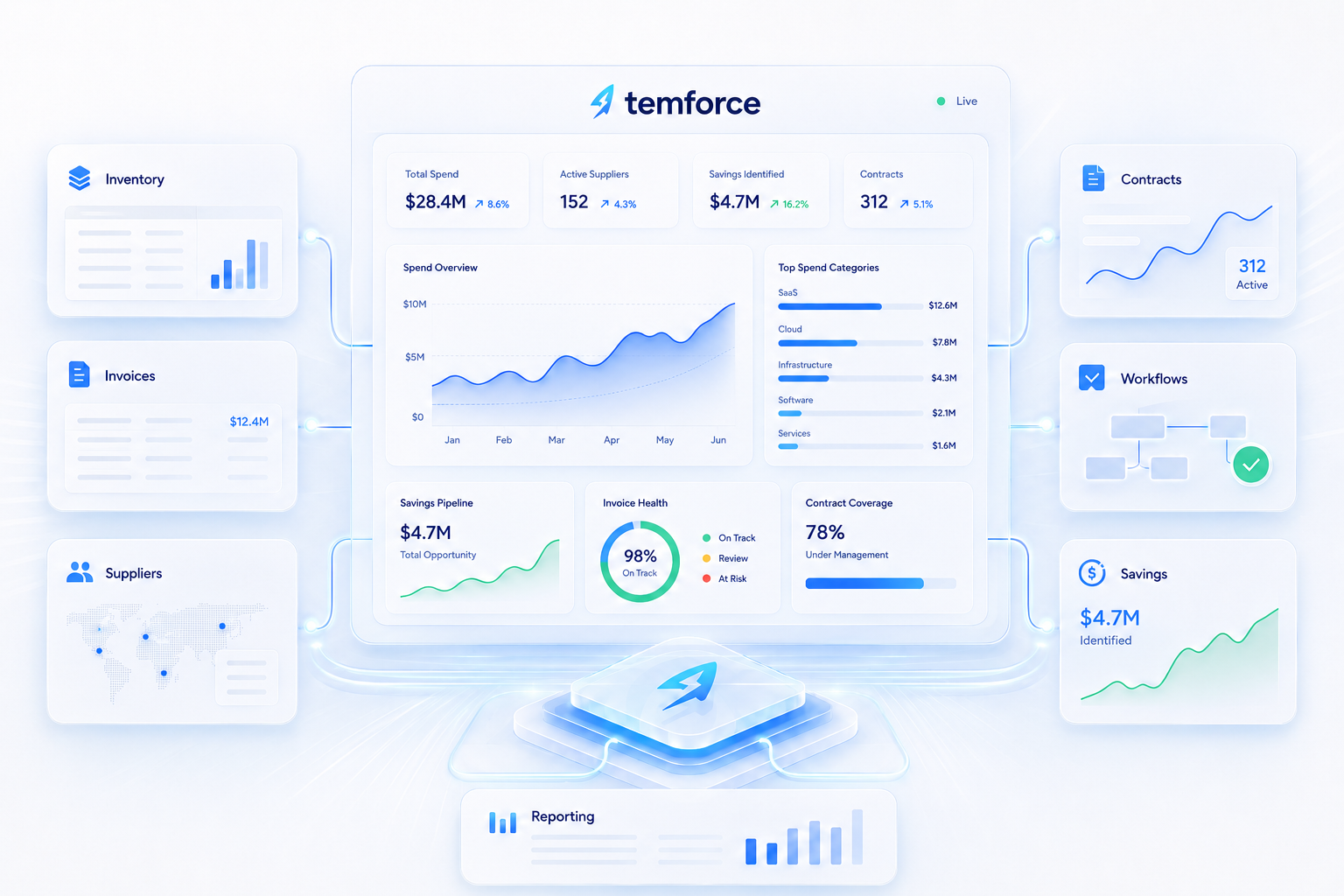
Clarify who owns inventory quality, invoice review, supplier follow-up, contract review, workflow movement, savings proof, and reporting.
Use daily execution, weekly operating reviews, monthly controls, quarterly supplier reviews, executive reporting, and continuous improvement.
Track savings, credits, recoveries, invoice corrections, supplier outcomes, lifecycle progress, data quality, workflow status, and reporting evidence.
A TEMOps governance model has six connected pillars.
The strongest governance model turns TEMOps into a repeatable operating system for visibility, action, accountability, and proof.
Role and ownership governance.
Define who owns inventory records, invoice exceptions, supplier follow-up, contract reviews, lifecycle requests, MCAD orders, savings opportunities, reporting, data quality, AI usage, API coordination, and support routines.
Inventory truth governance.
Define how inventory quality is reviewed, updated, assigned, validated, and connected to invoices, suppliers, contracts, owners, locations, cost centers, lifecycle status, workflows, AI, APIs, and reports.
Invoice validation governance.
Define the rhythm for invoice review, exception handling, dispute ownership, approval routing, credit follow-up, recovery validation, supplier correction tracking, and reporting to finance and leadership.
Supplier and contract governance.
Define how suppliers are reviewed, contracts are monitored, renewals are tracked, disputes are escalated, correction requests are documented, credits are confirmed, and supplier outcomes are reported.
Lifecycle workflow governance.
Define how requests, moves, changes, adds, disconnects, renewals, retirements, MCAD orders, supplier actions, inventory updates, billing confirmations, approvals, and savings are reviewed.
Savings, reporting, AI, API, and support governance.
Define how savings are tracked, dashboards are reviewed, Boostforce AI is used, ready-built APIs support connected data, support routines operate, and leadership reporting connects activity to measurable value.
Set a rhythm that keeps TEMOps work moving.
A governance cadence helps teams move from reactive follow-up to repeatable execution.
| Cadence | Primary Focus | What to Review |
|---|---|---|
| Daily execution | Move active work forward. | Open tasks, invoice exceptions, supplier responses, MCAD orders, requests, urgent disputes, missing data, and workflow blockers. |
| Weekly TEMOps review | Review operating status across workstreams. | Inventory quality, invoice exception aging, supplier follow-up, lifecycle workflow status, credits, recoveries, savings, and support needs. |
| Monthly controls review | Confirm financial, supplier, and operational controls. | Spend trends, invoice validation outcomes, savings proof, supplier corrections, billing changes, disconnects, cost center issues, and reporting accuracy. |
| Quarterly supplier review | Hold suppliers accountable. | Open issues, dispute performance, contract obligations, correction aging, credit status, recovery status, renewal risk, and service performance. |
| Executive reporting | Show leadership outcomes and risks. | Total spend, savings, recoveries, open risk, major suppliers, workflow progress, inventory quality, TEMOps maturity, and next actions. |
| Continuous improvement | Improve the operating model. | Workflow bottlenecks, reporting gaps, AI usage, API needs, support patterns, customization opportunities, adoption, and governance maturity. |
Give every stakeholder a clear TEMOps responsibility.
Governance becomes stronger when each team knows what it owns and how its work connects to the broader operating model.
Reviews spend, approvals, invoice validation outcomes, credits, recoveries, cost allocation, savings proof, and financial reporting.
Supports inventory truth, technical ownership, service changes, lifecycle updates, disconnects, renewals, and operational context.
Owns telecom inventory, carrier follow-up, circuit records, mobile services, billing account issues, MCAD orders, and disputes.
Supports supplier management, contract visibility, renewals, obligations, escalations, sourcing context, and supplier performance reviews.
Helps move requests, tasks, approvals, lifecycle actions, supplier follow-up, documentation, reporting cadence, and operating routines.
Respond to disputes, correction requests, credits, recoveries, contract questions, service changes, escalations, and billing issues.
Supports configuration, workflow improvement, reporting reviews, issue resolution, platform adoption, customization, AI, APIs, and guidance.
Reviews spend, savings, risks, supplier outcomes, inventory quality, workflow progress, operating maturity, and strategic decisions.
Governance turns TEMOps from a process into an operating discipline.
Temforce helps teams govern technology expense work by connecting inventory truth, invoice validation, supplier accountability, contracts, lifecycle workflows, Boostforce AI, ready-built APIs, application customization, dedicated support, savings tracking, dashboards, and reporting.
TEMOps Governance Framework FAQ.
Use these answers to understand TEMOps governance across roles, ownership, cadence, controls, KPIs, suppliers, invoices, savings, support, and reporting.
What is TEMOps governance?
TEMOps governance is the operating model that defines how Technology Expense Management work is owned, reviewed, measured, improved, and reported. It connects inventory truth, invoice validation, supplier accountability, contracts, lifecycle workflows, savings tracking, dashboards, AI, APIs, support, and reporting.
Why does TEMOps governance matter?
TEMOps governance matters because technology expense work often crosses finance, IT, telecom, procurement, operations, suppliers, support, and leadership. Governance creates a shared cadence, clear ownership, measurable controls, and evidence-backed reporting.
What should be included in a TEMOps governance framework?
A TEMOps governance framework should include roles, ownership, inventory controls, invoice validation routines, supplier reviews, contract reviews, lifecycle workflow governance, savings tracking, reporting cadence, KPIs, AI usage, API coordination, support routines, and executive reporting.
How often should TEMOps governance be reviewed?
TEMOps governance can include daily execution reviews, weekly operating reviews, monthly control reviews, quarterly supplier reviews, executive reporting, and continuous improvement sessions. The right cadence depends on complexity, spend, supplier activity, and operating maturity.
How do dashboards support TEMOps governance?
Dashboards support TEMOps governance by showing inventory quality, invoice exceptions, supplier performance, lifecycle workflow status, savings proof, credits, recoveries, AI-supported summaries, API-connected data, and leadership-ready reporting.
How does Temforce support TEMOps governance?
Temforce supports TEMOps governance by connecting inventory truth, invoice validation, supplier accountability, contracts, lifecycle workflows, Boostforce AI, ready-built APIs, application customization, dedicated support, savings tracking, dashboards, and reporting into one TEMOps platform.
Turn governance into TEMOps execution.
Temforce helps teams govern technology expense work with inventory truth, invoice validation, supplier accountability, contract visibility, lifecycle workflows, Boostforce AI, ready-built APIs, application customization, dedicated support, savings tracking, dashboards, and reporting.
