
Inventory truth is the framework behind technology expense control.
The Technology Inventory Truth Framework helps teams connect what exists to what is billed, who owns it, which supplier supports it, which contract governs it, what lifecycle status applies, where savings may exist, and how AI, APIs, workflows, support, and reporting can turn inventory data into TEMOps execution.
Technology inventory is not just a list. It is the operating record that gives invoices, suppliers, contracts, lifecycle work, AI, APIs, savings, and reporting something to trust.
Many organizations have inventory data spread across spreadsheets, invoices, supplier portals, finance files, network tools, contract folders, service records, and tribal knowledge. The problem is not only missing data. The bigger problem is disconnected truth.
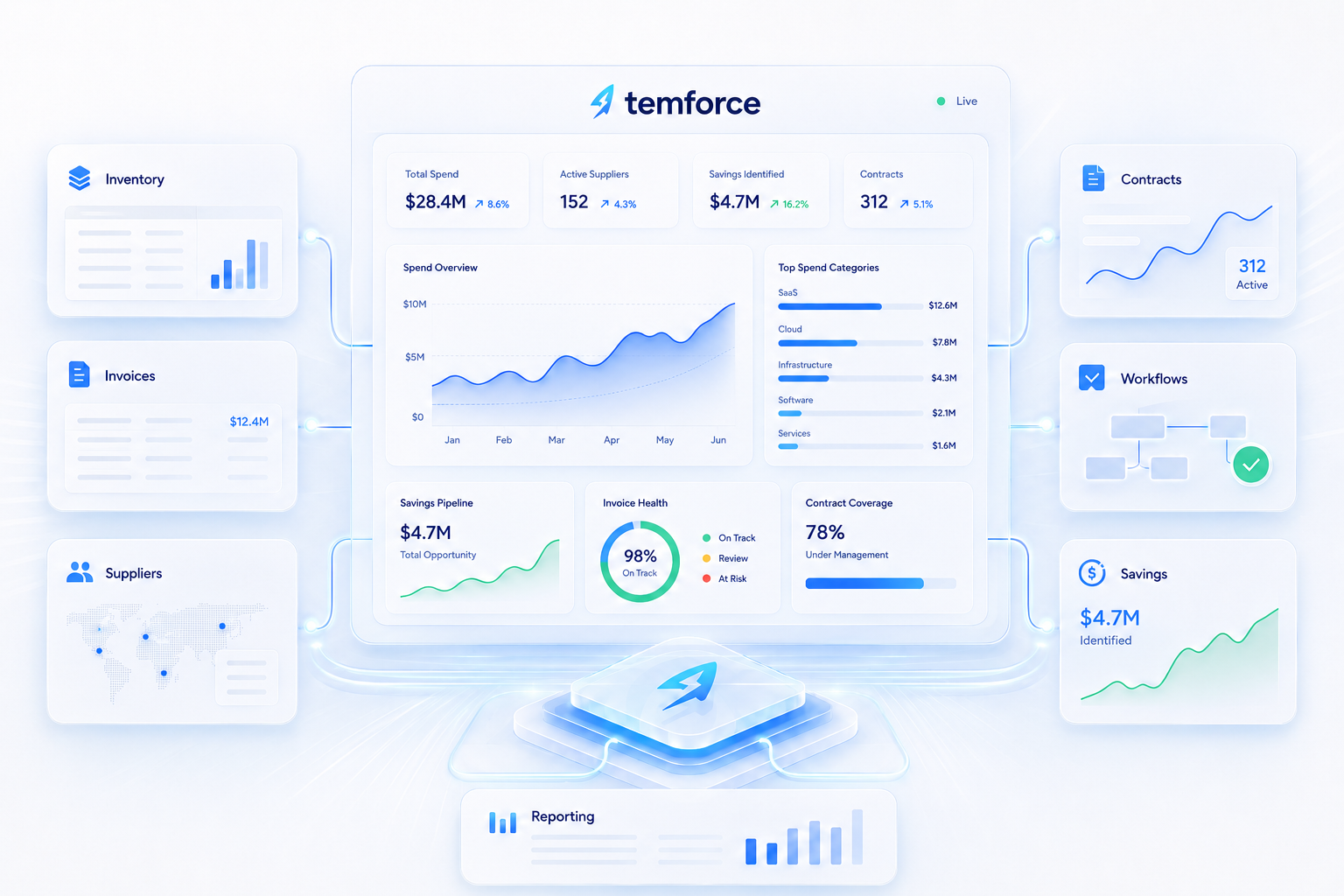
Services, assets, circuits, mobile lines, billing accounts, suppliers, contracts, owners, locations, cost centers, and lifecycle status need to connect.
Each record should help validate billed charges, expected costs, contract context, supplier activity, approvals, disputes, credits, recoveries, and savings.
When a record is wrong, stale, duplicate, disconnected, overbilled, missing ownership, or ready for disconnect, the platform should move it into TEMOps execution.
The inventory truth framework has six connected layers.
The framework turns inventory from a static record into the operating foundation for invoice validation, supplier accountability, contract visibility, lifecycle management, AI, APIs, support, savings, and reporting.
Record truth.
Record truth means the organization has a reliable inventory record for each service, asset, circuit, mobile line, network element, billing account, supplier relationship, owner, location, cost center, and contract connection. The record should be usable by finance, IT, telecom, procurement, operations, and leadership.
Billing truth.
Billing truth connects inventory to the invoices and billing accounts where charges appear. Teams should be able to see whether a billed item belongs to a known inventory record, whether the amount is expected, whether the supplier is correct, and whether a charge requires approval, dispute, correction, or follow-up.
Ownership truth.
Ownership truth answers who is responsible for each record, service, cost, decision, approval, dispute, renewal, disconnect, or lifecycle action. Without ownership truth, inventory becomes a passive list instead of an operating control layer.
Supplier and contract truth.
Supplier and contract truth connects the inventory record to the external party and commercial terms behind the service. Teams need visibility into supplier contacts, billing relationships, contract coverage, terms, renewals, amendments, commitments, obligations, disputes, and corrections.
Lifecycle truth.
Lifecycle truth explains where each inventory record stands in its operating life. New, active, changing, renewing, disputed, pending disconnect, disconnected, retired, or under review records should move through workflow and be validated against billing impact.
Intelligence and reporting truth.
Inventory truth should make the organization smarter. Boostforce AI, ready-built APIs, application customization, dedicated support, dashboards, and reporting help teams ask better questions, connect data flows, tailor workflows, improve adoption, and report outcomes with evidence.
Inventory truth depends on the right relationship model.
The goal is not to collect more fields for the sake of fields. The goal is to connect the records that explain cost, ownership, supplier accountability, lifecycle status, and operating action.
| Inventory Relationship | Why it matters | How Temforce supports the framework |
|---|---|---|
| Service to billing account | Teams need to know where the service appears on invoices and whether the billing account is correct. | Temforce connects inventory records to billing account context, invoice validation, supplier follow-up, and finance reporting. |
| Service to supplier | Supplier accountability depends on knowing which carrier, vendor, or provider supports the service. | Temforce connects supplier records, contacts, escalations, disputes, corrections, contracts, and reporting to the inventory record. |
| Service to contract | Contract visibility helps teams understand pricing context, commitments, renewals, amendments, obligations, and coverage. | Temforce connects contract management to inventory, suppliers, invoice validation, renewals, lifecycle activity, and savings proof. |
| Service to owner | Ownership clarifies who can approve, review, dispute, disconnect, renew, or validate the service. | Temforce connects owners, approvers, cost centers, departments, tasks, requests, decisions, and reporting. |
| Service to lifecycle status | Lifecycle status shows whether the service is active, pending change, under review, renewing, disconnecting, retired, or disputed. | Temforce supports requests, MCAD order management, lifecycle workflows, inventory updates, billing impact, and savings tracking. |
| Service to cost center | Cost center alignment helps finance understand allocation, approval context, budget impact, and reporting structure. | Temforce connects inventory to finance context, reporting views, invoice validation, approvals, and leadership dashboards. |
| Service to workflow | Inventory should trigger action when something is missing, wrong, stale, overbilled, duplicated, disputed, or ready for disconnect. | Temforce connects inventory records to tasks, requests, meetings, documents, supplier follow-up, AI support, dashboards, and reports. |
Use inventory truth checks to find waste and risk.
Inventory truth becomes valuable when it exposes the records, charges, suppliers, contracts, and lifecycle gaps that need action.
Records without a business, technical, finance, or operational owner create approval gaps, slow disputes, and weak lifecycle control.
A billed charge without a trusted inventory record may indicate missing data, duplicate billing, inactive service, supplier error, or review need.
Disconnected or retired services should be validated against invoices to confirm billing stopped and savings are documented.
Supplier mismatches can reveal incorrect records, billing account issues, contract gaps, consolidation opportunities, or dispute needs.
Inventory records without contract visibility can weaken renewal planning, invoice validation, supplier accountability, and pricing review.
Duplicate records, overlapping locations, redundant circuits, unused mobile lines, or duplicate software services can create savings opportunities.
Records that have not been reviewed, validated, updated, or linked to billing activity may require lifecycle review or ownership confirmation.
Records without cost center, department, owner, location, supplier, or contract context weaken reporting and leadership visibility.
The strongest inventory is not static. It becomes a TEMOps control layer.
Temforce helps teams turn technology inventory into an operating framework that supports invoice validation, supplier accountability, contract visibility, lifecycle workflows, Boostforce AI, ready-built APIs, application customization, dedicated support, savings tracking, and reporting.
Technology Inventory Truth Framework FAQ.
Use these answers to understand how inventory truth supports invoice validation, supplier control, contracts, lifecycle workflows, AI, APIs, support, savings, and reporting.
What is technology inventory truth?
Technology inventory truth is the trusted operating record of services, assets, billing accounts, suppliers, owners, locations, cost centers, contracts, lifecycle status, and spend context used to support invoice validation, supplier control, lifecycle workflows, savings, AI, APIs, and reporting.
Why does inventory truth matter in Technology Expense Management?
Inventory truth matters because teams cannot reliably validate invoices, manage suppliers, connect contracts, control lifecycle changes, identify savings, use AI effectively, connect APIs, or report outcomes if they do not know what exists and why it is being billed.
What should be included in a technology inventory record?
A technology inventory record should include service or asset details, supplier, billing account, owner, location, department, cost center, contract reference, lifecycle status, expected cost, invoice context, workflow status, and reporting fields.
How does inventory truth support invoice validation?
Inventory truth supports invoice validation by giving teams a reliable record to compare against billed charges, billing accounts, supplier records, contracts, approvals, expected charges, disputes, credits, recoveries, and finance context.
How does inventory truth support supplier and contract management?
Inventory truth connects each service or asset to the supplier, contract, billing account, renewal status, escalation path, pricing context, dispute history, correction activity, and reporting needed for supplier and contract accountability.
How do AI and APIs depend on inventory truth?
Boostforce AI and ready-built APIs become more useful when they are connected to trusted inventory records. Clean inventory context helps AI surface better answers and helps APIs support connected data flows, reporting, finance handoffs, and customer ecosystem alignment.
How does Temforce support the Technology Inventory Truth Framework?
Temforce supports the Technology Inventory Truth Framework by connecting inventory records to invoices, billing accounts, suppliers, contracts, owners, locations, lifecycle workflows, Boostforce AI, ready-built APIs, application customization, dedicated support, savings tracking, dashboards, and reporting.
Turn inventory into operating truth.
Temforce helps teams build inventory truth across technology services, telecom services, billing accounts, suppliers, contracts, owners, lifecycle workflows, Boostforce AI, ready-built APIs, application customization, dedicated support, savings tracking, dashboards, and reporting.
