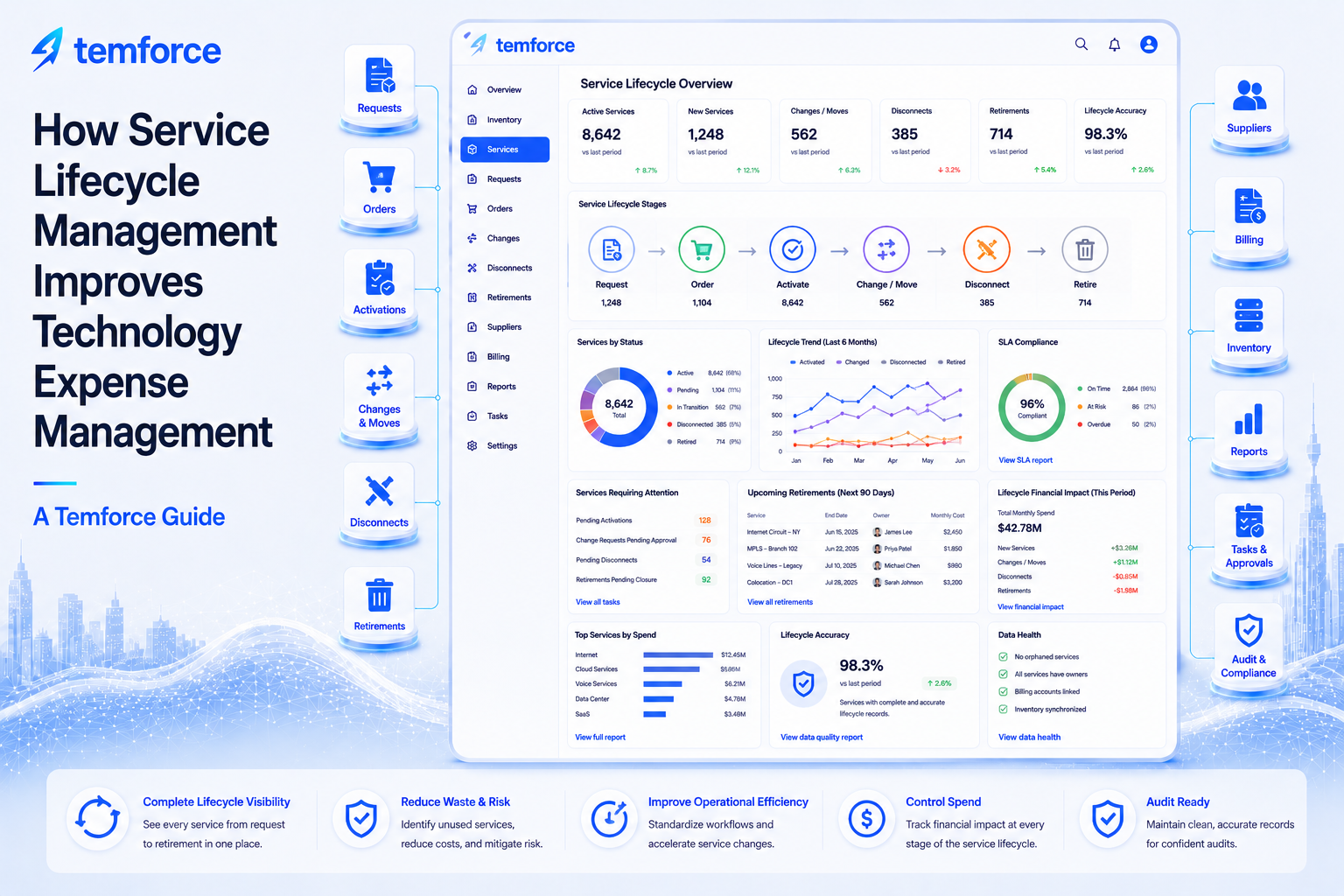
How Service Lifecycle Management Improves Technology Expense Management
May 31, 2026
Inventory
Service lifecycle management improves technology expense management by controlling how technology services are requested, activated, assigned, changed, renewed, disconnected, validated, and retired. When the service lifecycle is managed correctly, inventory stays cleaner, invoices become easier to validate, and waste is reduced before it becomes recurring spend.
Technology services do not stay static. They are ordered, installed, assigned, modified, billed, reviewed, renewed, and eventually disconnected or replaced. Service lifecycle management gives TEM teams a controlled way to manage those changes so operational records and financial records stay aligned.
A service should never enter, change, renew, or leave the environment without updating the inventory, billing, ownership, supplier, and finance records that depend on it.
Why service lifecycle management matters in TEM
Many technology expense problems are lifecycle problems. Services are ordered but never added to inventory. Users move but ownership is not updated. Contracts renew without review. Disconnects are requested but billing continues. Services are retired but cost centers are still charged.
A strong service lifecycle process helps teams control those changes before they create invoice exceptions, supplier disputes, reporting gaps, or recurring waste.
Lifecycle visibility connects active, pending, changed, suspended, renewed, disconnected, and retired services to the right records.
Every service change should have a requester, approver, owner, supplier action, inventory update, and closure record.
Controls help identify delayed disconnects, unassigned services, duplicate records, unsupported billing, and stale renewals.
Teams spend less time reconciling services after the fact when lifecycle events update records as work happens.
Service lifecycle management is one of the most direct ways to keep inventory truth alive. It connects the operational life of a service to the financial reality of what gets billed and reported.
The service lifecycle management model
A strong lifecycle model connects service activity to requests, inventory, suppliers, invoices, finance, contracts, ownership, and reporting.
| Lifecycle Stage | What to Track | Why It Matters | Risk If Missing |
|---|---|---|---|
| Request and approval | Requester, business need, approval owner, supplier, service type, budget, and expected start date. | Creates a governed entry point for new services and changes. | Services may be ordered without approval, ownership, or budget visibility. |
| Activation and assignment | Activation date, inventory record, user, owner, location, cost center, billing account, and supplier order. | Connects the new service to the records needed for billing and support. | Services may bill without being visible in inventory or finance reporting. |
| Move and change | Change type, effective date, new owner, location, cost center, rate plan, supplier ticket, and updated inventory. | Keeps records current as business needs change. | Stale records may cause billing, allocation, and reporting errors. |
| Renewal and review | Renewal date, contract coverage, usage, owner confirmation, pricing review, and optimization decision. | Ensures services are still needed before commitments continue. | Unused or overpriced services may renew automatically. |
| Disconnect and retire | Disconnect request, supplier confirmation, final bill, inventory retirement, billing stop, and credit follow-up. | Confirms the service is removed from both operations and billing. | Disconnected services may continue to bill or remain active in inventory. |
| Validation and reporting | Lifecycle status, invoice match, exception status, owner review, savings outcome, and dashboard category. | Shows whether lifecycle controls are working. | Leadership may not see lifecycle waste, aging requests, or disconnect leakage. |
How to manage service lifecycle in a TEMOps operating model
Service lifecycle management should be part of the recurring TEMOps operating rhythm. The goal is to make every service change visible, approved, assigned, updated, validated, and closed.
Define lifecycle stages
Standardize statuses such as requested, approved, ordered, active, changed, suspended, renewal review, disconnect pending, disconnected, retired, and archived.
Connect lifecycle events to requests
Use request and MACD workflows to capture the business reason, approval, supplier action, due date, owner, and expected outcome.
Update inventory as work happens
Ensure every service change updates ownership, location, billing account, supplier, contract, cost center, and service status.
Validate invoices against lifecycle status
Compare billed charges to active, changed, disconnected, suspended, and retired service records.
Review lifecycle exceptions
Flag open orders, delayed disconnects, services without owners, billed retired services, duplicate services, and renewal risks.
Report lifecycle outcomes
Show active services, pending changes, disconnect leakage, retired services, renewal exposure, savings, and exception aging.
What service lifecycle records should track
Lifecycle records should capture enough detail to support inventory accuracy, invoice validation, supplier follow-up, ownership control, and finance reporting.
- Service ID, service type, supplier, billing account, contract, inventory record, and lifecycle status
- Requester, approver, user, business owner, technical owner, finance owner, and supplier owner
- Request type, add, move, change, disconnect, suspend, renew, retire, transfer, or validate
- Order date, activation date, change date, disconnect request date, supplier confirmation date, and retirement date
- Location, cost center, GL code, business unit, department, allocation rule, and chargeback status
- Invoice match status, billed amount, expected amount, exception status, credit status, and final bill review
- Task owner, due date, next action, blocker, escalation level, resolution note, and closure evidence
- Dashboard category, aging, savings outcome, waste risk, renewal risk, and executive summary
If a service changes operationally, the change should also update inventory, ownership, billing, supplier, contract, and finance records.
Common service lifecycle management issues
Lifecycle issues usually appear when requests, inventory, suppliers, billing, ownership, and finance records are disconnected.
Users, locations, cost centers, and billing accounts may change without inventory updates.
Disconnect requests may not be confirmed, final-billed, credited, or fully retired from inventory.
Unassigned services make validation, approvals, cost allocation, and optimization harder.
Lifecycle reviews should confirm usage, ownership, pricing, and business need before renewal.
Orders, changes, disconnects, credits, and confirmations need supplier ticket visibility.
Leadership may miss aging requests, unclosed disconnects, inactive services, and lifecycle waste.
Example scenario: a disconnected service keeps billing
A service is requested for disconnect and the supplier confirms the order, but the invoice continues billing for two more cycles. In a weak process, the issue may be caught only after manual invoice review. In a stronger TEMOps process, the disconnect request, supplier confirmation, inventory status, final bill, expected stop date, billing exception, and credit recovery action are connected.
Instead of asking, “Was the disconnect requested?” the business asks, “Was the supplier confirmation received, did billing stop, was inventory retired, and was any credit recovered?”
How Temforce helps with service lifecycle management
Temforce helps organizations connect service lifecycle management to requests, inventory, invoices, suppliers, billing accounts, contracts, cost centers, tasks, reports, and dashboards.
The goal is to move lifecycle control away from scattered emails and manual spreadsheets and toward a governed TEMOps process with clear statuses, owners, supplier actions, inventory updates, and financial outcomes.
Track requested, active, changed, suspended, renewal review, disconnected, retired, and archived services.
Connect lifecycle changes to approvals, supplier actions, ownership updates, billing accounts, and inventory truth.
Report active services, pending disconnects, aging requests, renewal exposure, billing leakage, and completed actions.
