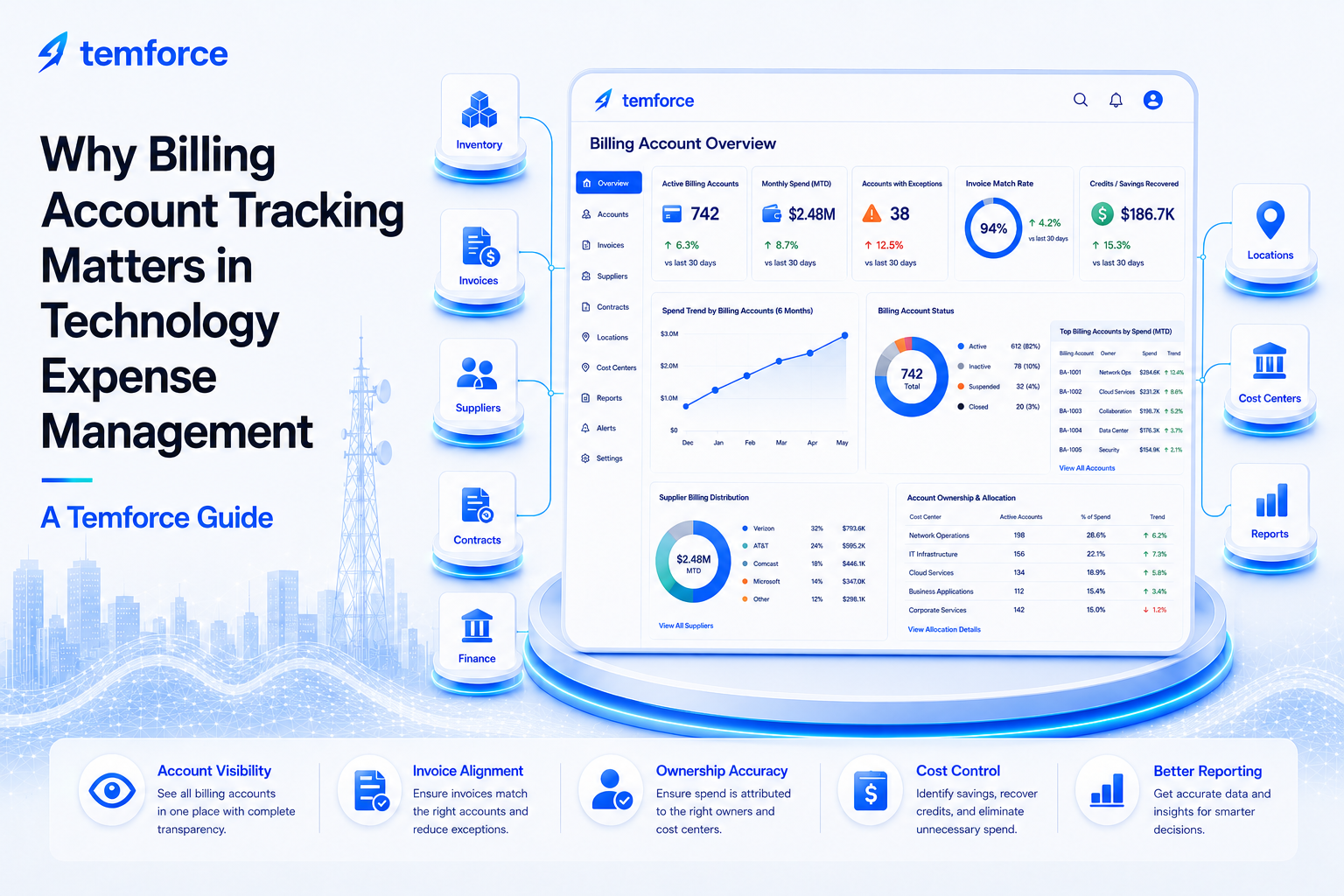
Why Billing Account Tracking Matters in Technology Expense Management
May 29, 2026
Cost Control
Billing account tracking matters in technology expense management because supplier invoices, inventory records, payment status, cost centers, contracts, disputes, credits, and reports all depend on knowing which billing accounts exist, what they contain, who owns them, and whether they should still be active.
A billing account is more than a supplier account number. It is an operating record that explains how services are grouped, billed, paid, allocated, validated, disputed, credited, and reported. When billing accounts are not tracked, invoice validation and finance control become harder than they need to be.
Every active billing account should have a supplier, owner, invoice history, inventory connection, payment status, cost center context, lifecycle status, and business purpose. If a billing account cannot be explained, it should be reviewed.
Why billing account tracking matters in TEM
Supplier billing accounts often become messy over time. Accounts are opened for projects, locations, service groups, acquisitions, migrations, supplier changes, or temporary needs. Some accounts stay active long after their purpose is unclear.
A strong billing account tracking process helps the business understand which accounts exist, what services they contain, what invoices they generate, who owns them, what charges are expected, and what needs cleanup.
Billing account tracking connects suppliers, invoices, services, locations, owners, contracts, cost centers, credits, and payments.
Billing accounts need clear business owners, finance owners, supplier contacts, lifecycle rules, and review responsibility.
Account tracking helps identify inactive accounts, missing invoices, unexpected charges, duplicate accounts, and unsupported billing.
Teams spend less time trying to decode supplier account numbers, billing structures, charge groupings, and finance ownership.
Billing accounts are one of the most important control points in TEM. If the billing account tracker is clean, invoices are easier to validate, finance has better allocation confidence, suppliers are easier to manage, and reporting becomes more trustworthy.
The billing account tracking model
A strong billing account model connects supplier billing structures to inventory, invoices, finance, ownership, contracts, payments, disputes, and reports.
| Billing Account Area | What to Track | Why It Matters | Risk If Missing |
|---|---|---|---|
| Account identity | Supplier, billing account number, customer number, invoice group, parent account, account type, and account status. | Creates a clean reference point for invoices, supplier support, disputes, payments, and reporting. | The same account may be tracked inconsistently across invoices, spreadsheets, supplier portals, and finance records. |
| Inventory connection | Services, circuits, devices, phone numbers, subscriptions, locations, users, and lifecycle status tied to the account. | Inventory explains what the billing account is supposed to contain. | Charges may be approved without knowing which active services they support. |
| Invoice history | Invoice numbers, invoice dates, billing periods, recurring charges, usage charges, taxes, fees, credits, and payment status. | Invoice history helps identify changes, gaps, duplicate billing, missing invoices, and unexpected charges. | Teams may miss invoice gaps, supplier errors, credit delays, and spend changes. |
| Ownership and finance coding | Business owner, finance owner, technical owner, cost center, GL code, business unit, department, and allocation rule. | Billing account ownership supports chargeback, accruals, budget review, and finance accountability. | Charges may post to the wrong cost center or remain unallocated. |
| Supplier and contract context | Supplier contacts, support paths, contract references, rate plans, terms, renewal dates, and pricing commitments. | Supplier and contract context supports disputes, renewals, pricing checks, credits, and escalation. | Pricing errors, renewal risks, and supplier accountability issues may be missed. |
| Lifecycle and cleanup status | Active, inactive, pending closure, under review, merged, migrated, retired, duplicate, or missing invoice status. | Lifecycle tracking helps identify accounts that should be closed, merged, reviewed, or corrected. | Old accounts may continue generating charges or hiding unmanaged services. |
How to manage billing accounts in a TEMOps operating model
Billing account tracking should be part of the recurring operating rhythm. The goal is to make each account explainable, validated, owned, and connected to the services and invoices it supports.
Build the account inventory
Capture supplier account numbers, invoice groups, parent accounts, account status, owners, finance codes, and supplier contacts.
Connect accounts to services
Link billing accounts to active inventory, service IDs, phone numbers, circuits, devices, subscriptions, locations, owners, and lifecycle status.
Review invoice activity
Compare account records against invoices, billing periods, recurring charges, usage charges, credits, fees, taxes, and payment confirmation.
Identify account exceptions
Flag inactive accounts, missing invoices, unexpected charges, unowned accounts, duplicate accounts, unmapped services, and stale cost centers.
Assign cleanup and supplier follow-up
Use tasks to route disputes, credit requests, account closures, supplier questions, payment issues, and inventory corrections.
Report on account health
Track account status, invoice coverage, unallocated spend, missing owners, active accounts not invoiced, and accounts that should be closed.
What billing account records should track
Billing account records should capture enough information to support invoice validation, payment control, cost allocation, supplier management, disputes, credits, reporting, and cleanup.
- Supplier, billing account number, customer number, invoice group, parent account, account type, and account status
- Business owner, finance owner, technical owner, department, business unit, cost center, GL code, and allocation rule
- Invoice numbers, billing periods, invoice totals, recurring charges, usage charges, taxes, fees, credits, and payment status
- Active services, service IDs, phone numbers, circuits, devices, subscriptions, locations, users, and lifecycle status
- Contract reference, rate plan, pricing terms, renewal date, supplier support path, and escalation contact
- Dispute status, credit status, payment confirmation, missing invoice status, account closure status, and supplier ticket numbers
- Request history, MACD activity, account changes, merges, migrations, disconnects, and cleanup actions
- Reporting category, dashboard status, account health, exception aging, and next action
If a supplier billing account appears on an invoice, it should be connected to active inventory, valid ownership, finance coding, and a clear business purpose.
Common billing account tracking issues
Billing account issues usually appear when supplier account structures, invoices, inventory, ownership, and finance data are not connected.
Accounts may remain active without a business owner, finance owner, technical owner, or review responsibility.
Missing invoices can create accrual issues, reporting gaps, supplier confusion, and delayed payment visibility.
Billing accounts may contain charges that cannot be tied to active inventory, known services, or valid locations.
Charges may be misallocated when billing accounts are tied to outdated cost centers, departments, or GL codes.
Supplier disputes, credits, billing corrections, and account closures are harder to manage when account context is incomplete.
Teams may not see inactive accounts, duplicate accounts, missing invoices, unmanaged spend, or unresolved billing exceptions.
Example scenario: an active billing account with no matching services
A supplier invoice includes a billing account that is still generating recurring charges, but the services on the account do not match active inventory. In a weak process, the invoice may be paid because the supplier account is familiar. In a stronger TEMOps process, the account is flagged for review, connected to inventory, assigned to an owner, and routed for supplier follow-up if the charges cannot be validated.
Instead of asking, “Do we recognize this supplier account?” the business asks, “What services does this account contain, who owns them, what invoice charges are expected, what cost center should fund them, and should this account still be active?”
How Temforce helps with billing account tracking
Temforce helps organizations connect billing accounts to the inventory, invoice, supplier, contract, finance, payment, dispute, credit, report, and dashboard records that support stronger TEM control.
The goal is to move billing account tracking away from scattered supplier account lists and toward a governed TEMOps process with clear ownership, invoice validation, account lifecycle control, and finance visibility.
Connect supplier accounts to invoices, inventory, owners, locations, services, contracts, cost centers, and lifecycle status.
Support invoice review, payment confirmation, cost allocation, accruals, chargebacks, GL coding, and unallocated spend review.
Track missing invoices, duplicate accounts, inactive accounts, disputes, credits, supplier follow-ups, and account closures.
