Why Site and Location Data Matter in Technology Expense Management
May 29, 2026
Cost Control
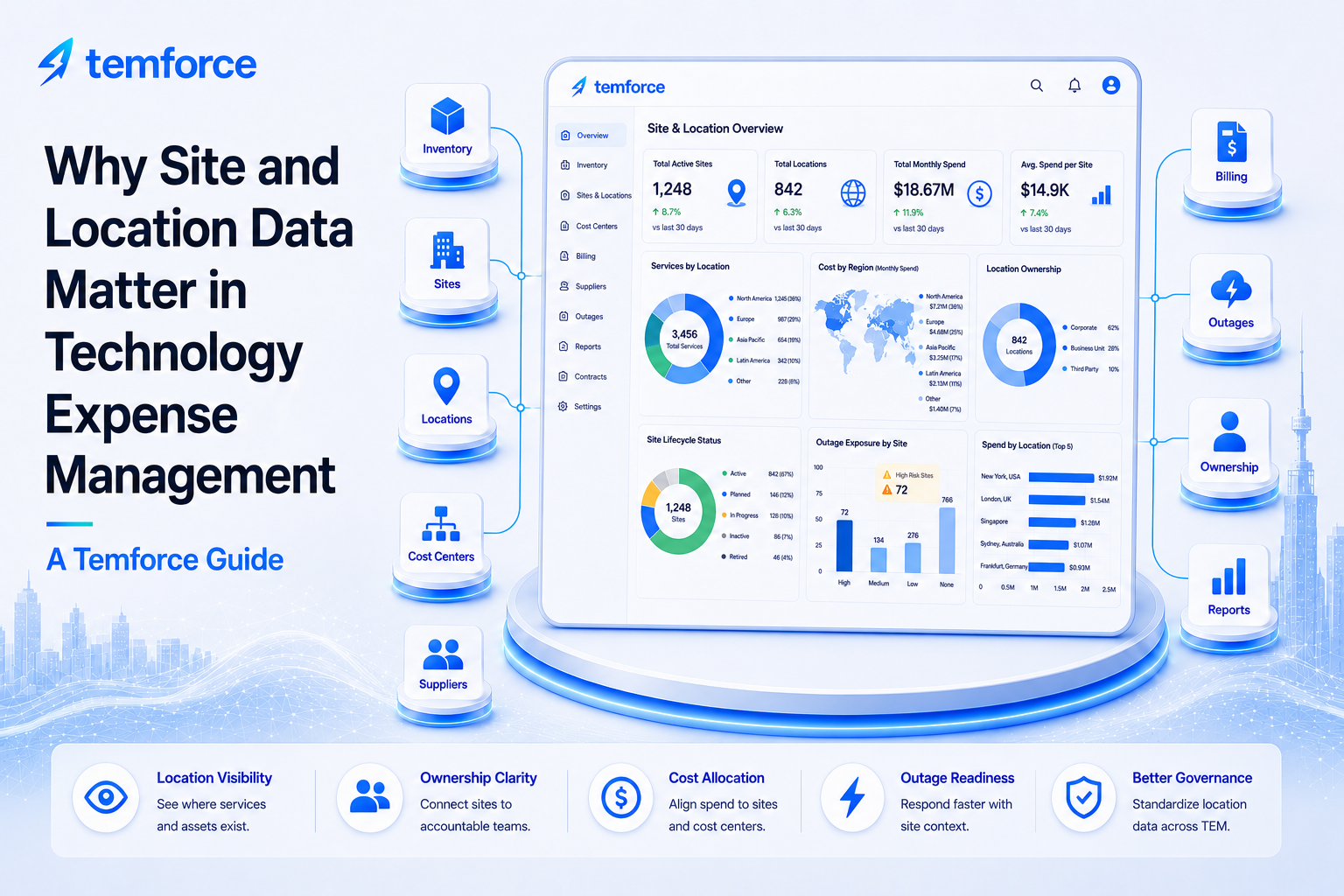
Site and location data matter in technology expense management because services, invoices, suppliers, outages, owners, contracts, cost centers, and requests all need a place to connect. When location data is clean, the business can understand where technology services exist, who uses them, what they cost, and what operational risk may exist at each site.
Location data is one of the most important operating fields in TEM. It helps explain where a service is installed, which business unit depends on it, which supplier supports it, which invoice contains it, which cost center funds it, and who should be contacted when something changes.
A service record without reliable location data is harder to validate, allocate, troubleshoot, renew, disconnect, and report. Location data turns inventory from a list of services into a usable operating map.
Why site and location data matters in TEM
Technology expense programs often struggle because location names, addresses, site codes, billing addresses, service addresses, and business unit labels do not match. One office may appear five different ways across invoices, contracts, supplier portals, and spreadsheets.
Clean location data gives the business a consistent way to connect services, suppliers, invoices, owners, cost centers, outages, and reports to the real operating footprint.
Location data connects services, suppliers, circuits, devices, applications, billing accounts, users, and business units to physical or logical sites.
Sites need owners, local contacts, cost centers, business units, support contacts, request rules, and lifecycle status.
Standard site data helps prevent duplicate records, stale addresses, wrong cost centers, unmanaged services, and missed disconnects.
Teams spend less time matching invoices, supplier records, service IDs, outages, and cost centers to the right location.
Location data is where TEM becomes practical. If the business can see every service tied to a site, it can validate invoices, respond to outages, review renewals, allocate costs, plan moves, and find waste with more confidence.
The site and location data model
A strong location model should connect site records to inventory, suppliers, invoices, requests, owners, contracts, outages, finance, and reports.
| Location Area | What to Track | Why It Matters | Risk If Missing |
|---|---|---|---|
| Site identity | Site name, site code, address, region, country, business unit, location type, and status. | Creates a consistent reference point across inventory, invoices, requests, and reports. | The same location may appear under multiple names, creating duplicate or incomplete records. |
| Service footprint | Services, circuits, devices, applications, subscriptions, accounts, suppliers, and billing accounts tied to the site. | Shows what technology services support the location. | Teams may not know what services exist at a site or what should be disconnected. |
| Ownership and contacts | Business owner, local contact, technical owner, finance owner, site manager, and escalation contact. | Location-level ownership helps route requests, outages, approvals, and cleanup work. | Issues slow down because no one knows who owns the site or service impact. |
| Finance and allocation | Cost center, GL code, department, business unit, allocation rule, chargeback owner, and budget owner. | Location data helps finance connect services and charges to the correct funding structure. | Charges may post to stale or incorrect cost centers. |
| Supplier and contract context | Supplier contacts, account numbers, contracts, renewal dates, support paths, SLA terms, and service commitments. | Supplier and contract visibility by site supports renewals, outages, and vendor accountability. | The business may miss site-specific supplier risk, contract exposure, or renewal opportunity. |
| Lifecycle and change activity | Open, closed, moving, expanding, consolidating, retired, pending disconnect, or under review. | Site lifecycle status explains why services should be added, changed, disconnected, or reviewed. | Closed or changing locations may continue billing for unnecessary services. |
How to use site data in a TEMOps operating model
Site data should be maintained as part of the operating workflow, not cleaned only during audits or major projects.
Standardize site records
Create consistent naming, site codes, address formats, regions, business units, location types, and lifecycle statuses.
Connect services to locations
Link circuits, devices, subscriptions, applications, phone numbers, billing accounts, and supplier services to the correct site.
Assign owners and contacts
Capture local contacts, business owners, technical owners, finance owners, approvers, and escalation paths for each site.
Map finance data
Connect site records to cost centers, GL codes, departments, business units, budget owners, and allocation rules.
Review lifecycle changes
Use moves, adds, changes, disconnects, closures, expansions, and consolidations to keep site and inventory data current.
Use reports to find gaps
Review missing locations, duplicate sites, stale addresses, inactive sites with active services, and services with unclear ownership.
What site and location records should track
Location records should capture enough information to support service visibility, financial allocation, outage response, supplier management, request control, and reporting.
- Site name, site code, address, city, state, country, region, location type, and lifecycle status
- Business unit, department, cost center, GL code, allocation rule, finance owner, and budget owner
- Local contact, business owner, technical owner, approver, site manager, and escalation owner
- Services, circuits, devices, subscriptions, applications, phone numbers, service IDs, and supplier references
- Suppliers, billing accounts, invoices, account numbers, support paths, contract references, and renewal dates
- Outage history, impacted services, SLA exposure, credits, service issues, and supplier escalations
- Requests, MACD activity, pending disconnects, site moves, closures, expansions, and consolidation activity
- Reporting category, dashboard grouping, cleanup status, missing data status, and next action
If a service can be billed, interrupted, moved, renewed, disconnected, or allocated, it should be tied to a reliable location or logical site record.
Common site and location data issues
Location problems usually appear when site records are created in different systems without a shared operating standard.
Supplier invoices, contracts, inventory files, and finance records may describe the same location differently.
Without site mapping, teams struggle to understand where a service is installed or who is affected.
Location changes can create allocation problems if cost centers, GL codes, and ownership are not updated.
During outages, teams may not know which site, users, services, or business units are affected.
Locations may close, move, or consolidate while services keep billing because lifecycle status is not governed.
Spend, inventory, outages, and supplier reports become less useful when site data is inconsistent or incomplete.
Example scenario: a closed office with active services
A business location closes, but several circuits and services continue billing because they were not tied to a governed site lifecycle process. In a weak process, the charges may stay active because each invoice line looks normal. In a stronger TEMOps process, the site closure triggers inventory review, disconnect requests, supplier follow-up, invoice validation, cost center updates, and reporting.
Instead of asking, “What services do we have?” the business asks, “Where are the services installed, who owns the site, is the location still active, what supplier supports it, and what should change now?”
How Temforce helps with site and location management
Temforce helps organizations connect site and location records to the inventory, invoice, supplier, contract, outage, request, finance, report, and dashboard data that make technology expense management operational.
The goal is to move location management away from inconsistent labels and scattered spreadsheets, and toward a governed TEMOps process with clear visibility, ownership, and action.
Connect services, suppliers, billing accounts, owners, contracts, cost centers, and lifecycle status to site records.
Use site data to support outages, local contacts, supplier escalations, service impact, requests, and disconnect activity.
Support cost allocation, chargebacks, spend by location, inactive site reporting, dashboard grouping, and cleanup actions.
