How Supplier Relationships Support Technology Expense Management
May 28, 2026
Category Management
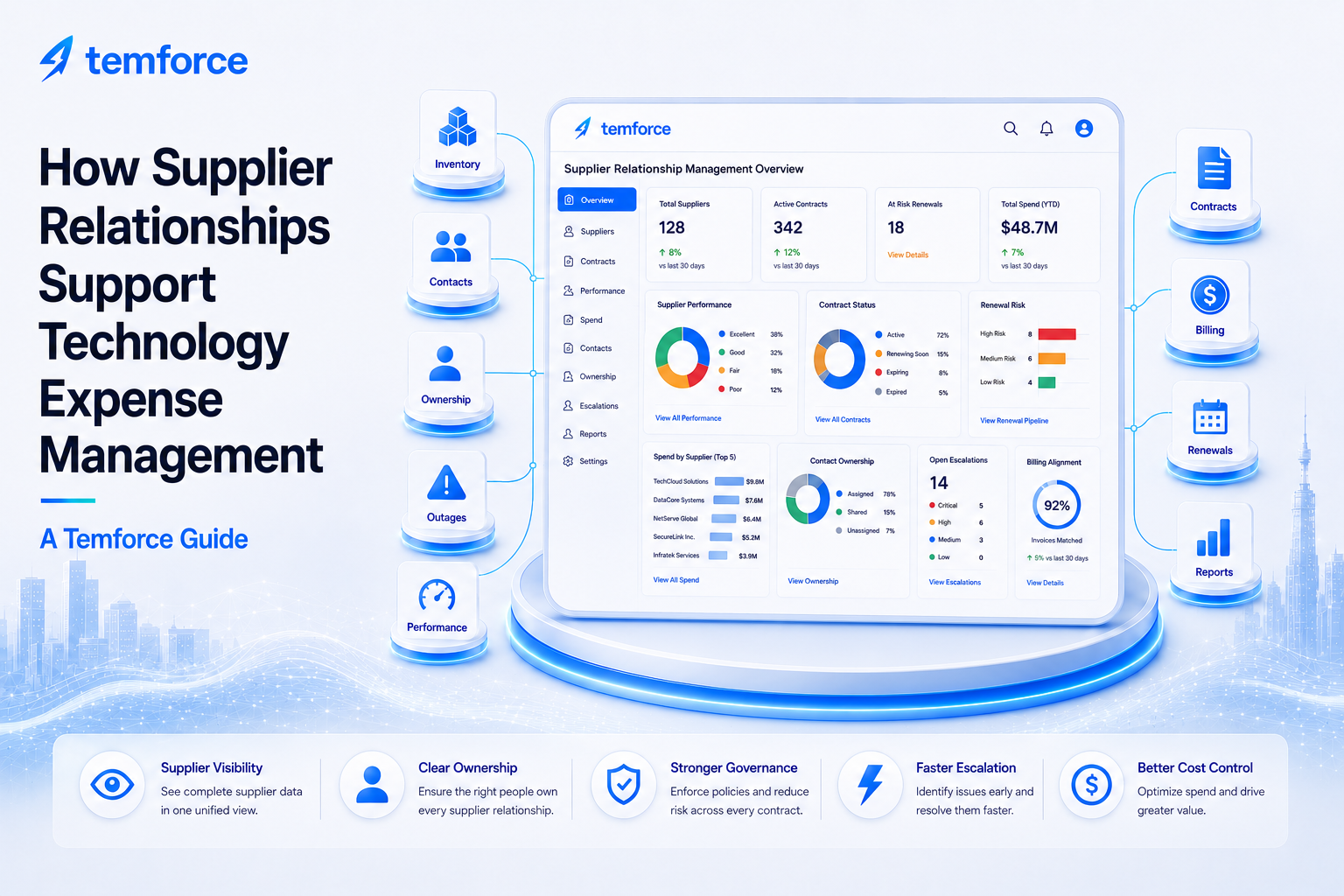
Supplier relationships support technology expense management by connecting supplier contacts, account ownership, contracts, invoices, outages, renewals, billing accounts, escalation paths, and service records into one operating view. Without relationship context, supplier management becomes reactive and fragmented.
Supplier relationship management in TEM is the discipline of knowing which suppliers support which services, who owns the relationship, who to contact, what contracts apply, what invoices are tied to the supplier, what outages or disputes exist, and how supplier activity affects technology spend.
Supplier management is not just vendor contact tracking. It is the operating layer that connects suppliers to inventory, contracts, invoices, outages, renewals, credits, tasks, reporting, and business accountability.
Why supplier relationships matter in TEM
Technology expense management depends on suppliers, but many organizations manage supplier information across emails, portals, spreadsheets, contracts, invoice files, and individual relationships. That creates gaps when teams need to validate charges, escalate outages, negotiate renewals, recover credits, or understand supplier exposure.
A stronger supplier relationship model creates a connected view of who the supplier is, what they provide, what they bill, who owns the relationship, and what action is required.
Supplier relationships connect services, contracts, invoices, billing accounts, locations, owners, outages, renewals, and spend.
Supplier activity needs clear relationship owners, escalation contacts, finance owners, contract owners, and operational accountability.
Disputes, outages, credits, performance issues, billing errors, and renewal risks can be tracked against the supplier relationship.
Teams spend less time searching for contacts, account details, contract owners, escalation paths, invoice context, and supplier history.
Supplier relationships are where many TEM issues either get solved quickly or get lost. If a team cannot identify the supplier owner, support path, account structure, contract context, and affected inventory, every outage, dispute, renewal, and invoice question takes longer than it should.
The supplier relationship management model
A strong supplier relationship model connects supplier data to the operational records that matter during invoice review, outage response, renewal planning, cost management, and reporting.
| Supplier Area | What to Track | Why It Matters | Risk If Missing |
|---|---|---|---|
| Supplier identity | Supplier name, parent company, business unit, service categories, account structure, and relationship owner. | Creates a clean view of who the organization buys from and what supplier entity supports each service. | Supplier spend and service ownership become fragmented across names, accounts, and teams. |
| Contacts and escalation paths | Account manager, support contacts, executive escalation, billing contacts, outage contacts, and renewal contacts. | Teams need the right contact path for outages, disputes, credits, renewals, and service questions. | Issues slow down because teams rely on outdated or informal contacts. |
| Inventory connection | Services, circuits, devices, applications, subscriptions, locations, owners, and billing accounts tied to the supplier. | Inventory shows what the supplier supports and what business areas may be impacted. | The organization cannot see supplier exposure across services and locations. |
| Invoice and billing context | Invoices, billing accounts, recurring charges, credits, disputes, payment status, and billing exceptions. | Supplier relationships need financial visibility to support validation and accountability. | Billing errors, credits, and disputes may age without supplier follow-up. |
| Contracts and renewals | Contract terms, renewal dates, notice windows, pricing, commitments, documents, and contract owners. | Supplier relationships should support renewal planning and negotiation readiness. | Renewals become supplier-driven instead of data-driven. |
| Performance and issues | Outages, disputes, SLA concerns, credit recovery, response time, unresolved issues, and recurring problems. | Supplier performance should be visible before renewal and negotiation decisions. | The business renews or expands relationships without seeing the full supplier history. |
How to manage supplier relationships in a TEMOps operating model
Supplier relationship management should be part of the recurring TEMOps operating rhythm, not something that only happens during a problem or renewal deadline.
Build the supplier profile
Capture supplier identity, contacts, parent company, account structure, relationship owner, service categories, and support paths.
Connect supplier records to inventory
Link the supplier to active services, billing accounts, locations, owners, service IDs, lifecycle status, and business units.
Connect supplier records to contracts
Tie the supplier to contract documents, pricing, renewal dates, notice periods, terms, commitments, and contract owners.
Connect supplier records to invoices
Review billing accounts, invoice exceptions, disputes, credits, recurring charges, payment history, and financial exposure.
Track outages and performance
Document service issues, outage history, supplier response, credits, escalations, recurring problems, and performance trends.
Use supplier data in reviews and renewals
Bring inventory, invoice, contract, outage, dispute, credit, and performance data into supplier review and renewal decisions.
What supplier relationship records should track
Supplier records should capture enough information to support operational response, invoice validation, contract governance, outage escalation, renewal planning, and performance reporting.
- Supplier name, parent company, service category, relationship owner, account owner, finance owner, and contract owner
- Account manager, billing contact, support contact, outage contact, renewal contact, and executive escalation contact
- Supplier account numbers, billing accounts, customer numbers, portals, support paths, and escalation instructions
- Active services, service IDs, locations, owners, cost centers, business units, lifecycle status, and inventory coverage
- Contract documents, renewal dates, notice windows, pricing terms, commitments, discounts, and contract status
- Invoices, recurring charges, disputes, credits, payment status, billing exceptions, and spend history
- Outages, service issues, supplier response, credits requested, credits received, and recurring issue history
- Supplier performance notes, review cadence, open tasks, next actions, and reporting classification
If a supplier supports a service, sends an invoice, owns a contract, responds to outages, or affects renewals, that relationship should be connected to inventory and governed as part of the TEMOps operating model.
Common supplier relationship issues
Supplier relationship issues usually appear when supplier information is not connected to inventory, contracts, invoices, outages, and ownership.
Account managers, billing contacts, support contacts, and escalation paths change, but the internal records do not.
The organization cannot quickly see which services, locations, accounts, and owners depend on the supplier.
Supplier records may not show contract terms, renewal dates, pricing, documents, commitments, or notice windows.
Disputes, credits, recurring charge changes, and billing errors may be handled without supplier-level visibility.
Outages, response time, credits, escalations, and recurring issues may not be visible during supplier reviews.
Supplier decisions become reactive when relationship ownership, finance ownership, and contract ownership are unclear.
Example scenario: a supplier issue that needs relationship context
A supplier has recurring billing errors and several recent outages. In a weak process, the invoice team handles the billing issue, the network team handles the outage, and the contract owner handles the renewal separately. In a stronger TEMOps process, the supplier relationship record connects the inventory, invoices, outages, credits, contracts, contacts, and renewal timeline into one view.
Instead of asking, “Who has the supplier contact?” the business asks, “What does this supplier support, what are they billing, what issues have occurred, what contracts are at risk, and who owns the next action?”
How Temforce helps with supplier relationships
Temforce helps organizations connect supplier relationships to the inventory, invoice, contract, outage, task, report, dashboard, and finance records that support stronger supplier accountability.
The goal is to move supplier management away from scattered contacts and reactive follow-up, and toward a governed TEMOps process with clear visibility, ownership, and action.
Connect suppliers to active services, locations, owners, billing accounts, cost centers, contracts, and lifecycle status.
Track supplier contacts, escalations, disputes, credits, outage follow-ups, renewal actions, and assigned responsibilities.
Use supplier history to support dashboards, renewal planning, invoice validation, outage review, and executive reporting.
