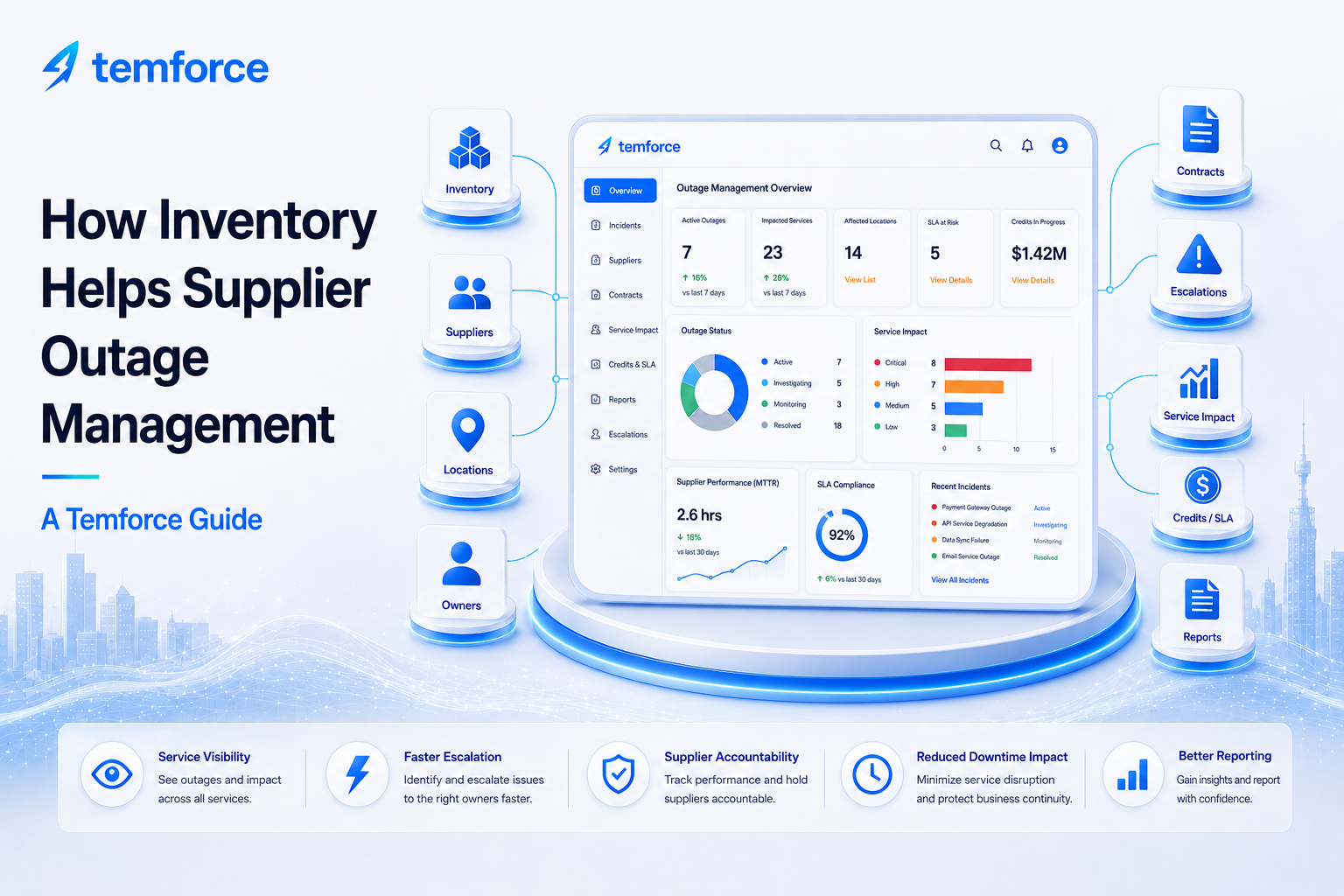
How Inventory Helps Supplier Outage Management
May 28, 2026
Inventory
Inventory helps supplier outage management by showing which services are affected, where they are located, who owns them, which supplier supports them, what escalation path applies, and what business impact may exist when a service is down.
Supplier outage management is not only about knowing that something is down. It is the operating discipline of understanding what is down, who is affected, which supplier owns the issue, how to escalate it, what contract or SLA may apply, and what records need to be updated after the event.
Outage response is only as strong as the inventory behind it. If the service, location, owner, supplier, escalation contact, and contract context are unclear, the response slows down before the supplier even starts troubleshooting.
Why inventory matters during supplier outages
During an outage, teams do not have time to search through old spreadsheets, supplier portals, invoices, email chains, and tribal knowledge. They need to know what service is impacted, where it is installed, who owns it, who to contact, and what supplier information is needed to open and escalate the case.
Accurate inventory gives outage response teams the context they need to move faster and communicate with more confidence.
Inventory connects the outage to services, locations, suppliers, users, owners, billing accounts, and business units.
Outages need clear owners, escalation paths, supplier contacts, communication steps, and resolution tracking.
Supplier response, outage duration, credits, disputes, SLA exposure, and recurring issues can be tracked against the services affected.
Teams spend less time searching for service IDs, contacts, sites, owners, contracts, and billing account details during an active incident.
Inventory turns outage management from a scramble into an operating process. When the service record already connects the supplier, owner, site, circuit ID, billing account, contract, and escalation path, the business can respond faster and measure supplier performance more effectively.
The supplier outage management model
A strong outage process connects inventory, suppliers, relationships, contracts, tasks, finance, reports, and dashboards.
| Outage Area | What to Know | Why Inventory Matters | Risk If Missing |
|---|---|---|---|
| Service identification | Service ID, circuit ID, phone number, device, application, account, subscription, or supplier reference. | Inventory gives teams the identifiers needed to open supplier tickets and validate the affected service. | Teams lose time trying to identify the impacted service or supplier record. |
| Location and site context | Site, address, room, floor, demarc, region, business unit, and local contact. | Inventory shows where the service is installed and who can support on-site coordination. | Supplier dispatch, local troubleshooting, and impact assessment may be delayed. |
| Ownership | Business owner, technical owner, local contact, finance owner, and escalation owner. | Inventory identifies who should be notified, who can approve action, and who owns the business impact. | Outage communication becomes unclear and decisions slow down. |
| Supplier and relationship data | Supplier name, support contact, account manager, escalation path, ticket process, and relationship owner. | Inventory connects the service to the supplier relationship needed for response and escalation. | Teams rely on outdated contacts or informal escalation paths. |
| Contract and SLA context | Service level terms, support commitments, credit language, renewal status, and contract owner. | Inventory helps connect the outage to the contract and performance expectations. | SLA exposure, credits, and supplier accountability may be missed. |
| Reporting and follow-up | Outage duration, business impact, credits, supplier response, resolution notes, and recurring issue history. | Inventory gives the outage record the service context needed for reporting and future supplier reviews. | The same supplier issues may repeat without meaningful operating review. |
How to use inventory during outage response
A strong supplier outage workflow should move from identification to escalation, communication, resolution, credit tracking, and reporting.
Identify the impacted service
Use inventory to confirm the service ID, supplier, account, location, owner, billing record, and lifecycle status.
Confirm the business impact
Identify the affected site, users, department, business unit, cost center, critical function, and local contact.
Open and escalate the supplier case
Use supplier contacts, account information, support paths, contract context, service IDs, and escalation rules to route the issue.
Assign internal tasks
Assign follow-ups for local coordination, supplier escalation, executive communication, finance impact, and outage updates.
Track resolution and credits
Document outage start time, resolution time, supplier response, credits expected, credits received, and invoice impact.
Update reports and dashboards
Use outage history to support supplier reviews, renewal decisions, contract discussions, risk reporting, and service improvement.
What outage management should track
Outage records should capture enough information to support response, escalation, supplier accountability, finance impact, and long-term reporting.
- Supplier name, service ID, circuit ID, billing account, location, owner, business unit, and impacted users
- Outage start time, reported time, supplier ticket number, escalation time, resolution time, and total duration
- Business impact, affected sites, affected services, criticality, priority, and communication status
- Supplier contact, account manager, escalation path, support level, contract reference, and SLA context
- Internal owner, technical owner, local contact, finance owner, task owner, and executive communication owner
- Supplier response notes, root cause, resolution notes, recurring issue history, and next steps
- Credits expected, credits requested, credits received, invoice impact, and dispute follow-up
- Dashboard category, supplier review category, renewal impact, and reporting classification
If an outage affects a service that appears in inventory or on an invoice, the outage record should connect back to the service, supplier, location, owner, contract, and billing account.
Common supplier outage management issues
Outage response often breaks down when supplier, inventory, contract, and ownership data are not connected before the outage happens.
Teams know something is down, but they cannot quickly identify the service ID, supplier, location, or account.
Supplier contacts, account managers, local contacts, and internal owners are missing or stale.
The organization may not know whether the outage qualifies for credits, escalation, or supplier performance review.
Without location, owner, and business unit context, teams struggle to communicate who is affected and how severe the issue is.
Credits may be promised but never validated against the invoice or reported back to finance.
Supplier performance issues repeat when outage history is not captured and reviewed over time.
Example scenario: a network outage at a critical location
A location loses connectivity during business hours. In a weak process, the team scrambles to identify the circuit, supplier, account number, local contact, and escalation path. In a stronger TEMOps process, the inventory record already connects the service to the supplier, site, owner, billing account, contract, and escalation path.
Instead of asking, “Who knows what this service is?” the business asks, “Which service is impacted, who owns it, which supplier supports it, what is the escalation path, and what follow-up is required after resolution?”
How Temforce helps with supplier outage management
Temforce helps organizations connect outages to the inventory, supplier, relationship, contract, finance, task, report, and dashboard records that support faster response and better supplier accountability.
The goal is to make outage response part of the broader TEMOps operating model, not a separate event that disappears after the service is restored.
Connect impacted services to suppliers, locations, owners, billing accounts, contracts, escalation contacts, and lifecycle status.
Assign outage follow-ups, supplier escalations, credit tracking, reporting updates, and recurring issue reviews.
Track outage history, supplier performance, impacted services, credits, escalations, and operating risk over time.
