How Inventory Supports Contract and Renewal Management
May 28, 2026
Category Management
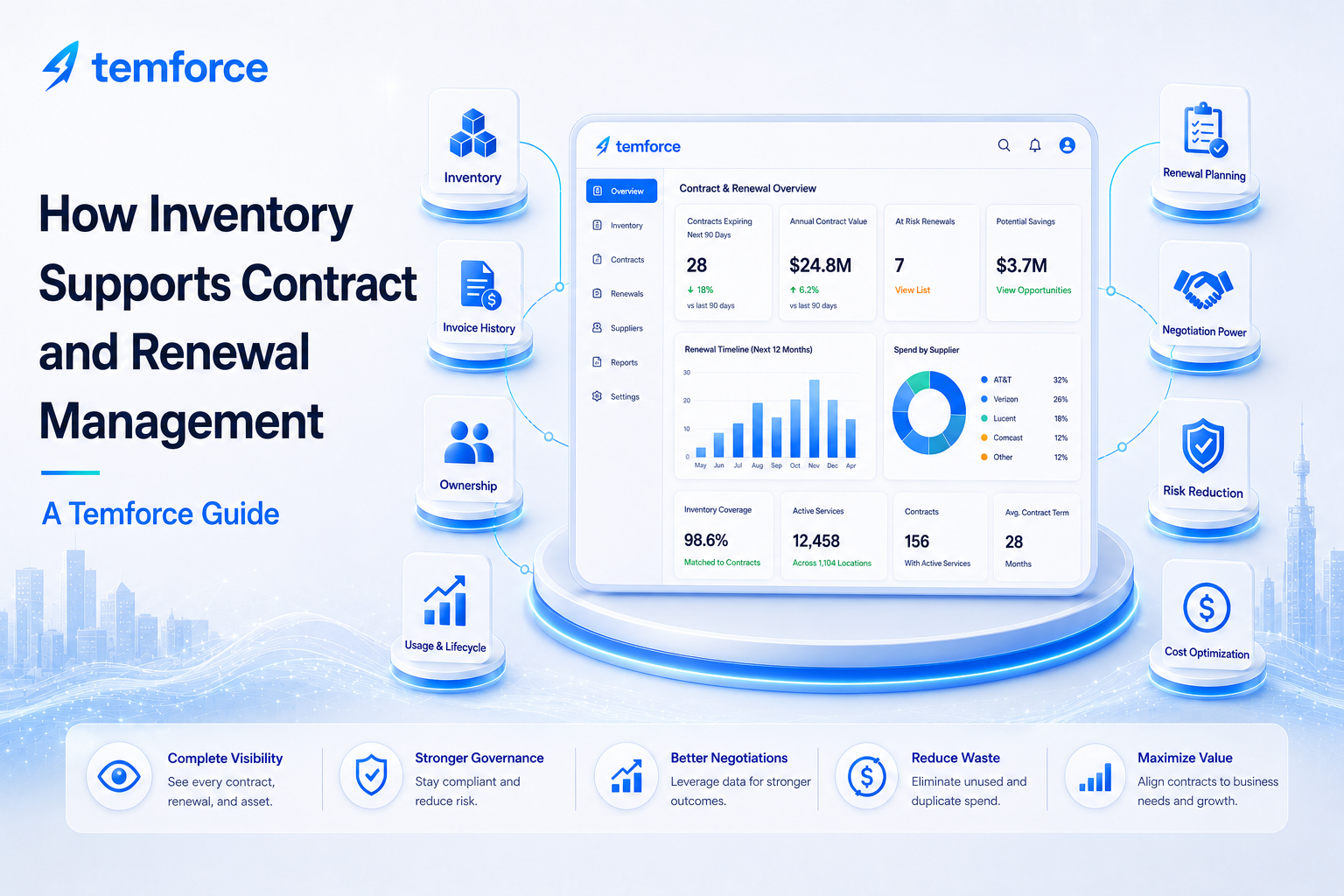
Inventory supports contract and renewal management by showing which services, suppliers, billing accounts, owners, locations, cost centers, and lifecycle statuses are actually tied to the agreements your organization is about to renew, renegotiate, or retire.
Contract and renewal management is not only about tracking expiration dates. It is the operating discipline of knowing what the contract covers, what the business still uses, what the supplier is billing, who owns the services, what pricing applies, and whether the renewal still makes sense.
A contract renewal should never happen in isolation. It should be reviewed against inventory truth, invoice history, supplier performance, business ownership, usage, lifecycle status, and future demand.
Why inventory matters for contract renewals
Many organizations renew technology contracts using supplier spreadsheets, prior-year spend, or calendar reminders. That creates risk because the renewal decision may not reflect what the business actually owns, uses, needs, or should disconnect.
Inventory gives the renewal process the operational context needed to make better decisions before the organization is locked into another term.
Inventory connects contract records to services, locations, suppliers, billing accounts, owners, and active recurring charges.
Renewals need owners, timelines, approvals, supplier contacts, negotiation steps, and a clear decision path before the deadline.
Inventory helps avoid renewing inactive services, stale commitments, wrong account structures, unsupported charges, or unnecessary capacity.
When inventory and contracts are connected, teams spend less time rebuilding service lists and chasing owners at the last minute.
Contract renewals become risky when the business cannot clearly answer what the contract supports. If the inventory is weak, renewal planning becomes a supplier-driven event. If the inventory is strong, renewal planning becomes a business decision.
The contract and renewal management model
A strong renewal process connects contract records to inventory, invoices, suppliers, finance, requests, dashboards, and tasks.
| Renewal Area | What to Review | Why Inventory Matters | Risk If Missed |
|---|---|---|---|
| Contract coverage | Services, billing accounts, locations, suppliers, products, and commitments covered by the agreement. | Inventory confirms what is actually tied to the contract. | The business may renew services that are no longer needed or miss services that should be governed. |
| Lifecycle status | Active, pending disconnect, inactive, retired, under review, or future-state services. | Inventory shows whether services should remain part of the renewal. | Inactive or soon-to-be-disconnected services may be renewed unnecessarily. |
| Ownership | Business owner, technical owner, finance owner, approver, department, and cost center. | Ownership helps confirm who can approve, reject, or challenge the renewal. | Renewal decisions may happen without the right business input. |
| Invoice history | Recurring charges, usage, credits, disputes, billing changes, and supplier invoice behavior. | Inventory links services to invoice evidence and spend history. | The business may negotiate from incomplete or inaccurate spend data. |
| Supplier performance | Outages, disputes, credits, service issues, response times, escalations, and relationship history. | Inventory connects supplier performance to the affected services and locations. | The organization may renew without accounting for supplier performance issues. |
| Future demand | Growth, contraction, location changes, technology roadmap, service changes, and pending requests. | Inventory shows what the current estate looks like before the business commits to the next term. | Commitments may not match future business need. |
How to use inventory in renewal planning
Renewal planning should begin before the contract is close to expiration. The goal is to move from reactive renewal approval to informed supplier, financial, and operational decision-making.
Identify upcoming renewals
Track renewal dates, expiration dates, notice periods, auto-renewal windows, supplier contacts, contract owners, and decision deadlines.
Map the contract to inventory
Connect the agreement to active services, locations, billing accounts, suppliers, cost centers, owners, products, and lifecycle status.
Review usage, spend, and invoice history
Compare recurring charges, usage trends, credits, disputes, billing changes, service utilization, and expected cost against the contract.
Confirm owners and business need
Validate whether each service is still needed, who owns it, whether demand has changed, and whether the renewal supports the current business.
Identify disconnect and optimization opportunities
Flag inactive services, duplicate services, stale locations, unused capacity, overlapping suppliers, pricing issues, and services ready for retirement.
Negotiate or renew with evidence
Use inventory, invoice, supplier, performance, and finance data to support negotiation, renewal, consolidation, or termination decisions.
Update inventory and contract records
Record the renewal decision, new terms, pricing, commitments, owner approvals, supplier changes, and future renewal dates.
What contract and renewal management should track
A renewal record should capture enough detail to support business review, supplier negotiation, financial planning, reporting, and governance.
- Supplier name, contract name, contract owner, business owner, finance owner, and supplier contact
- Contract start date, expiration date, renewal date, notice period, auto-renewal language, and decision deadline
- Covered services, service IDs, products, billing accounts, locations, departments, users, and cost centers
- Monthly recurring charges, annualized spend, usage, pricing terms, discounts, minimum commitments, and renewal pricing
- Lifecycle status, pending disconnects, inactive services, duplicate services, and optimization opportunities
- Supplier performance, outages, disputes, credits, escalations, and unresolved service issues
- Approval status, renewal decision, negotiation notes, requested changes, supplier proposal, and final outcome
- Updated contract terms, updated inventory records, new renewal dates, and reporting classification
If a contract renewal cannot be tied to active inventory, current spend, clear ownership, business need, and supplier performance, the renewal is not ready for approval.
Common renewal management issues
Contract renewals often become expensive when inventory, invoice, supplier, and owner data are not connected early enough.
The agreement references services, accounts, locations, or products that do not align to the current inventory.
Auto-renewal dates, notice periods, and decision deadlines pass before the business has time to review options.
The contract is up for renewal, but business ownership, finance approval, or technical accountability is unclear.
The business renews based on contract terms without reviewing invoice history, credits, disputes, or actual spend.
Outages, service issues, disputes, escalations, and unresolved credits are not considered before renewal approval.
Inactive, duplicate, stale, or pending-disconnect services remain in the renewal scope and continue driving cost.
Example scenario: renewal planning before the deadline
A supplier contract is approaching renewal. In a weak process, the supplier sends a proposal and the business rushes to approve it before the deadline. In a stronger TEMOps process, the renewal is compared against inventory, invoice history, supplier performance, cost centers, business ownership, lifecycle status, and future demand.
Instead of asking, “Should we renew this supplier contract?” the business asks, “Which services are active, who owns them, what are we paying, what should be disconnected, what terms should change, and what outcome should we negotiate?”
How Temforce helps with contract and renewal management
Temforce helps organizations connect contracts and renewals to the inventory, invoice, supplier, finance, dashboard, report, and task records that make renewal decisions stronger.
The goal is to move renewal management away from calendar reminders and supplier-driven urgency, and toward an evidence-based TEMOps process.
Connect contracts to active services, suppliers, billing accounts, owners, locations, cost centers, and lifecycle status.
Track renewal dates, notice windows, approvals, supplier follow-ups, decision deadlines, and assigned work.
Support renewal decisions with invoice history, supplier performance, outage history, credits, disputes, and reporting.
