
If your TEM provider gives you ticket numbers instead of answers, you do not have control.
Enterprise technology expense management work cannot disappear into slow queues, vague ownership, unclear supplier follow-up, and endless status checks. Tickets should create accountability, not hide the work.
Large service organizations can still leave enterprise teams waiting for answers, chasing updates, waiting on roadmap promises, and trying to understand who owns the result.
Tickets should not become hiding places.
A ticket number can make a request feel captured, but capture is not the same as execution. If your team cannot see the owner, action, supplier dependency, due date, status, blocker, invoice impact, inventory impact, or outcome, the ticket is just another place for work to disappear.
Technology expense management needs more than a queue. It needs an operating path from request to action to evidence.
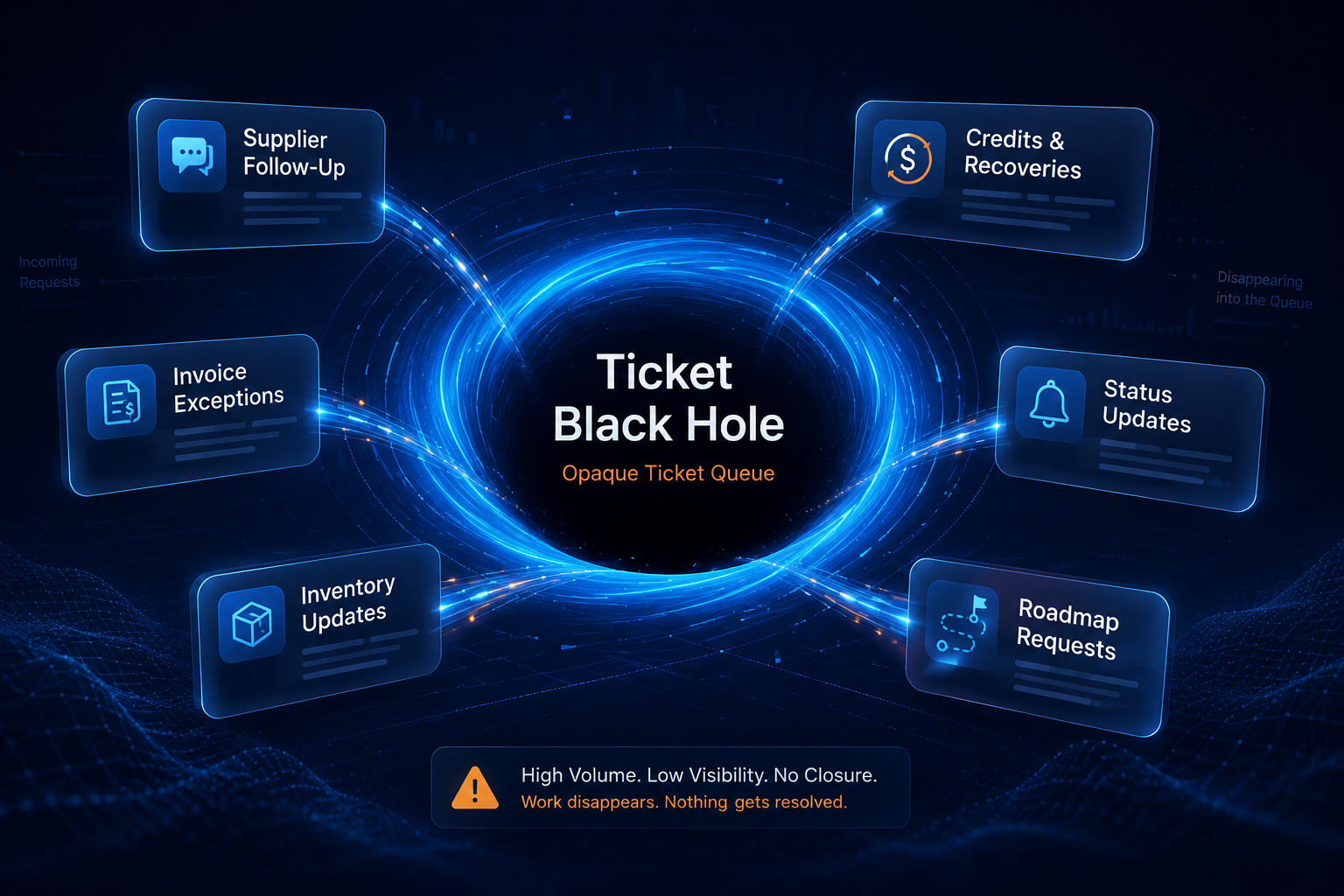
A ticketing model can create the appearance of progress without the evidence of execution.
The problem is not using tickets. The problem is when tickets become the operating model instead of supporting one.
Your team has a ticket number, but not a meaningful answer about what changed, what is blocked, or what happens next.
The request moves between queues, teams, suppliers, and account resources, but nobody can clearly explain who owns the result.
Carrier corrections, billing disputes, contract questions, credits, quotes, and escalations need visible follow-through.
The ticket may close before the charge is corrected, the credit is issued, the recovery is confirmed, or the next invoice proves the change.
Disconnects, corrections, ownership changes, service updates, and supplier responses do not always make it back into the source of truth.
Teams have to recreate what happened later instead of having savings, credits, recoveries, and corrections connected to the work.
Ticketing captures the request. TEMOps drives the outcome.
Temforce helps teams move beyond static ticket queues and toward structured TEMOps execution across requests, tasks, suppliers, invoices, inventory, reporting, and proof.
Technology expense work needs status, owner, action, due date, dependency, supplier activity, and proof, not just a ticket number.
If nobody can explain what is happening, who owns it, or what comes next, the vendor process is not protecting the enterprise.
Large platforms can leave enterprise teams waiting months or years for practical enhancements, custom reporting, workflow changes, or functionality their program needs now.
The work is not done until the correction, credit, recovery, supplier response, inventory update, or decision is visible.
From request to resolution, every step should be visible.
A better operating model connects the request to the work, the work to the supplier, the supplier to the outcome, and the outcome to proof.
The request enters the workflow with the right context: inventory, invoice, supplier, account, location, contract, or cost center.
Ownership, priority, due date, dependency, next action, and escalation path become visible.
Teams follow up with suppliers, validate invoices, process MACD work, update inventory, or drive dispute resolution.
The outcome is checked against billing, supplier response, service status, inventory, credit, recovery, or approval evidence.
The completed action becomes part of the operating record: correction, credit, recovery, update, savings, or decision.
Signs your TEM provider is giving you queue management instead of accountability.
If too many of these feel familiar, your team may not have a service problem. It may have an operating model problem.
Progress depends on repeated follow-up instead of transparent ownership and visible next steps.
Carrier outreach, dispute updates, corrections, escalations, and quotes are unclear or trapped in someone else’s inbox.
Closure means little if the credit, correction, recovery, inventory update, or invoice validation never confirms the result.
Custom reporting, workflow changes, and practical improvements wait behind broad platform priorities.
Services change, suppliers respond, disconnects happen, but the operating record does not stay current.
Findings should become trackable actions with supplier follow-up, credit tracking, and evidence of resolution.
If everything requires escalation to move, the process is not designed for dependable execution.
If your team has to rebuild the story in spreadsheets and email, the platform is not carrying the operating load.
Stop accepting ticket numbers when your business needs answers.
Temforce helps enterprise teams move from opaque queues to TEMOps execution: clear ownership, visible supplier follow-up, invoice validation, inventory updates, workflow accountability, reporting confidence, and savings proof.
