How TEM Software Connects Inventory, Invoices, Finance, Suppliers, and Reporting
May 31, 2026
Inventory
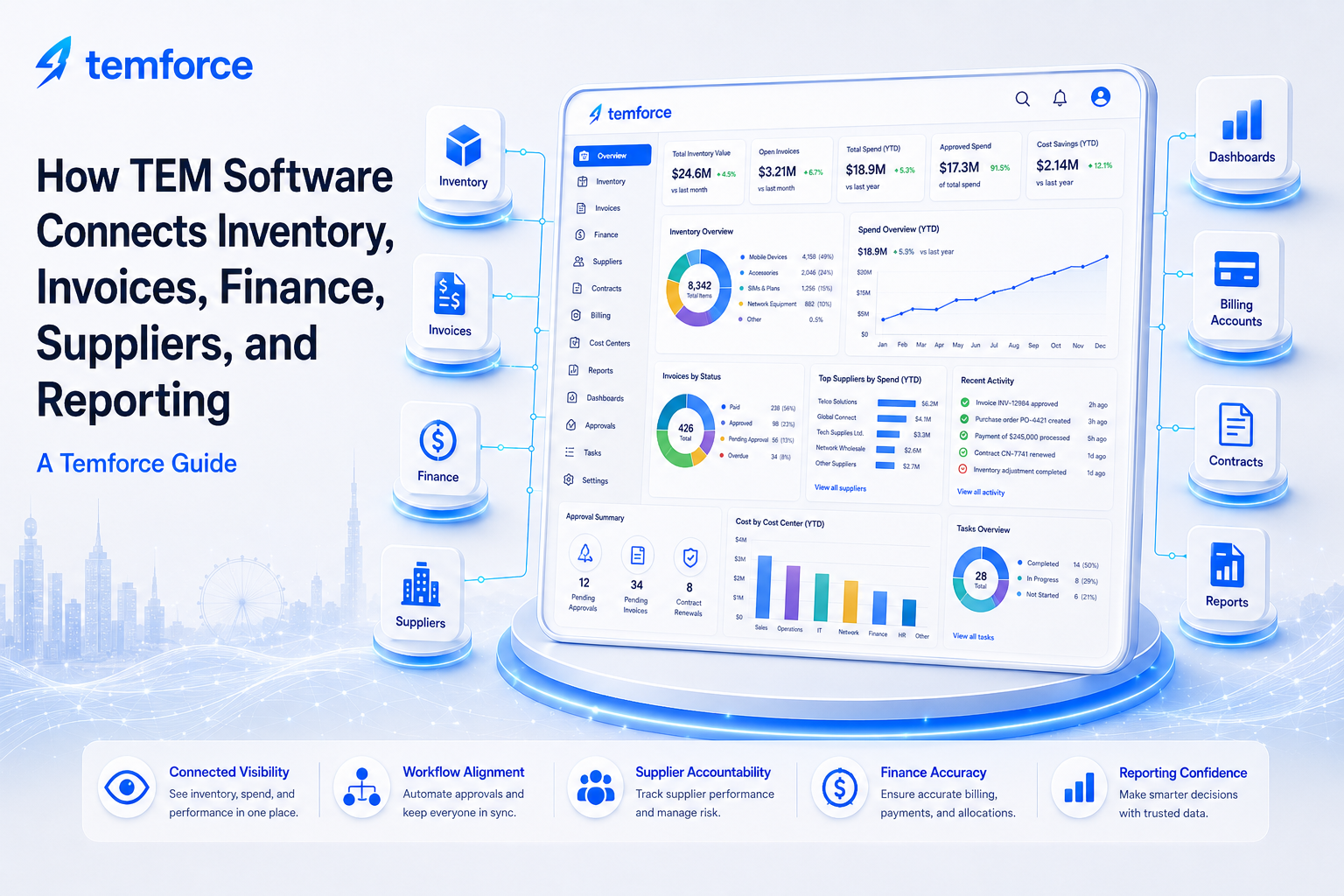
TEM software connects inventory, invoices, finance, suppliers, and reporting by giving technology expense teams one operating model for the records, workflows, controls, and dashboards that manage spend. The value is not just storing data. The value is connecting the data so every invoice, asset, supplier, contract, task, cost center, and report supports better decisions.
A strong TEM program depends on connected information. Inventory explains what the organization owns or uses. Invoices show what suppliers bill. Finance records explain where costs belong. Supplier records provide accountability. Reports and dashboards turn that activity into management insight. TEM software should bring all of those pieces together.
TEM software should not be a collection of disconnected modules. It should be an operating platform where inventory, invoices, suppliers, contracts, finance, tasks, and reports reinforce one another.
Why connected TEM software matters
Technology expense management breaks down when teams manage inventory in one place, invoices in another, contracts in a shared drive, supplier issues in email, finance allocations in spreadsheets, and dashboards in separate reporting files. Disconnected systems create duplicate work, stale records, weak visibility, and slower decisions.
Connected TEM software gives teams a single structure for seeing what exists, what is billed, who owns it, what it costs, what needs action, and what leadership should know.
Connected software ties inventory, invoices, billing accounts, suppliers, contracts, cost centers, tasks, and reports into one view.
Assignments, approvals, workflows, review cadences, evidence, and dashboards help teams manage TEM consistently.
Controls help identify invoice exceptions, stale inventory, missing owners, supplier issues, contract exposure, and finance gaps.
Teams spend less time reconciling spreadsheets and more time managing actions, savings, suppliers, and governance outcomes.
The strongest TEM software acts like the operating layer for technology expense management. It connects the work, the records, the financial controls, and the reporting cadence in one place.
The connected TEM software model
A strong platform connects the major TEM domains so each record helps explain and control the others.
| Platform Area | What It Connects | Why It Matters | Risk If Missing |
|---|---|---|---|
| Inventory hub | Services, assets, users, owners, locations, suppliers, billing accounts, lifecycle status, and contracts. | Creates the operational source of truth for what should exist and what should be billed. | Invoices and reports may be reviewed without knowing what is actually active. |
| Invoice control | Invoice intake, validation, exceptions, approvals, payments, credits, disputes, accruals, and reporting. | Helps teams validate charges and move invoices through a controlled workflow. | Billing errors, missing credits, and approval delays may become recurring problems. |
| Finance alignment | Cost centers, GL codes, chargeback rules, allocations, budgets, accruals, and period controls. | Connects operational spend to finance-ready reporting. | Charges may be misallocated, miscoded, or difficult to explain. |
| Supplier and contract control | Supplier records, contacts, contracts, rate sheets, renewals, disputes, service issues, and escalations. | Supports supplier accountability, pricing validation, and renewal readiness. | Supplier issues may lack context, evidence, or clear ownership. |
| Task and governance workflow | Assignments, approvals, reviews, due dates, exception queues, escalation paths, and closure evidence. | Turns TEM findings into tracked and completed action. | Reports may identify issues without creating resolution. |
| Reports and dashboards | Spend, inventory, invoices, suppliers, contracts, cost centers, tasks, savings, exceptions, and data health. | Gives leadership a confident view of performance, risk, and outcomes. | Reporting may become static, incomplete, or disconnected from real operations. |
How connected TEM software should work
TEM software should support the full operating cycle from request and inventory through invoice validation, finance alignment, supplier management, governance review, and executive reporting.
Start with inventory truth
Use inventory as the foundation for services, assets, users, owners, suppliers, locations, billing accounts, contracts, and lifecycle status.
Connect invoices to operational records
Match invoice charges to inventory, billing accounts, contracts, expected rates, cost centers, disputes, credits, and approvals.
Align spend to finance
Apply cost centers, GL codes, chargeback rules, allocations, accruals, payment status, and period controls.
Manage suppliers and contracts
Connect supplier contacts, service issues, contract documents, rate sheets, renewals, credits, disputes, and escalations.
Turn findings into tasks
Assign invoice exceptions, data cleanup, supplier follow-up, lifecycle updates, renewal decisions, and governance findings.
Report the operating picture
Use dashboards and reports to show spend, risk, savings, data health, exceptions, ownership, and completed outcomes.
What connected TEM software should track
Connected TEM software should track the records and relationships needed to manage technology spend with accuracy, accountability, and confidence.
- Inventory records, services, assets, users, owners, locations, suppliers, billing accounts, lifecycle status, and contracts
- Invoices, invoice lines, validation rules, approvals, exceptions, disputes, credits, payments, and accruals
- Cost centers, GL codes, chargeback rules, allocations, budgets, forecasts, period controls, and finance owners
- Supplier records, contacts, account structures, tickets, escalations, performance, contracts, documents, and renewals
- Requests, MACD activity, service lifecycle events, disconnects, ownership changes, and fulfillment status
- Tasks, assignments, due dates, priorities, blockers, escalations, resolution notes, and closure evidence
- Reports, dashboards, data health, savings opportunities, risk indicators, exception aging, and executive summaries
- Governance reviews, review cadence, findings, remediation plans, audit trail, and improvement outcomes
If a TEM record affects cost, risk, ownership, supplier accountability, finance reporting, or operational action, it should connect to the platform records around it.
Common TEM software connection issues
Platform issues usually appear when TEM teams have software modules, spreadsheets, emails, supplier portals, and finance exports that do not share the same operating truth.
Charges are harder to validate when inventory records are incomplete, stale, or disconnected from billing accounts.
Missing cost centers, GL codes, chargeback rules, and period controls weaken reporting confidence.
Disputes, credits, renewals, outages, and escalations are slower when supplier records are disconnected.
Dashboards lose value when issues are not assigned, tracked, escalated, and closed.
Reports should show what is happening and connect to the records and actions behind the numbers.
Without recurring review controls, even good data eventually drifts.
Example scenario: one invoice exception touches every TEM domain
A supplier invoice includes a charge that does not match the expected rate. In a disconnected process, the team may need to search inventory records, contract documents, supplier emails, finance spreadsheets, and reporting files separately. In a connected TEM software model, the invoice line links to the service record, contract rate sheet, supplier account, cost center, owner, dispute task, credit expectation, and dashboard status.
Instead of asking, “Where is the information?” the business asks, “What does the connected record tell us, who owns the action, and how will the outcome be reported?”
How Temforce connects inventory, invoices, finance, suppliers, and reporting
Temforce helps organizations connect inventory, invoices, finance records, suppliers, contracts, billing accounts, requests, tasks, dashboards, and reports into one TEMOps operating model.
The goal is to move technology expense management away from disconnected tools and toward a platform where records, workflows, financial controls, and reporting all support each other.
Link inventory, suppliers, billing accounts, contracts, invoices, cost centers, GL codes, users, locations, and lifecycle status.
Assign exceptions, requests, disputes, governance findings, supplier follow-ups, renewals, and cleanup actions.
Report spend, savings, risks, data health, exceptions, supplier activity, finance status, and completed outcomes.
