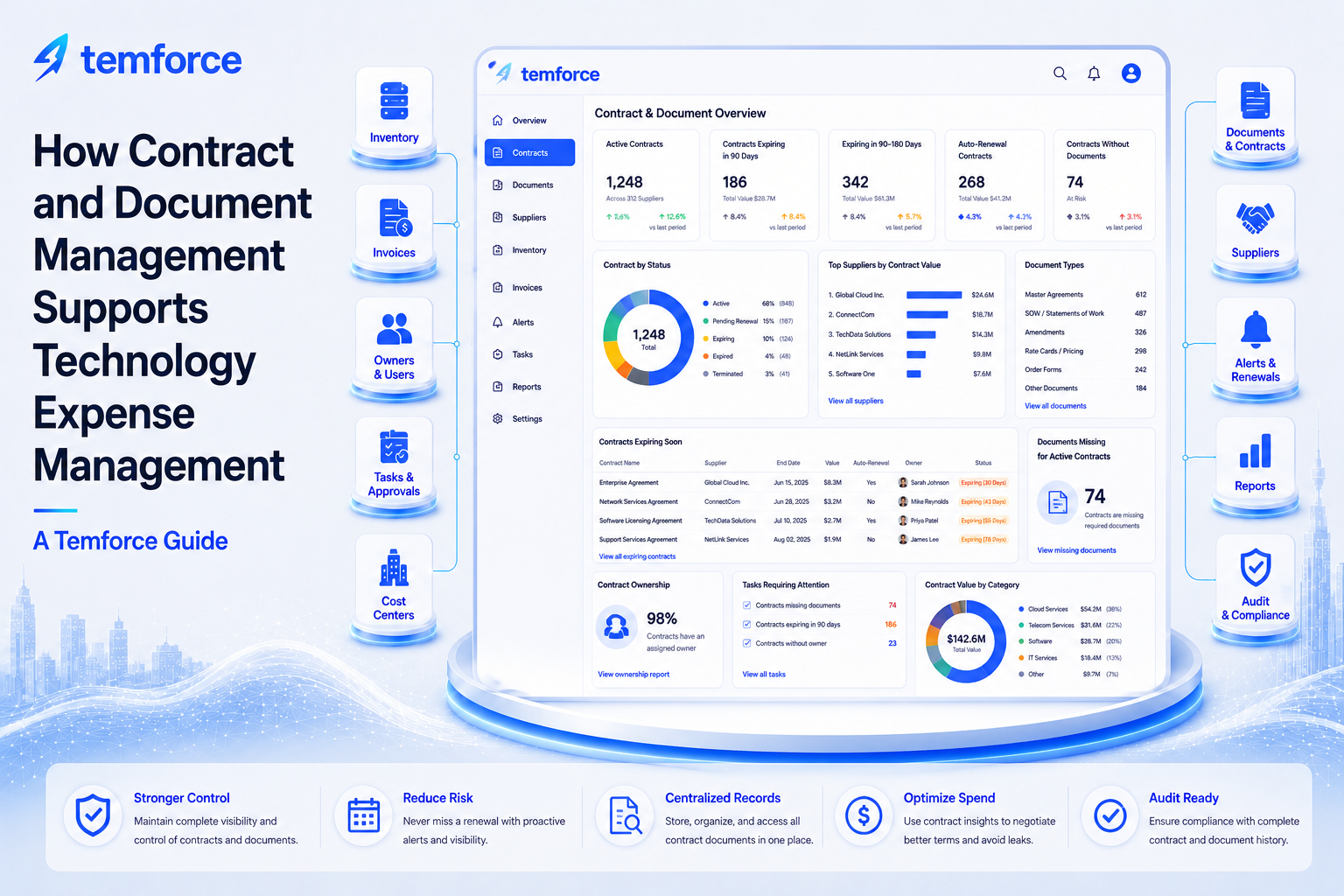
How Contract and Document Management Supports Technology Expense Management
May 31, 2026
Contract Management
Contract and document management supports technology expense management by connecting agreements, amendments, rate sheets, order forms, renewal notices, supplier documents, pricing terms, and audit evidence to the operational records that drive spend. When contract documents are organized and connected, invoice validation, renewals, supplier management, and cost control become stronger.
TEM teams often need to answer practical contract questions quickly. What rate should this invoice use? Which services are covered? When does the agreement renew? Which document governs this billing account? Who owns the supplier relationship? Contract and document management turns those answers into accessible operating data.
Contract documents should not live apart from the work they govern. They should connect to suppliers, invoices, inventory, requests, billing accounts, renewals, disputes, credits, cost centers, and reporting.
Why contract and document management matters in TEM
Technology expense environments depend on supplier agreements, pricing schedules, service orders, amendments, statements of work, renewal language, disconnect terms, billing rules, and service-level commitments. If those documents are hard to find, the business cannot easily validate invoices, challenge suppliers, manage renewals, or confirm what should be billed.
A strong contract and document management process gives TEM, finance, procurement, legal, supplier management, and operations a shared source of contractual truth.
Contract visibility connects agreements, rate sheets, amendments, order forms, renewals, suppliers, invoices, and services.
Every agreement, renewal, rate sheet, and supplier document needs an owner, status, effective date, and review path.
Controls help identify incorrect rates, missing discounts, expired terms, unsupported fees, and renewal surprises.
Teams spend less time searching email folders, shared drives, supplier portals, and old spreadsheets for contract evidence.
Contract and document management gives TEM teams the evidence they need to validate charges, manage suppliers, prepare renewals, recover credits, and support confident governance reviews.
The contract and document management model
A strong model connects contract documents to the supplier, service, invoice, renewal, and finance records they support.
| Document Area | What to Track | Why It Matters | Risk If Missing |
|---|---|---|---|
| Contract identity | Supplier, agreement name, document type, effective date, expiration date, owner, and status. | Creates a clear record of which document governs the relationship. | Teams may rely on outdated terms or incomplete contract records. |
| Pricing and rate terms | Rate sheets, discounts, fees, minimums, commitments, price escalators, and billing rules. | Supports invoice validation and supplier dispute evidence. | Incorrect rates, missing discounts, and unsupported charges may go unnoticed. |
| Service coverage | Covered services, billing accounts, locations, inventory records, service orders, and product categories. | Connects contract terms to the services and assets being billed. | Charges may be validated against the wrong agreement or no agreement at all. |
| Renewal control | Renewal date, notice window, auto-renewal terms, negotiation owner, decision status, and risk level. | Gives teams time to review, renegotiate, consolidate, or exit before deadlines. | Renewals may surprise the business or lock in poor terms. |
| Document evidence | Amendments, addenda, order forms, SOWs, quote approvals, service acceptance, and supplier notices. | Provides audit support and proof for invoice, dispute, or renewal decisions. | Teams may lack evidence when challenging suppliers or explaining spend. |
| Governance outcome | Review date, document owner, action status, renewal plan, exception notes, and next decision. | Turns documents into active governance records. | Contracts may sit in a repository without driving action. |
How to manage contracts and documents in a TEMOps operating model
Contract and document management should be part of the recurring TEMOps operating rhythm. The goal is to keep document truth connected to billing, inventory, suppliers, renewals, and finance activity.
Centralize the documents
Collect agreements, amendments, rate sheets, order forms, SOWs, renewal notices, supplier letters, and supporting documents.
Tag the contract records
Assign supplier, category, owner, effective date, expiration date, notice window, billing accounts, and service coverage.
Connect contracts to operations
Link documents to invoices, inventory, requests, cost centers, suppliers, billing accounts, renewals, disputes, and credits.
Validate invoices against terms
Use contract terms to check rates, discounts, service coverage, fees, credits, taxes, and billing rules.
Track renewals and decisions
Monitor renewal dates, owner assignments, negotiation status, opportunity, risk, and required business decisions.
Report contract governance
Show expiring contracts, missing documents, unmanaged renewals, pricing exceptions, supplier risk, and completed reviews.
What contract and document records should track
Contract and document records should capture enough detail to support invoice validation, renewal planning, supplier governance, audit readiness, and cost control.
- Supplier, contract name, document type, contract owner, business owner, legal owner, and procurement owner
- Effective date, expiration date, renewal date, notice window, auto-renewal flag, and decision status
- Rate sheet, discounts, price escalators, minimum commitments, service-level terms, fees, taxes, and billing rules
- Covered services, billing accounts, inventory records, service orders, locations, product categories, and account groups
- Amendments, addenda, SOWs, order forms, quotes, supplier notices, approval evidence, and acceptance documents
- Invoice validation rules, dispute evidence, credit support, pricing exceptions, and supplier response history
- Renewal owner, negotiation status, opportunity amount, risk level, next action, due date, and review status
- Dashboard category, document completeness, governance review date, audit note, and executive summary
If a contract affects pricing, billing, renewal risk, supplier accountability, or invoice validation, it should be connected to the TEM records it governs.
Common contract and document management issues
Contract issues usually appear when documents live in disconnected repositories, email folders, legal systems, procurement tools, supplier portals, and spreadsheets.
Teams may not be able to locate the agreement, amendment, order form, or rate sheet needed to validate charges.
Invoices can be approved even when billed rates, discounts, or fees do not match the governing document.
Auto-renewals, notice periods, and expiration dates can surprise the business when they are not actively tracked.
Teams may not know which billing accounts, locations, services, or inventory records are governed by the agreement.
Supplier challenges become harder when the team cannot quickly produce the term, rate, or document that supports the claim.
A repository alone does not create control unless documents are reviewed, linked, assigned, and acted on.
Example scenario: an invoice rate does not match the contract
A supplier invoice includes a recurring charge that appears higher than expected. In a weak process, the team searches emails and shared drives for the applicable rate sheet. In a stronger TEMOps process, the invoice line is connected to the supplier contract, rate sheet, billing account, service record, and dispute workflow. The team can validate the mismatch and request correction with evidence.
Instead of asking, “Where is the contract?” the business asks, “Which document governs this charge, what rate should apply, who owns the supplier follow-up, and what action is required?”
How Temforce helps with contract and document management
Temforce helps organizations connect contracts and documents to invoices, suppliers, billing accounts, inventory, requests, cost centers, renewals, disputes, credits, reports, and dashboards.
The goal is to move contract documentation away from disconnected storage and toward a governed TEMOps process with clear document ownership, pricing evidence, renewal visibility, and operational linkage.
Organize agreements, amendments, rate sheets, order forms, SOWs, supplier documents, and renewal notices in context.
Use contract evidence to validate rates, resolve disputes, recover credits, manage suppliers, and explain billing issues.
Report expiring contracts, notice windows, missing documents, open decisions, supplier risk, and contract review status.
