
Estimate the value of turning TEM into software-backed execution.
Use this TEM software ROI calculator to estimate potential value from invoice validation, inventory cleanup, supplier accountability, lifecycle control, savings tracking, Boostforce AI, ready-built APIs, support efficiency, dashboards, and reporting.
TEM software ROI comes from more than savings estimates. It comes from visibility, workflow, accountability, and proof.
A practical ROI model should connect recurring spend, invoice exceptions, inventory cleanup, supplier corrections, lifecycle activity, productivity gains, credits, recoveries, AI-supported answers, API-connected data, and executive reporting into one value story.
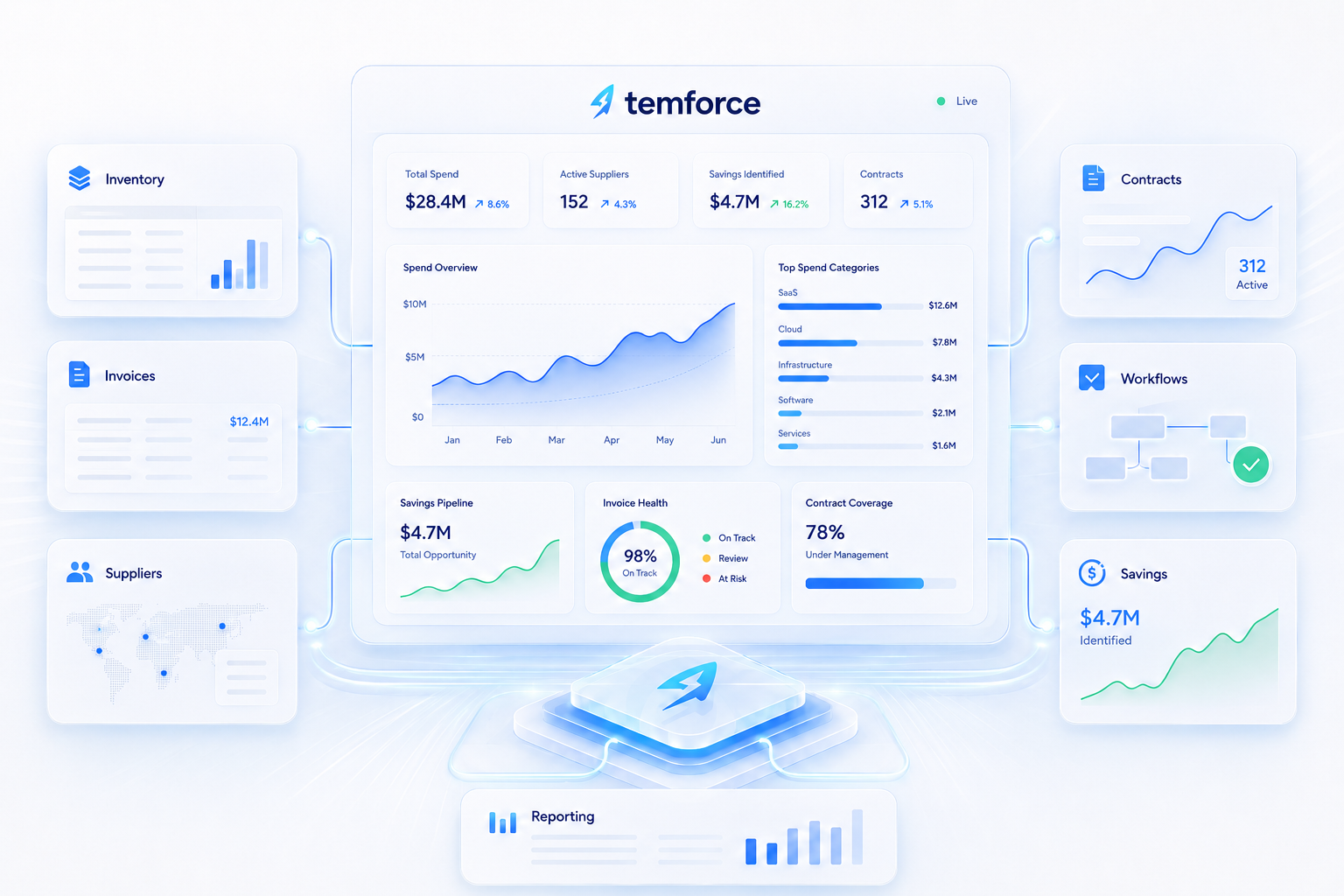
Estimate value from billing errors, duplicate charges, missing credits, stale inventory, unused services, supplier issues, and contract gaps.
Connect disputes, supplier follow-up, lifecycle actions, MCAD orders, disconnects, recoveries, credits, and approvals to ownership.
Connect realized savings, credits, recoveries, productivity gains, supplier outcomes, AI-supported insight, and dashboards to leadership reporting.
Estimate potential TEM software ROI using your operating assumptions.
This calculator is directional. Actual results depend on data quality, supplier complexity, invoice volume, lifecycle activity, adoption, workflow execution, and the savings opportunities present in your environment.
Enter your estimate.
Use conservative inputs to estimate potential annual value from spend under management, recoverable savings, productivity improvement, and TEMOps execution.
Estimated annual value.
Use these results as a planning conversation starter for a TEM software business case. The stronger the data, workflow adoption, supplier follow-up, and savings proof, the stronger the realized value can become.
Estimated payback period: 8.2 months. This is a directional estimate and should be validated with your actual invoices, inventory records, supplier data, lifecycle workflows, and support model.
Measure TEM software ROI across six value categories.
The strongest ROI story connects hard-dollar savings to operating improvements that make savings easier to find, capture, and prove over time.
Incorrect charges, duplicate charges, missing credits, billing after disconnect, disputed fees, supplier corrections, and recoveries.
Unused services, stale records, duplicate assets, orphaned charges, missing ownership, inaccurate inventory, and disconnected billing.
Disconnect savings, retirement savings, renewal control, MCAD order management, supplier action, billing confirmation, and avoided waste.
Carrier corrections, vendor follow-up, contract obligations, escalation outcomes, recovery commitments, credit tracking, and performance visibility.
Fewer spreadsheets, faster reporting, clearer ownership, fewer manual handoffs, better workflow status, and more repeatable TEMOps execution.
Boostforce AI can help users summarize activity, identify patterns, ask better questions, surface context, and accelerate operating decisions.
Ready-built APIs can support reporting, finance handoffs, integrations, customer ecosystem alignment, workflow continuity, and connected data.
Dashboards can show spend, savings, recoveries, supplier outcomes, inventory quality, lifecycle progress, support activity, and proof.
A practical ROI model should connect value source, action, and proof.
ROI becomes easier to defend when the calculation is tied to the operating evidence behind the result.
| Value Source | What to Measure | How Temforce Supports the Value |
|---|---|---|
| Invoice validation | Duplicate charges, incorrect rates, missing credits, billing after disconnect, disputed charges, recoveries, and corrections. | Temforce connects invoices to inventory truth, suppliers, contracts, billing accounts, disputes, credits, recoveries, and reporting. |
| Inventory cleanup | Unused services, stale records, duplicate assets, missing owners, supplier gaps, billing mismatches, and disconnected charges. | Temforce connects inventory records to owners, locations, cost centers, suppliers, contracts, invoices, workflows, and reports. |
| Lifecycle control | Disconnect savings, renewals, retirements, MCAD orders, service changes, billing confirmation, and avoided recurring waste. | Temforce supports lifecycle workflows, supplier action, inventory updates, invoice impact, savings tracking, and reporting evidence. |
| Supplier accountability | Supplier corrections, dispute aging, credits, recoveries, contract obligations, escalation outcomes, and performance improvement. | Temforce connects suppliers to issues, contracts, invoices, disputes, credits, recoveries, lifecycle actions, and reporting. |
| Productivity improvement | Reduced manual tracking, fewer spreadsheet handoffs, faster report preparation, clearer ownership, and fewer disconnected follow-ups. | Temforce supports workflow visibility, tasks, dashboards, AI summaries, API-connected data, support routines, and repeatable execution. |
| Executive reporting | Spend visibility, savings proof, recoveries, open risk, supplier outcomes, workflow status, inventory quality, and TEMOps maturity. | Temforce connects dashboards and reporting to inventory truth, invoice validation, supplier outcomes, savings, AI, APIs, and support. |
The strongest ROI story is built on operating evidence.
Temforce helps teams connect value to proof through inventory truth, invoice validation, supplier accountability, contract visibility, lifecycle workflows, Boostforce AI, ready-built APIs, application customization, dedicated support, savings tracking, dashboards, and reporting.
TEM Software ROI Calculator FAQ.
Use these answers to understand how a TEM software ROI calculator can support business case planning, savings tracking, invoice validation, inventory cleanup, supplier accountability, AI, APIs, support, and reporting.
What is a TEM software ROI calculator?
A TEM software ROI calculator is a planning tool that estimates potential value from Technology Expense Management software. It can include invoice validation savings, inventory cleanup, supplier corrections, lifecycle savings, recoveries, credits, productivity improvement, AI-supported answers, API-connected data, dashboards, and reporting.
What inputs should be used in a TEM software ROI model?
Common inputs include annual technology and telecom spend, estimated recoverable savings rate, invoice volume, supplier complexity, manual hours reduced, blended labor cost, lifecycle activity, expected credits, recoveries, and estimated platform investment.
Why does TEM software ROI depend on inventory truth?
TEM software ROI depends on inventory truth because invoice validation, supplier accountability, lifecycle control, savings tracking, and reporting all rely on knowing what services exist, who owns them, who bills them, and what status applies.
How does invoice validation affect ROI?
Invoice validation can affect ROI by identifying incorrect charges, duplicate charges, missing credits, billing after disconnect, supplier billing errors, contract mismatches, disputed fees, credits, recoveries, and correction opportunities.
How do AI and APIs support TEM software ROI?
Boostforce AI can help users summarize activity, surface patterns, ask better questions, and explain cost context. Ready-built APIs can support connected data flows, finance handoffs, reporting, integrations, and customer ecosystem alignment.
How does Temforce support ROI tracking?
Temforce supports ROI tracking by connecting inventory truth, invoice validation, supplier accountability, contracts, lifecycle workflows, disputes, credits, recoveries, Boostforce AI, ready-built APIs, application customization, dedicated support, savings tracking, dashboards, and reporting.
Turn ROI estimates into tracked, proven value.
Temforce helps teams connect ROI planning to inventory truth, invoice validation, supplier accountability, contract visibility, lifecycle workflows, Boostforce AI, ready-built APIs, application customization, dedicated support, savings tracking, dashboards, and reporting.
Estimate the value of turning TEM into software-backed execution.
Use this TEM Software ROI Calculator to estimate potential annual value from invoice validation, inventory cleanup, supplier accountability, lifecycle management, billing corrections, disconnect savings, credits, recoveries, Boostforce AI, ready-built APIs, dedicated support, and reporting.
TEM software ROI is not only about finding billing errors.
It is about creating a repeatable operating model that prevents waste, validates spend, proves savings, and improves control.
Technology expense savings often come from many places: incorrect charges, duplicate services, billing after disconnect, missed credits, supplier errors, contract mismatches, unused services, inventory cleanup, renewal control, workflow visibility, and better reporting. Temforce helps teams connect those savings opportunities to action and proof.
Invoice validation can surface billing errors, missing credits, incorrect charges, duplicate charges, supplier issues, recoveries, and dispute opportunities.
Inventory truth can reveal unused services, stale records, orphaned costs, duplicate assets, incorrect ownership, and lifecycle savings opportunities.
Requests, MCAD order management, supplier follow-up, contract visibility, AI, APIs, support, dashboards, and reports help move savings from idea to outcome.
Estimate potential annual TEM savings from better operating control.
Enter a few practical assumptions to estimate potential annual savings. This calculator is directional and designed to support planning, business case development, and demo conversations.
Your estimated annual TEM value
Use this directional estimate to frame the business case for TEM software, TEMOps execution, invoice validation, inventory truth, supplier accountability, lifecycle control, AI, APIs, support, and reporting.
Estimated payback: 5.4 months. Results are directional and should be validated against your actual spend, suppliers, inventory quality, invoice history, lifecycle activity, and savings opportunities.
Strong TEM ROI usually comes from multiple value streams.
The business case becomes stronger when savings, productivity, supplier accountability, lifecycle control, AI, APIs, support, and reporting are connected instead of evaluated separately.
Find incorrect charges, duplicate charges, missing credits, contract mismatches, supplier billing errors, disputed charges, and recoverable value.
Identify services that are stale, duplicated, unowned, inactive, disconnected, misassigned, or no longer needed.
Track supplier follow-up, correction requests, escalations, credits, recoveries, open disputes, and billing outcomes.
Connect contract terms, pricing context, commitments, amendments, renewals, and supplier obligations to operating decisions.
Control requests, MCAD order management, supplier actions, inventory updates, billing impact, savings, and completion proof.
Ask better questions, summarize activity, surface answers, explain cost context, identify patterns, and move insight toward action.
Support integrations, reporting needs, finance handoffs, ecosystem alignment, operational continuity, and connected TEM data.
Show credits, recoveries, billing corrections, supplier outcomes, workflow status, inventory cleanup, and measurable TEMOps outcomes.
Frame the ROI around truth, action, and proof.
A practical ROI model should connect the source of value to the workflow that captures it and the reporting that proves it.
| ROI Area | Where value comes from | How Temforce supports the value path |
|---|---|---|
| Invoice validation | Incorrect charges, missing credits, duplicate charges, contract mismatches, supplier billing errors, and recoveries. | Temforce connects invoice validation to inventory truth, supplier follow-up, disputes, credits, recoveries, and reporting evidence. |
| Inventory cleanup | Unused services, stale records, orphaned costs, duplicate assets, inactive billing, ownership gaps, and missing lifecycle status. | Temforce connects inventory records to billing accounts, suppliers, contracts, owners, lifecycle workflows, AI, APIs, and reports. |
| Lifecycle control | Disconnect savings, renewal control, move/change/add management, billing impact validation, and supplier action tracking. | Temforce supports requests, MCAD order management, supplier action, inventory updates, invoice validation, savings tracking, and proof. |
| Supplier accountability | Carrier corrections, vendor escalations, dispute resolution, credits, recoveries, contract obligations, and performance improvement. | Temforce connects supplier records, contacts, escalations, disputes, contracts, corrections, credits, recoveries, and reports. |
| Workflow productivity | Reduced manual tracking, fewer disconnected spreadsheets, cleaner reporting, better follow-up, faster answers, and improved visibility. | Temforce connects TRACforce tasks, TRACsheets, TRACMeets, dashboards, documents, AI, APIs, support, and reporting. |
| Reporting confidence | Leadership visibility into spend, exceptions, supplier activity, credits, recoveries, workflow status, savings, and operating progress. | Temforce connects savings proof to invoice validation, supplier outcomes, lifecycle changes, inventory cleanup, dashboards, and reports. |
The best ROI story is not just savings. It is operating control.
Temforce helps teams connect savings opportunities to the platform capabilities that make them repeatable: inventory truth, invoice validation, supplier accountability, contract visibility, lifecycle workflows, Boostforce AI, ready-built APIs, application customization, dedicated support, dashboards, and reporting.
TEM Software ROI Calculator FAQ.
Use these answers to understand how TEM software ROI can come from inventory truth, invoice validation, supplier control, lifecycle workflows, AI, APIs, support, savings, and reporting.
What is a TEM software ROI calculator?
A TEM software ROI calculator is a planning tool that estimates potential value from better Technology Expense Management. It can include invoice validation savings, inventory cleanup, supplier accountability, lifecycle control, productivity improvement, credits, recoveries, and reporting value.
Where does TEM software ROI usually come from?
TEM software ROI can come from billing corrections, duplicate charge removal, missing credits, recoveries, disconnect savings, unused service cleanup, supplier corrections, contract visibility, workflow efficiency, AI-supported answers, API-connected data, and better reporting.
Why does inventory truth matter to ROI?
Inventory truth matters because teams need to know what services, assets, billing accounts, suppliers, owners, locations, cost centers, contracts, and lifecycle statuses exist before they can validate invoices, find waste, manage suppliers, and prove savings.
How does invoice validation support TEM ROI?
Invoice validation supports ROI by comparing billed charges to inventory, billing accounts, expected charges, contracts, supplier records, approvals, disputes, credits, recoveries, and finance context. This can surface billing errors, missing credits, duplicate charges, and savings opportunities.
How do AI and APIs support ROI?
Boostforce AI can help users ask better questions, summarize activity, surface answers, explain cost context, and identify patterns. Ready-built APIs can support connected data flows, integrations, finance handoffs, reporting, and customer ecosystem alignment.
How does Temforce help prove TEM software ROI?
Temforce helps prove ROI by connecting inventory truth, invoice validation, supplier accountability, contracts, lifecycle workflows, disputes, credits, recoveries, Boostforce AI, ready-built APIs, application customization, dedicated support, savings tracking, dashboards, and reporting.
Turn TEM savings potential into measurable operating value.
Temforce helps teams connect TEM software ROI to inventory truth, invoice validation, supplier accountability, contract visibility, lifecycle workflows, Boostforce AI, ready-built APIs, application customization, dedicated support, savings tracking, dashboards, and reporting.
