
Evaluate TEM software by execution capability, not just features.
Use this TEM software evaluation checklist to compare how platforms handle inventory truth, invoice validation, supplier accountability, contract visibility, requests, MCAD order management, lifecycle workflows, Boostforce AI, ready-built APIs, application customization, dedicated support, savings tracking, dashboards, and reporting.
A good TEM platform should help your team do the work. A great TEM platform should connect the data, workflow, support, intelligence, and proof behind the work.
Many evaluations compare features without asking whether the platform can support the operating model. A stronger checklist asks how the software connects inventory to invoices, suppliers to contracts, lifecycle changes to billing impact, AI to trusted records, APIs to ecosystem needs, and savings to reporting evidence.
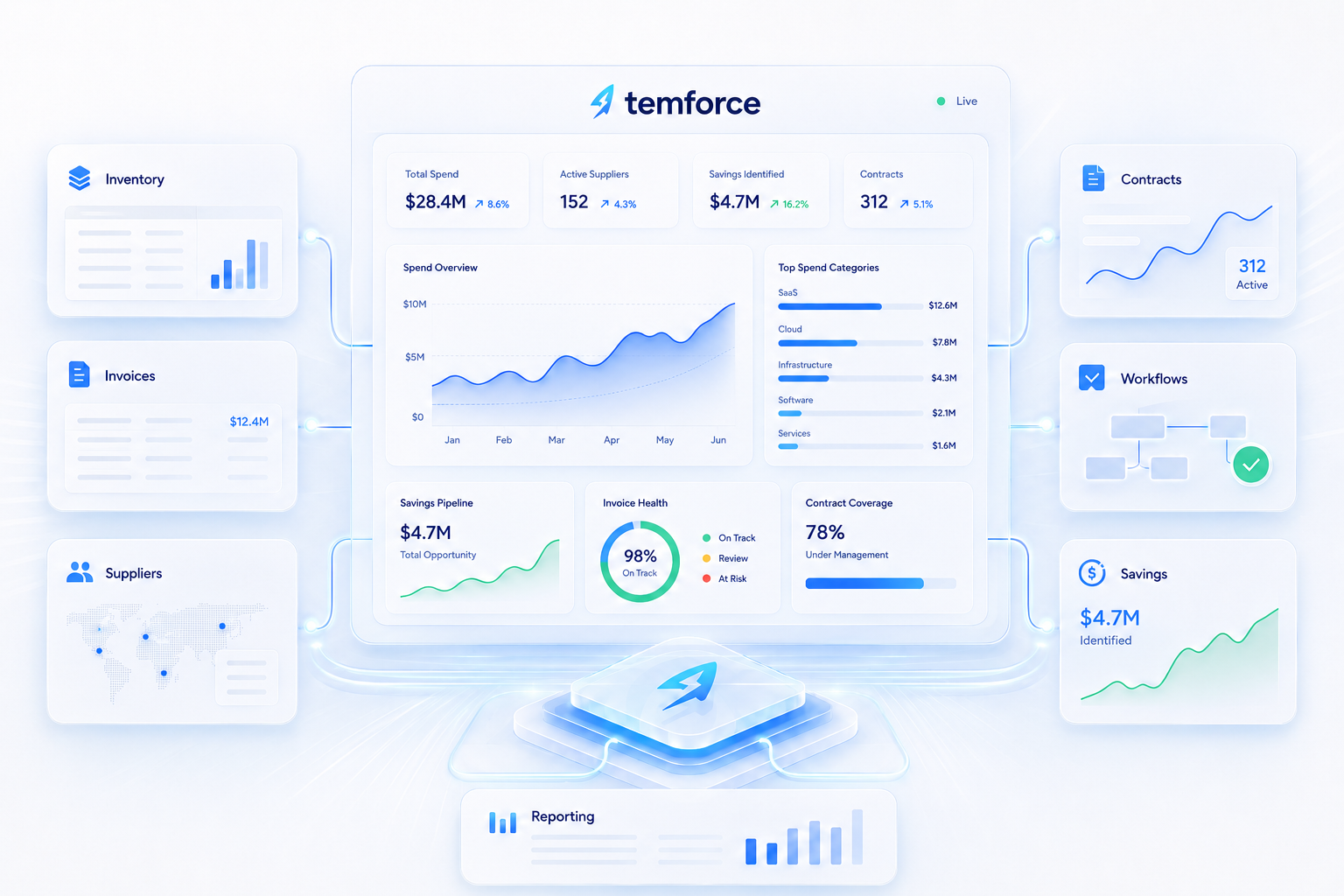
Look for connected records across services, assets, billing accounts, suppliers, owners, locations, cost centers, contracts, and lifecycle status.
Look for requests, approvals, MCAD order management, disputes, supplier follow-up, credits, recoveries, renewals, disconnects, and task ownership.
Look for savings evidence, invoice corrections, supplier outcomes, inventory cleanup, workflow status, dashboards, reports, AI answers, and API-connected data.
Use this checklist to compare TEM software across ten operating dimensions.
The best evaluation process looks beyond a product tour and asks whether the platform can support the actual TEMOps work your organization needs to run.
Can the platform maintain reliable records for services, assets, circuits, mobile lines, billing accounts, suppliers, owners, locations, cost centers, contracts, lifecycle status, and spend context?
Can the platform validate charges against inventory, billing accounts, expected costs, supplier records, contracts, approvals, disputes, credits, recoveries, and finance context?
Can supplier contacts, carrier issues, vendor follow-up, escalations, correction requests, dispute status, billing outcomes, and supplier performance be tracked in one operating view?
Can contracts connect to suppliers, inventory, invoice validation, renewal dates, obligations, pricing context, amendments, lifecycle decisions, and reporting?
Can the platform manage moves, changes, adds, disconnects, approvals, due dates, supplier actions, inventory updates, billing impact, and completion evidence?
Can renewals, disconnects, retirements, changes, supplier actions, billing confirmations, inventory updates, savings, and reporting move through structured workflow?
Can users ask better questions, summarize activity, surface answers, explain cost context, identify patterns, and connect insight to action across trusted TEM data?
Can the platform support data flows, integrations, reporting needs, finance handoffs, ecosystem alignment, operational continuity, and connected TEM data?
Can workflows, fields, terminology, permissions, reporting views, dashboards, and customer-specific operating patterns be configured and supported after launch?
Can the platform report credits, recoveries, billing corrections, disconnect savings, supplier outcomes, inventory cleanup, workflow status, executive dashboards, and measurable TEMOps outcomes?
Score each vendor by operating fit.
Use a simple 1 to 5 score for each dimension. The goal is not just to compare whether a feature exists, but whether the feature supports repeatable execution.
| Score | Meaning | What to look for during evaluation |
|---|---|---|
| 1 - Weak | The capability is missing, highly manual, unclear, or disconnected from the operating model. | The vendor shows a screen but cannot explain how the data, workflow, ownership, support, or reporting connects. |
| 2 - Developing | The capability exists in a limited way, but it may require workarounds, manual tracking, or outside spreadsheets. | The workflow depends on customer-side effort, exports, custom tracking, or disconnected follow-up. |
| 3 - Moderate | The capability is usable, but deeper connection to inventory, invoices, suppliers, contracts, lifecycle workflows, or reporting may be limited. | The vendor can demonstrate the function, but it may not fully support TEMOps execution across the full operating journey. |
| 4 - Strong | The capability is connected, configurable, and practical for repeatable operations. | The platform shows clear links between records, workflows, suppliers, invoices, contracts, lifecycle actions, savings, and reports. |
| 5 - Excellent | The capability supports a complete operating model with strong usability, reporting, customization, support, intelligence, and evidence. | The platform demonstrates how work moves from truth to action to proof, with AI, APIs, support, and dashboards reinforcing value. |
Ask questions that reveal real execution capability.
These questions help separate software that looks good in a demo from software that can support TEMOps execution after go-live.
Ask how inventory connects to invoices, billing accounts, suppliers, contracts, owners, locations, cost centers, lifecycle status, AI, APIs, and reporting.
Ask how invoice exceptions move into disputes, supplier follow-up, credits, recoveries, finance validation, savings tracking, and reports.
Ask how supplier contacts, escalations, correction requests, contract obligations, open disputes, outcomes, and performance reporting are managed.
Ask how contract terms, renewals, amendments, pricing context, commitments, and obligations connect to invoice validation and lifecycle decisions.
Ask how moves, changes, adds, disconnects, renewals, retirements, inventory updates, billing impact, and savings proof are controlled.
Ask how AI summarizes activity, surfaces answers, explains cost context, identifies patterns, and connects insight to trusted TEM records.
Ask how APIs support connected data flows, integrations, reporting, finance handoffs, operational processes, and customer ecosystem needs.
Ask how support helps with configuration, adoption, reporting, workflow improvement, issue resolution, customization, and ongoing value.
The right TEM software should turn evaluation into operating confidence.
Temforce is built to connect the major parts of Technology Expense Management: inventory truth, invoice validation, supplier accountability, contract visibility, lifecycle workflows, Boostforce AI, ready-built APIs, application customization, dedicated support, savings tracking, dashboards, and reporting.
TEM Software Evaluation Checklist FAQ.
Use these answers to evaluate TEM software around inventory truth, invoice validation, supplier control, workflows, AI, APIs, customization, support, savings, and reporting.
What should be included in a TEM software evaluation checklist?
A TEM software evaluation checklist should include inventory truth, invoice validation, supplier accountability, contract visibility, requests, MCAD order management, lifecycle workflows, AI, APIs, application customization, dedicated support, savings tracking, dashboards, and reporting.
How should TEM software be evaluated?
TEM software should be evaluated by how well it supports real operating work. The platform should connect records, workflows, suppliers, invoices, contracts, lifecycle actions, AI, APIs, support, savings, and reporting.
Why is inventory truth important in TEM software evaluation?
Inventory truth is important because invoice validation, supplier accountability, lifecycle decisions, savings tracking, AI answers, API connectivity, and reporting all depend on knowing what services, assets, billing accounts, suppliers, owners, locations, and cost centers exist.
Should AI and APIs be part of a TEM software checklist?
Yes. AI and APIs should be part of the checklist because modern TEM software should help users ask better questions, summarize activity, surface answers, connect data flows, support reporting, align finance handoffs, and integrate with customer ecosystem needs.
Why does customization matter when comparing TEM software?
Customization matters because technology expense operations vary by customer. Workflows, fields, terminology, permissions, reporting views, dashboards, and operating patterns should fit the customer’s reality instead of forcing every team into the same process.
How does Temforce support TEM software evaluation?
Temforce supports TEM software evaluation by connecting inventory truth, invoice validation, supplier control, contracts, requests, MCAD order management, lifecycle workflows, Boostforce AI, ready-built APIs, application customization, dedicated support, savings tracking, dashboards, and reporting.
Use the checklist to evaluate TEM software for execution.
Temforce helps teams evaluate and run Technology Expense Management with inventory truth, invoice validation, supplier accountability, contract visibility, lifecycle workflows, Boostforce AI, ready-built APIs, application customization, dedicated support, savings tracking, dashboards, and reporting.
