
Assess whether your organization is ready for TEMOps execution.
Use this Technology Expense Management Readiness Assessment to evaluate inventory truth, invoice validation, supplier control, contract visibility, lifecycle workflows, Boostforce AI, ready-built APIs, application customization, dedicated support, savings tracking, reporting, and operating discipline.
TEM readiness is not just about buying software. It is about whether your data, workflows, people, suppliers, invoices, and reporting can support repeatable control.
Many organizations feel the pain of technology expense complexity before they have the operating structure to fix it. The readiness question is simple: can your team see what exists, validate what is billed, assign what needs action, hold suppliers accountable, control lifecycle changes, prove savings, and report outcomes?
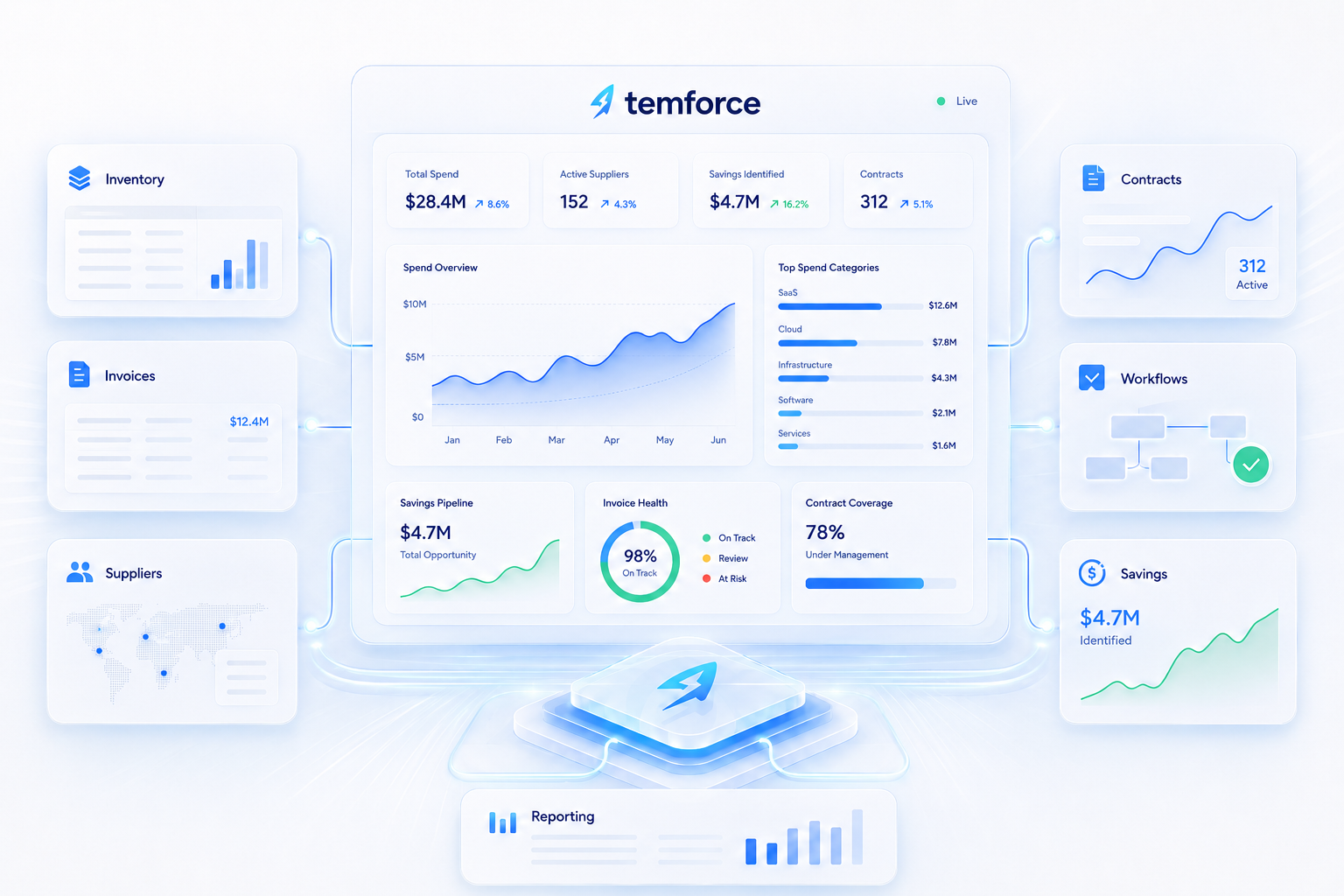
Evaluate whether services, assets, circuits, mobile lines, billing accounts, suppliers, contracts, owners, locations, cost centers, and lifecycle status are connected.
Evaluate whether invoice exceptions, supplier issues, requests, MCAD orders, renewals, disconnects, credits, recoveries, and lifecycle work move through visible ownership.
Evaluate whether savings, corrections, credits, recoveries, supplier outcomes, inventory cleanup, workflow status, and reporting evidence are reliable.
Score your TEM readiness across eight operating areas.
Use this test to identify where your organization is strong, where risk exists, and where Temforce can help turn disconnected work into TEMOps execution. Select a score from 1 to 5 for each area to receive an overall readiness grade.
Your TEM readiness grade is C.
You have a workable TEM foundation, but there are still gaps that can limit invoice control, supplier accountability, lifecycle execution, savings proof, and reporting. Temforce can help your team build more structure and move toward stronger operating control.
This readiness test is a practical self-assessment. Use the score to guide a Temforce demo conversation around inventory truth, invoice validation, supplier control, lifecycle workflows, AI, APIs, support, savings, and reporting.
Use your score to identify your TEMOps maturity stage.
The goal is not perfection before action. The goal is to understand your starting point and create a practical path toward stronger technology expense control.
Inventory is incomplete, invoices are reviewed manually, supplier follow-up is scattered, lifecycle changes are difficult to track, and savings proof is inconsistent.
Teams have some records and processes, but inventory, invoices, suppliers, contracts, lifecycle workflows, disputes, and reports are still disconnected.
Core records, workflows, invoice validation, supplier follow-up, lifecycle activity, and savings tracking are connected enough to support repeatable execution.
Inventory truth, invoice validation, supplier control, contracts, lifecycle workflows, AI, APIs, customization, support, savings, and reporting operate as one model.
Ask the questions that expose operating gaps.
These questions help teams uncover where technology expense control is working, where it is fragile, and where software-backed TEMOps execution can create value.
Can we trust our inventory?
Assess whether inventory records are complete, current, owned, connected to billing accounts, mapped to suppliers, tied to contracts, linked to locations and cost centers, and useful for invoice validation.
Can we validate recurring spend?
Assess whether invoices are checked against inventory, billing accounts, expected charges, contract context, supplier records, approvals, disputes, credits, recoveries, and finance requirements.
Can we hold suppliers accountable?
Assess whether supplier issues, carrier disputes, vendor contacts, escalation paths, contract obligations, correction requests, credits, recoveries, and outcomes are visible and connected to the right records.
Can we control lifecycle changes?
Assess whether requests, approvals, moves, changes, adds, disconnects, renewals, retirements, supplier actions, inventory updates, and billing changes move through structured workflow.
Can we prove outcomes?
Assess whether the organization can report savings, credits, recoveries, corrections, supplier outcomes, inventory cleanup, open disputes, workflow status, and operating progress in a leadership-ready way.
Readiness improves when TEM becomes an operating system, not a side process.
Temforce helps teams move from scattered records, manual invoice checks, supplier follow-up gaps, lifecycle confusion, and inconsistent reporting into a software-backed TEMOps model built on inventory truth, workflow control, AI, APIs, customization, support, savings proof, and reporting.
Technology Expense Management Readiness Assessment FAQ.
Use these answers to understand how to assess readiness for inventory truth, invoice validation, supplier control, lifecycle workflows, AI, APIs, support, savings, and reporting.
What is a Technology Expense Management readiness assessment?
A Technology Expense Management readiness assessment helps organizations evaluate whether their inventory, invoices, suppliers, contracts, lifecycle workflows, AI, APIs, support model, savings tracking, and reporting are ready to support repeatable TEMOps execution.
How is the TEM readiness grade calculated?
The readiness grade is based on eight operating areas: inventory truth, invoice validation, supplier accountability, contract visibility, lifecycle workflows, AI and API readiness, customization and support, and savings and reporting. Each area is scored from 1 to 5, then averaged into an A-F readiness grade.
Why should TEM readiness start with inventory truth?
TEM readiness should start with inventory truth because invoice validation, supplier accountability, contract visibility, lifecycle management, AI answers, API connectivity, savings tracking, and reporting all depend on knowing what services, assets, billing accounts, suppliers, owners, locations, and cost centers exist.
How do I know if my organization is ready for TEM software?
Your organization is ready for TEM software when it has clear pain around spend visibility, invoice validation, supplier follow-up, contract control, lifecycle management, savings proof, or reporting, and is ready to connect those activities into a structured operating model.
What are signs that TEM readiness is low?
Signs of low readiness include incomplete inventory, manual invoice review, disconnected supplier follow-up, unclear ownership, missing contract context, lifecycle changes not reflected in billing, savings that are hard to prove, and reporting that leadership cannot trust.
How does Temforce support TEM readiness?
Temforce supports TEM readiness by connecting inventory truth, invoice validation, supplier control, contracts, lifecycle workflows, Boostforce AI, ready-built APIs, application customization, dedicated support, savings tracking, dashboards, and reporting into one TEMOps platform.
Move from readiness questions to TEMOps execution.
Temforce helps teams turn technology expense readiness into action by connecting inventory truth, invoice validation, supplier accountability, contract visibility, lifecycle workflows, Boostforce AI, ready-built APIs, application customization, dedicated support, savings tracking, dashboards, and reporting.
