
Use your TEM software demo to test execution, not just features.
A strong TEM software demo should show how the platform handles real Technology Expense Management work: inventory truth, invoice validation, supplier accountability, contracts, requests, MCAD order management, lifecycle workflows, savings proof, Boostforce AI, ready-built APIs, application customization, dedicated support, and reporting.
A TEM software demo should not feel like a product tour. It should feel like a working session around your operating reality.
Many TEM demos focus on screens, menus, and feature lists. Better demos show whether the software can solve the actual operating problem: disconnected inventory, recurring invoice complexity, supplier follow-up gaps, contract visibility issues, lifecycle changes, manual reporting, and savings that are difficult to prove.
Use examples like invoice exceptions, missing inventory records, supplier disputes, disconnect requests, renewals, credits, recoveries, and reporting needs.
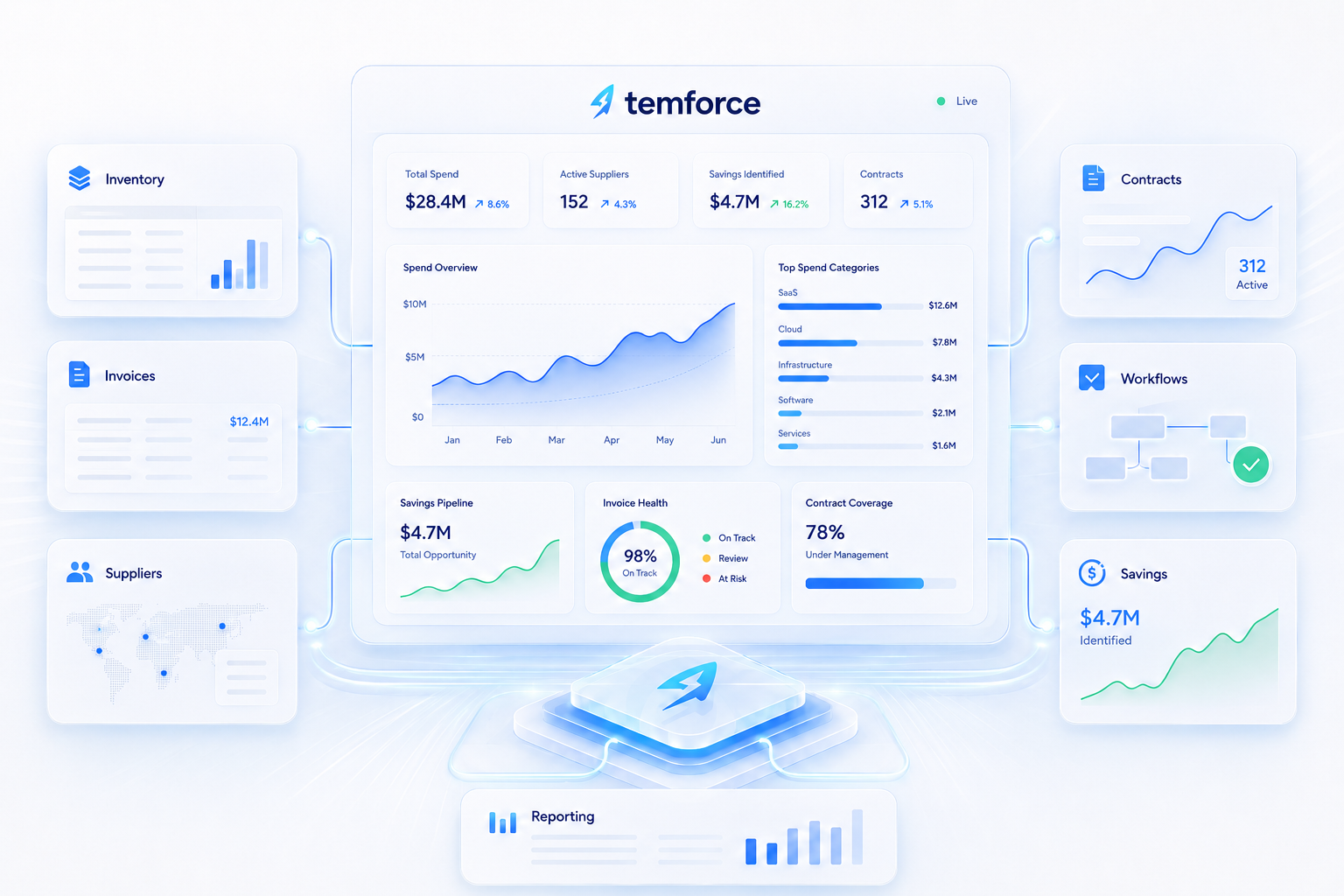
A strong demo should show how inventory connects to billing accounts, suppliers, contracts, invoices, workflow, savings, AI, APIs, and reporting.
Ask how workflows are configured, reports are tailored, APIs are supported, AI helps users, and dedicated support helps customers succeed.
Ask the demo to prove how TEM work gets done.
The best TEM software demo moves through an operating journey: what exists, what is billed, what is wrong, who owns the next action, what changed, how savings are proven, and how leadership sees the outcome.
Start with inventory truth.
Ask the demo to show how the platform manages the operating record behind the spend. This should include technology inventory, telecom inventory, billing accounts, suppliers, owners, locations, cost centers, contracts, service relationships, and lifecycle status.
Walk through invoice validation.
Ask the demo to show how invoices are validated against inventory, billing accounts, contracts, expected charges, supplier records, approvals, disputes, credits, recoveries, and finance context. The demo should not stop at identifying an exception. It should show what happens next.
Test supplier and contract accountability.
Ask the demo to show how carrier and vendor records connect to contracts, invoice issues, disputes, renewals, billing corrections, escalation paths, contacts, commitments, obligations, and reporting. Supplier accountability should be visible, not buried in email and portals.
Run a lifecycle workflow from request to proof.
Ask the demo to show a request, move, change, add, disconnect, renewal, or retirement workflow. The platform should show ownership, due dates, approvals, supplier actions, inventory updates, billing impact, completion evidence, and savings tracking.
Evaluate AI, APIs, customization, support, and reporting.
Modern TEM software should be more than a database. Ask how AI helps users ask questions, how APIs connect data flows, how the application can be customized, how dedicated support works, and how reporting shows value across inventory, invoices, suppliers, contracts, workflows, savings, and outcomes.
Use this scorecard to evaluate real platform fit.
A demo should make it clear whether the software can support your operating model, not just whether the vendor can show attractive screens.
| Demo Area | What to ask | What a strong answer should show |
|---|---|---|
| Inventory truth | How do inventory records connect to billing accounts, suppliers, contracts, owners, locations, cost centers, and lifecycle status? | A connected operating record that supports invoice validation, supplier control, lifecycle workflows, AI, APIs, and reporting. |
| Invoice validation | How are invoices compared to inventory, contracts, approvals, expected charges, disputes, credits, recoveries, and finance context? | A clear path from invoice exception to workflow, supplier follow-up, correction, recovery, savings proof, and reporting. |
| Supplier accountability | How do you track supplier contacts, issues, escalations, contract obligations, billing corrections, and follow-up status? | Visible supplier history, accountable ownership, connected contracts, dispute workflow, and measurable outcomes. |
| Lifecycle workflows | How does the platform manage requests, MCAD order management, disconnects, renewals, retirements, inventory updates, and billing impact? | Workflow ownership, status visibility, documentation, supplier action tracking, billing validation, and savings evidence. |
| AI and APIs | How does AI help users ask questions, and how do APIs support connected data flows, reporting, finance, and integrations? | Practical answers, summarized activity, connected data movement, integration readiness, reporting support, and customer ecosystem alignment. |
| Customization and support | How can workflows, fields, terminology, reports, permissions, and views be customized, and what support is provided? | Configurable application behavior, tailored operating views, dedicated support, issue resolution, adoption help, and ongoing improvement. |
| Savings and reporting | How are credits, recoveries, disconnect savings, billing corrections, supplier outcomes, and inventory cleanup reported? | Leadership-ready dashboards and reporting that connect savings to evidence, workflow status, supplier activity, and invoice results. |
Bring the right context so the demo can prove real value.
The better your demo inputs, the more useful the demo becomes. Prepare a small set of business scenarios that reveal whether the platform can handle actual TEMOps execution.
Use a scenario involving unknown ownership, billing account confusion, missing service detail, supplier mismatch, location changes, or lifecycle status gaps.
Ask how the platform handles billing errors, duplicate charges, missing credits, disconnect issues, disputed charges, contract mismatches, or unusual fees.
Test carrier accountability, vendor response tracking, escalation paths, issue ownership, correction requests, and outcome reporting.
Ask how contracts connect to inventory, suppliers, invoices, renewals, amendments, commitments, pricing context, and workflows.
Test whether the platform connects request intake, approvals, supplier action, inventory update, billing impact, and savings proof.
Ask how the platform reports inventory quality, invoice exceptions, supplier activity, workflow status, credits, recoveries, savings, and outcomes.
Ask how Boostforce AI can help summarize activity, surface answers, explain cost context, identify patterns, and move from insight to action.
Ask how ready-built APIs can support connected data flows, finance handoffs, reporting, operational processes, and customer ecosystem alignment.
The demo should prove whether TEM software can become your operating layer.
The right TEM software should help your team know what exists, validate what is billed, assign what needs action, hold suppliers accountable, connect contracts, manage lifecycle changes, ask better questions, connect data flows, customize workflows, prove savings, and report outcomes.
TEM Software Demo Guide FAQ.
Use these answers to prepare for a TEM software demo that evaluates execution, inventory truth, invoice validation, workflows, AI, APIs, customization, support, savings, and reporting.
What should I ask during a TEM software demo?
Ask how the platform manages inventory truth, invoice validation, supplier accountability, contracts, requests, MCAD order management, lifecycle workflows, savings proof, Boostforce AI, ready-built APIs, application customization, dedicated support, and reporting.
How do I know if a TEM software demo is useful?
A useful TEM software demo shows how real work gets done. It should connect inventory records to invoices, suppliers, contracts, workflows, billing corrections, credits, recoveries, lifecycle changes, savings evidence, AI, APIs, and reporting.
Why should inventory truth be part of the demo?
Inventory truth should be part of the demo because invoice validation, supplier accountability, contract visibility, lifecycle decisions, savings tracking, AI answers, API connectivity, and reporting depend on knowing what services, assets, billing accounts, suppliers, owners, locations, and cost centers exist.
Should the demo include invoice validation?
Yes. The demo should show how invoices are validated against inventory, billing accounts, contracts, approvals, expected charges, disputes, credits, recoveries, and finance context. It should also show how exceptions move into workflow.
Should I ask about AI and APIs in a TEM software demo?
Yes. Ask how Boostforce AI helps users ask better questions, summarize activity, surface answers, explain cost context, and identify patterns. Ask how ready-built APIs support connected data flows, integrations, finance handoffs, reporting, and customer ecosystem alignment.
Why should customization and support be evaluated in the demo?
Customization and support matter because TEM software needs to fit customer workflows, reporting needs, data structures, terminology, permissions, and adoption requirements. Dedicated support helps sustain value after implementation.
How does Temforce support TEM software demo evaluation?
Temforce supports demo evaluation by showing how inventory truth, invoice validation, supplier control, contracts, lifecycle workflows, Boostforce AI, ready-built APIs, application customization, dedicated support, savings tracking, and reporting connect in one TEMOps platform.
Run a TEM software demo that proves execution.
Temforce helps teams evaluate TEM software around the work that matters: inventory truth, invoice validation, supplier accountability, contract visibility, lifecycle workflows, Boostforce AI, ready-built APIs, application customization, dedicated support, savings tracking, and reporting.
