
Build the business case for Technology Expense Management that finance, IT, and leadership can believe in.
A strong Technology Expense Management business case is not just about finding billing errors. It is about proving how inventory truth, invoice validation, supplier accountability, contract control, lifecycle workflows, Boostforce AI, ready-built APIs, application customization, dedicated support, savings tracking, and reporting create measurable operating value.
The TEM business case becomes stronger when it moves beyond cost cutting. It should prove better visibility, better control, better execution, and better evidence.
Many organizations know technology spend is difficult to control, but they struggle to explain the business case in a way that connects finance, IT, procurement, telecom, and operations. Temforce gives teams a clearer story: build inventory truth, validate invoices against reality, manage suppliers and contracts, control lifecycle changes, document savings, and report outcomes.
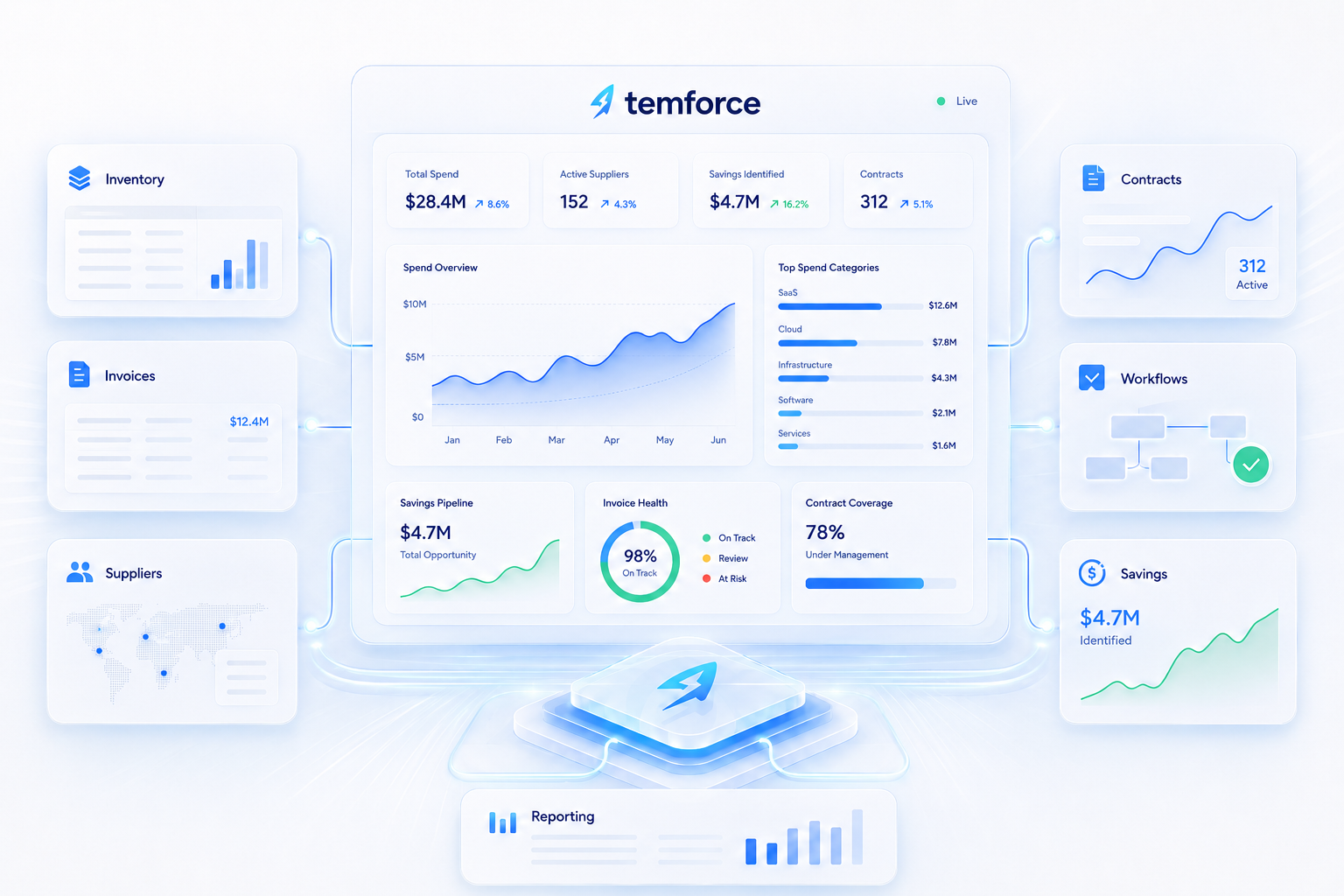
Inventory truth gives teams a trusted record for services, assets, circuits, mobile lines, billing accounts, suppliers, owners, locations, contracts, and lifecycle status.
Invoice findings, supplier follow-up, disputes, requests, MCAD orders, renewals, disconnects, credits, recoveries, and approvals should move through visible ownership.
Credits, recoveries, billing corrections, disconnect savings, supplier outcomes, inventory cleanup, and workflow completion should connect back to evidence.
Build the business case around five operating outcomes.
The strongest Technology Expense Management business case shows how the platform improves visibility, validates spend, reduces waste, strengthens supplier accountability, and creates repeatable TEMOps execution.
Prove the value of inventory truth.
Technology spend cannot be controlled well if the organization does not know what exists, who owns it, where it belongs, which supplier bills it, which account it appears on, and whether it is still needed. Inventory truth is the foundation of the business case because it gives every other savings and control activity a reliable starting point.
Show how invoice validation protects recurring spend.
Recurring technology and telecom charges can change quietly through new services, billing errors, missed disconnects, supplier changes, contract issues, duplicate charges, taxes, fees, and account structure changes. The business case should explain how invoice validation catches problems earlier and connects exceptions to action.
Connect supplier and contract accountability to measurable outcomes.
Suppliers and contracts shape technology spend, but the value is often lost when terms, renewals, disputes, billing corrections, carrier responses, escalation paths, and contract obligations are disconnected. Temforce helps teams connect supplier accountability to operating records, invoice validation, lifecycle changes, and savings proof.
Turn lifecycle management into cost control.
The business case should show that savings do not only come from invoice errors. They also come from better lifecycle control: requests, MCAD order management, moves, changes, adds, disconnects, renewals, retirements, inventory updates, billing changes, supplier follow-up, and reporting.
Use AI, APIs, customization, support, and reporting to sustain the value.
The business case should not stop at implementation. Temforce supports long-term TEMOps maturity with Boostforce AI, ready-built APIs, application customization, dedicated support, configurable workflows, dashboards, and reporting. The result is a platform that can support changing business needs instead of becoming another static system.
Translate TEMOps capability into business value.
A practical business case connects platform capabilities to the value categories leadership already cares about: cost control, risk reduction, process efficiency, supplier accountability, visibility, auditability, and better decision support.
| Business Case Area | What leadership needs to understand | How Temforce supports the case |
|---|---|---|
| Spend visibility | Teams need a reliable view of services, assets, billing accounts, suppliers, contracts, owners, locations, and cost centers. | Temforce centers inventory truth as the operating record behind technology expense management, invoice validation, lifecycle activity, AI, APIs, and reporting. |
| Invoice validation | Recurring charges should be validated against operating reality, not accepted simply because they appear on an invoice. | Temforce connects invoice validation to inventory, billing accounts, supplier records, contracts, approvals, disputes, credits, recoveries, and finance context. |
| Supplier accountability | Carrier and vendor follow-up should have visible ownership, status, escalation, correction tracking, and measurable outcomes. | Temforce connects supplier records, contacts, issue history, contracts, disputes, workflow activity, billing corrections, credits, recoveries, and reporting. |
| Lifecycle control | Requests, moves, changes, adds, disconnects, renewals, and retirements should update inventory and be validated against billing. | Temforce supports requests, MCAD order management, lifecycle workflows, supplier follow-up, inventory updates, billing impact, and savings proof. |
| Workflow efficiency | TEM work should not disappear into emails, spreadsheets, portals, meetings, and disconnected tickets. | Temforce connects TRACforce tasks, TRACsheets, TRACMeets, dashboards, documents, approvals, supplier follow-up, and reporting into TEMOps execution. |
| Modern enablement | The platform should support better questions, connected data flows, configuration, adoption, and ongoing improvement. | Temforce includes Boostforce AI, ready-built APIs, application customization, dedicated support, dashboards, reports, and configurable operating views. |
| Savings proof | Identified savings are not enough. Leadership needs proof of credits, recoveries, disconnect savings, corrections, and outcomes. | Temforce connects savings to workflow status, supplier corrections, lifecycle changes, invoice validation, credits, recoveries, inventory cleanup, and reporting evidence. |
A strong TEM business case should include more than software features.
The business case should show the current-state problem, future-state operating model, platform capabilities, expected value drivers, adoption approach, and reporting plan.
Show where inventory, invoices, suppliers, contracts, requests, disputes, savings, reporting, and accountability are disconnected today.
Explain how inventory truth, invoice validation, supplier control, lifecycle workflows, AI, APIs, support, and reporting will work together.
Frame value around spend visibility, cost control, supplier accountability, contract visibility, workflow efficiency, savings proof, and reporting.
Include billing corrections, credits, recoveries, disconnect savings, inventory cleanup, supplier issues, contract opportunities, and lifecycle control.
Explain the risk of unmanaged spend, incomplete inventory, weak invoice validation, missed renewals, open disputes, and supplier follow-up gaps.
Include configuration, data readiness, workflow setup, reporting views, application customization, dedicated support, and user adoption.
Show how ready-built APIs and connected data flows can support reporting, finance handoffs, integrations, and operational continuity.
Plan reporting for inventory quality, invoice exceptions, workflow status, supplier activity, credits, recoveries, savings, and executive outcomes.
The business case is strongest when TEM is framed as operating control.
Temforce helps teams show that Technology Expense Management is not only a cost-reduction project. It is a control framework for inventory truth, invoice validation, supplier accountability, contract visibility, lifecycle execution, AI-supported insight, API connectivity, support, savings proof, and reporting.
Technology Expense Management Business Case FAQ.
Use these answers to frame the business case for TEM software, inventory truth, invoice validation, supplier accountability, lifecycle workflows, AI, APIs, support, savings, and reporting.
What is a Technology Expense Management business case?
A Technology Expense Management business case explains why an organization should invest in TEM software, processes, and operating controls to improve spend visibility, invoice validation, supplier accountability, contract visibility, lifecycle management, savings tracking, and reporting.
What should be included in a TEM business case?
A TEM business case should include current-state pain, inventory truth gaps, invoice validation needs, supplier and contract risks, lifecycle workflow challenges, savings categories, expected value drivers, adoption planning, data connectivity, support needs, and reporting outcomes.
Why does inventory truth matter in the business case?
Inventory truth matters because invoice validation, supplier accountability, lifecycle decisions, savings tracking, AI answers, API connectivity, and reporting all depend on knowing what services, assets, billing accounts, suppliers, contracts, owners, locations, and cost centers exist.
How does invoice validation support the business case?
Invoice validation supports the business case by helping teams identify incorrect charges, missing credits, contract mismatches, duplicate charges, disconnect issues, supplier billing errors, credits, recoveries, and savings opportunities.
How does Temforce help prove savings?
Temforce helps prove savings by connecting savings actions to invoice validation, supplier corrections, billing credits, recoveries, disconnects, lifecycle changes, inventory cleanup, workflow status, and reporting evidence.
How do AI and APIs strengthen the TEM business case?
Boostforce AI helps users ask better questions, summarize activity, surface answers, explain cost context, and identify patterns. Ready-built APIs help support connected data flows, integrations, finance handoffs, reporting needs, and customer ecosystem alignment.
Why include dedicated support and customization in the business case?
Dedicated support and application customization help the platform fit the customer’s operating model, improve adoption, configure workflows, tailor reporting, support issue resolution, align data structures, and sustain long-term value.
Build a TEM business case around truth, control, execution, and proof.
Temforce helps teams connect inventory truth, invoice validation, supplier accountability, contract visibility, lifecycle workflows, Boostforce AI, ready-built APIs, application customization, dedicated support, savings tracking, and reporting into one practical Technology Expense Management business case.
