
Technology Expense Management is the discipline of controlling technology spend through inventory truth, invoice validation, and execution.
Technology Expense Management, often called TEM, helps organizations manage the services, suppliers, invoices, contracts, workflows, savings, and reporting behind technology spend. Temforce brings that work into one TEMOps platform built around inventory truth, Boostforce AI, ready-built APIs, dedicated support, application customization, and measurable outcomes.
Technology Expense Management is not just bill review. It is the operating system for knowing what exists, what is billed, what should change, and what value was created.
Technology Expense Management connects the records and workflows behind recurring technology spend. That includes telecom services, cloud services, software, mobility, network services, billing accounts, suppliers, contracts, invoices, approvals, disputes, lifecycle activity, savings, and reporting.
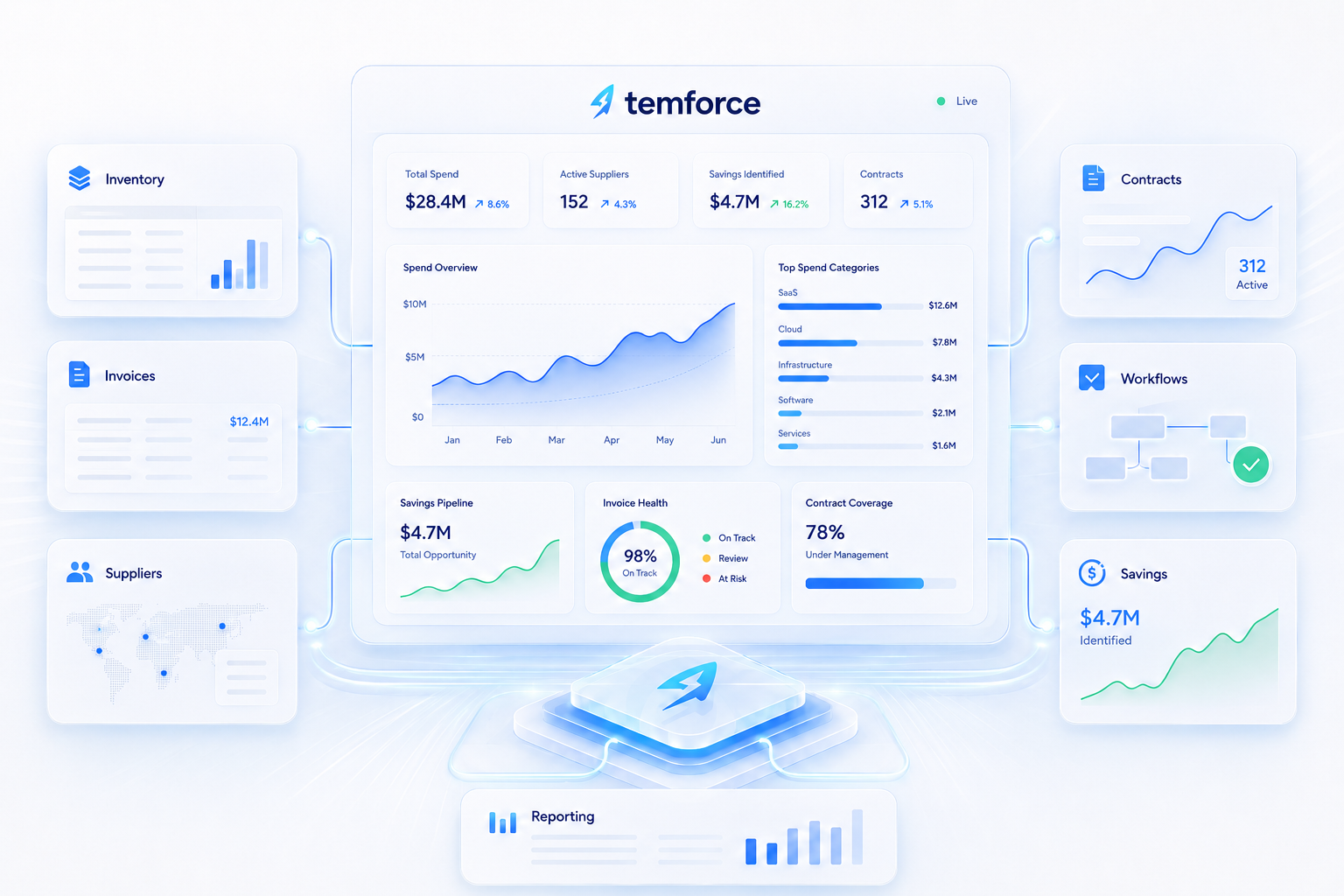
Technology Expense Management starts with trusted records for services, assets, telecom inventory, billing accounts, suppliers, owners, locations, contracts, and lifecycle status.
Teams validate invoices against inventory, billing accounts, contracts, approvals, expected charges, disputes, credits, recoveries, and finance context.
TEM works best when requests, tasks, supplier follow-up, disputes, renewals, disconnects, savings, AI, APIs, support, and reporting are connected.
Technology Expense Management works when the operating pieces are connected.
Strong TEM programs connect inventory, invoices, suppliers, contracts, requests, lifecycle activity, disputes, finance validation, savings, AI, APIs, dedicated support, application customization, and reporting.
Manage technology inventory, telecom inventory, billing accounts, suppliers, owners, locations, cost centers, contracts, lifecycle status, and spend context.
Compare invoices against inventory, billing accounts, contracts, approvals, expected charges, disputes, credits, recoveries, and finance context.
Track supplier records, contacts, issue history, escalation paths, contract obligations, billing corrections, credits, recoveries, and follow-up status.
Manage supplier agreements, renewals, amendments, commitments, obligations, service coverage, invoice validation, and renewal workflows.
Track business needs, approvals, owners, locations, cost centers, supplier context, service requirements, due dates, and supporting documentation.
Move adds, changes, disconnects, renewals, and service actions through visible ownership, supplier follow-up, inventory updates, and billing validation.
Track credits, recoveries, billing corrections, disconnect savings, inventory cleanup, supplier outcomes, optimization activity, and reporting evidence.
Report spend, inventory quality, invoice exceptions, supplier activity, workflow status, lifecycle actions, credits, recoveries, savings, and executive outcomes.
Help users summarize activity, surface answers, identify patterns, explain cost context, and move from insight to action.
Support connected data flows, integrations, reporting needs, finance handoffs, operational processes, and customer ecosystem alignment.
Configure workflows, terminology, reporting priorities, visibility, permissions, data structures, and customer-specific execution patterns.
Dedicated support helps customers move faster, solve issues, refine workflows, configure reporting, improve adoption, and sustain operating value.
Without Technology Expense Management, spend becomes hard to trust.
When inventory, invoices, suppliers, contracts, workflows, and reporting are disconnected, teams lose visibility into what they own, what they pay for, what needs action, and what savings were actually captured.
| Common TEM Challenge | What can happen without control | How Temforce helps |
|---|---|---|
| Unclear inventory | Teams cannot easily confirm what services exist, who owns them, where they belong, or whether they should still be active. | Temforce centers inventory truth as the operating record behind invoice validation, supplier control, lifecycle activity, AI, APIs, and reporting. |
| Invoice complexity | Recurring charges, billing accounts, supplier invoices, credits, disputes, and approvals become difficult to validate. | Temforce connects invoice validation to inventory, billing accounts, contracts, suppliers, disputes, credits, recoveries, and finance context. |
| Supplier accountability gaps | Carrier and vendor issues can sit in emails, portals, spreadsheets, and meeting notes without clear ownership. | Temforce connects supplier records, contacts, escalation paths, issue history, contracts, disputes, workflows, and reporting. |
| Contract disconnects | Renewals, obligations, amendments, service coverage, and pricing expectations may not be connected to spend activity. | Temforce connects contracts to inventory, invoices, supplier accountability, renewals, savings work, and reporting evidence. |
| Workflow fragmentation | Requests, approvals, orders, disconnects, disputes, renewals, and savings actions become hard to track. | Temforce supports visible workflow through requests, MCAD order management, tasks, meetings, supplier follow-up, and reporting. |
| Weak savings proof | Teams may identify opportunities but struggle to prove credits, recoveries, billing corrections, disconnect savings, and outcomes. | Temforce connects savings actions to workflow status, supporting data, supplier corrections, recoveries, and reporting evidence. |
Technology Expense Management works best when spend control starts with operating truth.
Temforce helps teams move from scattered TEM activity to connected execution by bringing inventory, invoices, suppliers, contracts, workflows, savings, AI, APIs, support, and reporting into one platform.
What Is Technology Expense Management FAQ.
Use these answers to understand how Technology Expense Management connects inventory truth, invoice validation, suppliers, contracts, workflows, savings, AI, APIs, support, and reporting.
What is Technology Expense Management?
Technology Expense Management is the discipline of managing technology inventory, telecom inventory, invoices, billing accounts, suppliers, contracts, workflows, lifecycle activity, savings, and reporting so organizations can control technology spend.
What does Technology Expense Management software do?
Technology Expense Management software helps teams centralize inventory, validate invoices, manage suppliers, connect contracts, track requests, control lifecycle activity, prove savings, use AI and APIs, and report outcomes.
Why does TEM need inventory truth?
TEM needs inventory truth because invoice validation, supplier accountability, lifecycle decisions, savings tracking, AI answers, API connectivity, and reporting all depend on knowing what exists and how it connects to billing.
How does Technology Expense Management help reduce waste?
Technology Expense Management helps reduce waste by identifying billing errors, unused services, missing credits, duplicate records, contract issues, disconnect opportunities, supplier corrections, and savings actions.
How is TEM different from simple expense tracking?
Simple expense tracking shows cost after the fact. TEM connects cost to inventory, invoices, suppliers, contracts, workflows, disputes, lifecycle actions, savings proof, AI, APIs, and reporting.
How does Temforce support Technology Expense Management?
Temforce supports Technology Expense Management by connecting inventory truth, invoice validation, supplier control, contracts, requests, MCAD order management, workflows, savings tracking, Boostforce AI, ready-built APIs, application customization, dedicated support, and reporting.
Turn Technology Expense Management into operating control.
Temforce helps teams connect inventory truth, invoice validation, supplier accountability, contract visibility, workflow control, Boostforce AI, ready-built APIs, application customization, dedicated support, savings tracking, and reporting into one practical Technology Expense Management platform.
