
A practical TEM RFP checklist for choosing software that executes.
Use this TEM RFP checklist to evaluate inventory truth, telecom invoice validation, supplier control, contracts, workflow governance, savings proof, Boostforce AI, ready-built APIs, application customization, dedicated support, and reporting.
A TEM RFP should evaluate more than features. It should test whether the platform can govern inventory, invoices, suppliers, contracts, workflows, savings, AI, APIs, support, and reporting.
The strongest TEM RFPs ask vendors to prove how their platform supports real operating work. Temforce is built around the TEMOps model: connect the data, govern the work, support the customer, and make savings easier to prove.
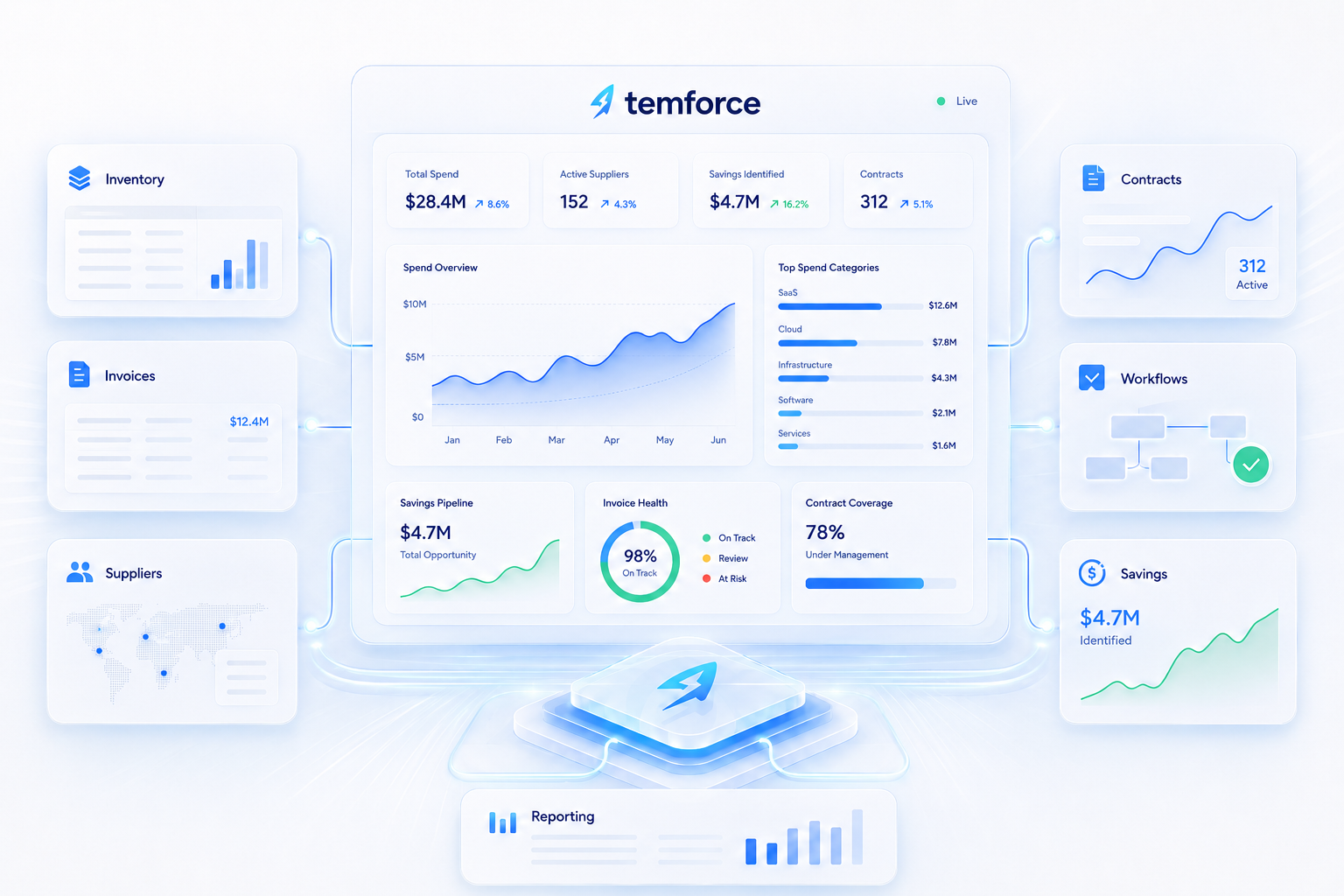
Evaluate whether services, billing accounts, suppliers, owners, locations, contracts, cost centers, and lifecycle status can work together.
Evaluate invoice validation, approvals, disputes, supplier follow-up, renewals, disconnects, tasks, savings actions, and reporting workflows.
Evaluate savings evidence, credits, recoveries, billing corrections, inventory cleanup, support model, AI readiness, and integration fit.
What is a TEM RFP checklist?
A TEM RFP checklist helps teams structure vendor questions for telecom expense management software, Technology Expense Management software, telecom invoice management, telecom inventory management, supplier control, workflow governance, savings reporting, AI readiness, APIs, support, and implementation fit.
Use consistent RFP categories so each vendor is evaluated against the same operating requirements, not just polished demos.
Make sure the RFP captures inventory, billing accounts, suppliers, lifecycle activity, invoice validation, disputes, and workflow control.
Ask how each vendor supports invoice accuracy, cost allocation, savings proof, credits, recoveries, reporting, and financial governance.
What every TEM RFP should include.
Use these sections to structure your RFP and make sure vendors explain how their TEM software supports the full operating lifecycle.
- Service, circuit, mobile line, account, and asset records
- Supplier, owner, location, and cost center mapping
- Billing account and invoice connections
- Lifecycle status, cleanup, and reporting views
- Invoice intake, validation, approvals, and allocation support
- Matching to inventory, billing accounts, and contracts
- Exception, dispute, credit, and recovery tracking
- Finance validation and reporting workflows
- Supplier contacts, accounts, rates, and escalation paths
- Issue history, disputes, and follow-up activity
- Commercial context and relationship visibility
- Supplier performance and accountability reporting
- Contract storage, search, terms, and obligations
- Renewal windows, amendments, and commitments
- Supplier agreement and service coverage context
- Sourcing and negotiation support
- Requests, approvals, assignments, and due dates
- Moves, adds, changes, and disconnect workflows
- Task ownership, status, and resolution tracking
- Visible follow-up across teams and suppliers
- Spend, inventory, invoice, supplier, and savings dashboards
- Exportable reports and leadership summaries
- Credits, recoveries, disconnects, and optimization tracking
- Evidence that ties savings to actions and outcomes
Do not leave AI, APIs, customization, and support out of the RFP.
Modern TEM software needs to help teams ask better questions, connect systems, configure workflows, and receive support from people who understand the TEMOps mission.
Require vendors to explain how AI helps users summarize activity, surface answers, identify patterns, ask better questions, and move from insight to action.
Require vendors to explain API capabilities, integration readiness, reporting flows, data movement, and alignment with surrounding systems.
Require vendors to explain workflow configuration, terminology, reporting views, permissions, data structure, and operating model flexibility.
Require vendors to explain support model, adoption help, configuration support, issue resolution, reporting assistance, and long-term operating guidance.
TEM RFP questions to ask every vendor.
Use this table to strengthen vendor evaluation and keep the RFP focused on the operating capabilities that matter most.
| RFP Area | Questions to ask vendors | How Temforce approaches the area |
|---|---|---|
| Inventory truth | How does your platform connect services, billing accounts, suppliers, owners, locations, cost centers, contracts, and lifecycle status? | Temforce centers inventory as the operating record behind invoice validation, supplier control, lifecycle activity, reporting, and savings. |
| Telecom invoice validation | How does your platform validate invoices against inventory, billing accounts, contracts, approvals, disputes, and expected charges? | Temforce connects invoice management to the records and workflows that help teams validate, approve, dispute, allocate, and report. |
| Invoice audit and disputes | How are exceptions, disputes, supplier follow-up, credits, recoveries, documentation, and resolution status tracked? | Temforce helps teams manage dispute workflow, supplier follow-up, credits, recoveries, documentation, and resolution status. |
| Supplier control | How does your platform manage supplier contacts, rates, billing accounts, escalation paths, issue history, and commercial context? | Temforce helps teams connect supplier relationships, account context, dispute status, credits, contracts, and follow-up activity. |
| Contracts and renewals | How does your platform manage contract terms, renewals, amendments, obligations, commitments, and service coverage? | Temforce helps teams store, search, manage, and act on contracts with visibility into renewals, commitments, supplier terms, and obligations. |
| Requests and MCAD | How does your platform manage requests, moves, adds, changes, disconnects, approvals, assignments, and service activity? | Temforce supports request visibility and MCAD order management so work can begin with structure, ownership, routing, and accountable follow-up. |
| Workflow governance | How does your platform assign work, route approvals, track due dates, document decisions, and show status? | Temforce emphasizes visible workflow for approvals, disputes, supplier follow-up, disconnects, renewals, cleanup tasks, and savings actions. |
| Dashboards and reporting | How does your platform report on spend, inventory, invoices, suppliers, contracts, disputes, savings, and workflow performance? | Temforce gives teams dashboard and reporting visibility across the operating areas that drive Technology Expense Management performance. |
| Savings proof | How does your platform tie savings back to evidence, invoice records, supplier actions, credits, recoveries, and workflow steps? | Temforce helps connect savings actions to supporting data, workflow status, recoveries, disconnects, supplier corrections, and reporting evidence. |
| Boostforce AI | How does AI help users ask questions, summarize activity, identify patterns, explain data, and create next steps? | Boostforce AI helps turn complexity into clarity by helping users surface answers, summarize operating data, and create actionable next steps. |
| Ready-built APIs | What APIs, integrations, data flows, reporting connections, and system alignment options are available? | Temforce includes ready-built API capabilities to support connected data flows, integrations, reporting needs, and customer ecosystem alignment. |
| Application customization | How can the platform adapt to our business language, workflows, reporting requirements, permissions, and operating structure? | Temforce can be configured around customer needs, including workflows, terminology, reporting priorities, data structure, and TEMOps execution. |
| Dedicated support | Who supports the customer after launch, and how does support help with adoption, configuration, reporting, and issue resolution? | Temforce pairs software with dedicated support to help customers improve adoption, execution, issue resolution, and long-term operating value. |
AI-ready TEM begins with an RFP that demands trusted operating data.
AI can only be useful when the underlying data is connected and trusted. A strong TEM RFP should ask vendors how they connect inventory, invoices, suppliers, contracts, workflows, savings, support activity, APIs, and reporting into one reliable model.
TEM RFP Checklist FAQ.
Use these answers to structure a stronger TEM RFP around inventory truth, invoice validation, supplier control, workflows, AI, APIs, support, savings, and reporting.
What should a TEM RFP include?
A TEM RFP should include requirements for technology and telecom inventory management, telecom invoice validation, invoice audit workflows, supplier control, contract visibility, requests, MCAD order management, finance validation, savings tracking, reporting, AI, APIs, application customization, dedicated support, and admin controls.
Why should inventory truth be included in a TEM RFP?
Inventory truth should be included because invoice validation, supplier accountability, cost allocation, lifecycle governance, savings, AI, and reporting all depend on knowing what exists, who owns it, what supplier bills it, and what should happen next.
Should a TEM RFP include AI requirements?
Yes. A modern TEM RFP should ask how AI helps users ask better questions, summarize activity, surface patterns, explain data, identify opportunities, and move from insight to action using trusted operating data.
Why should APIs be part of a TEM RFP?
APIs should be part of a TEM RFP because TEM software often needs to connect with surrounding systems, finance data, reporting flows, operational processes, service records, and customer ecosystem requirements.
Why does dedicated support matter in a TEM RFP?
Dedicated support matters because TEM work is operationally complex. Customers need help with adoption, configuration, issue resolution, workflow improvement, reporting, and long-term operating value.
How does Temforce align with TEM RFP requirements?
Temforce aligns with TEM RFP requirements by connecting inventory truth, invoice validation, supplier control, contracts, requests, MCAD activity, workflows, savings, reporting, Boostforce AI, ready-built APIs, application customization, dedicated support, and TEMOps execution.
Build a TEM RFP around execution, not checkbox features.
Temforce helps teams connect inventory truth, invoice validation, supplier accountability, workflow control, Boostforce AI, ready-built APIs, application customization, dedicated support, savings tracking, and reporting into one practical Technology Expense Management platform.
